
During Model Development requirements for the loyalty-fraud initiative, the business goal is to flag suspicious redemption behavior without a predefined list of known fraud types, since new fraud patterns keep emerging that historical labels don't cover. Which modeling approach should the project manager expect the data science team to propose, and why?
Select an answer to reveal the explanation.
Short Explanation
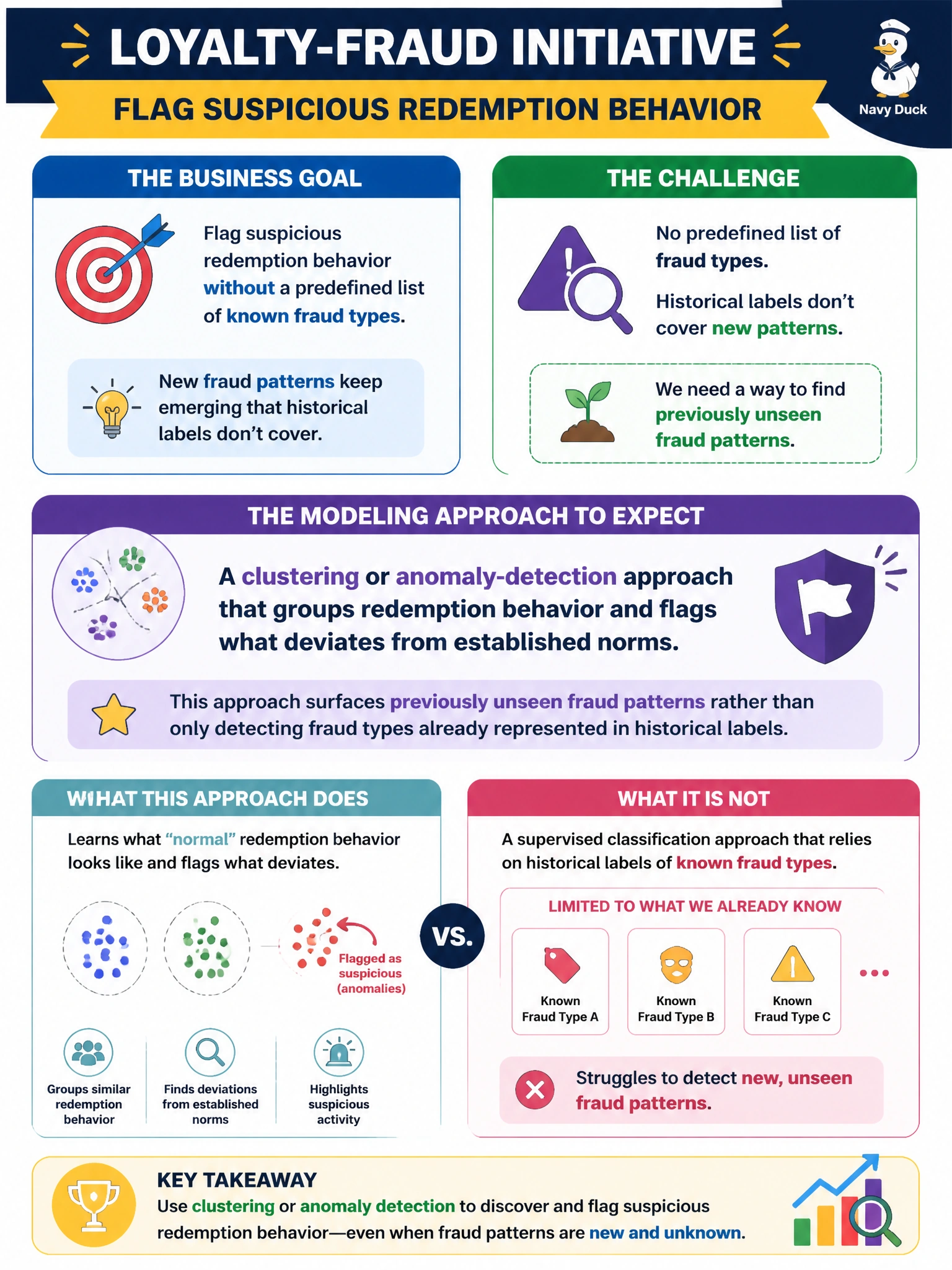
When the whole point is catching fraud patterns nobody's labeled yet, you don't lean on a model that only knows the labels it was trained on. Clustering/anomaly detection flags what looks abnormal, known pattern or not.
Full Explanation
Model Development requirements should drive the choice of modeling approach, and a requirement to surface fraud patterns that historical labels don't cover points toward clustering or anomaly-detection techniques, which group behavior and flag deviations from normal patterns without needing every fraud type to already be labeled — exactly what's needed when new fraud behavior keeps emerging. A supervised classification approach trained only on historical labels would, by construction, only ever recognize fraud types it has already seen labeled examples of, missing the entire point of the stated business goal — and the claim that classification is the "only" CPMAI-recognized approach for fraud detection is simply false; CPMAI is method-agnostic and expects the PM to match the technique to the requirement. A reinforcement-learning agent taking real-time blocking actions through live trial-and-error against actual customer accounts is both a mismatch for this requirement (the goal is detection/flagging, not autonomous account-blocking decisions) and operationally reckless — experimenting with live customer accounts risks real financial and reputational harm, the kind of premature-production risk CPMAI's phased, evaluated approach exists to prevent. An ensemble of several supervised classifiers voting together is a genuine ensemble-methods technique for improving performance, but it doesn't solve the actual gap here: every classifier in the ensemble is still trained on the same historical labels, so voting among them cannot surface a fraud pattern none of them ever saw an example of — the ensemble improves confidence on known patterns, it doesn't grant visibility into unknown ones the way an unsupervised, deviation-based approach does.