
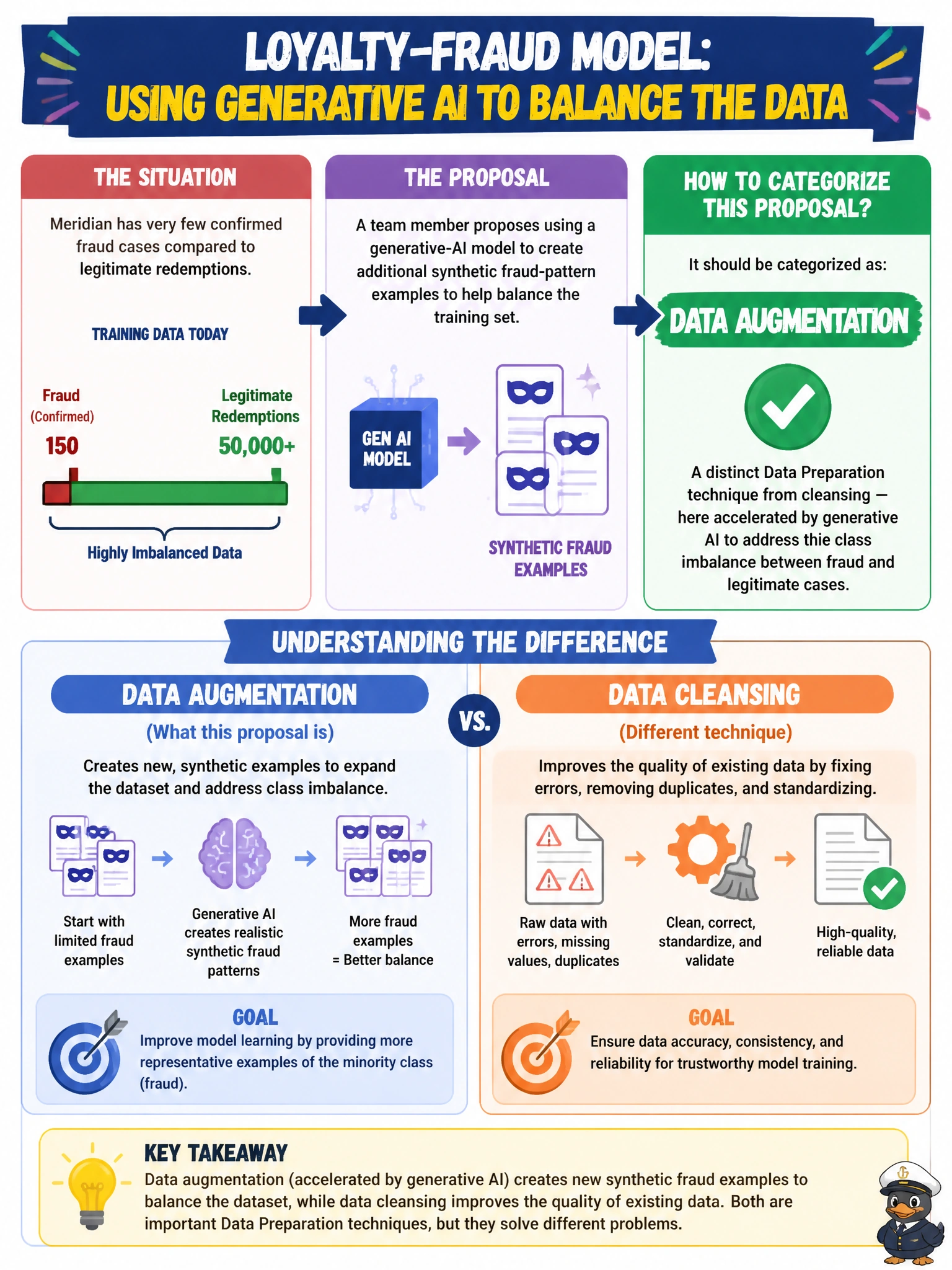
For the loyalty-fraud model, Meridian has very few confirmed fraud cases compared to legitimate redemptions. A team member proposes using a generative-AI model to create additional synthetic fraud-pattern examples to help balance the training set, separate from the earlier step of cleaning up existing transcript records. How should the project manager categorize this proposal?
Select an answer to reveal the explanation.
Short Explanation
Cleansing fixes what's already there; augmentation adds more of what's scarce. Using GenAI to synthesize additional fraud examples for a badly imbalanced dataset is augmentation, accelerated — a distinct move from tidying up existing records.
Full Explanation
Data augmentation is a distinct Data Preparation technique from cleansing: cleansing removes noise, errors, and inconsistencies from data that already exists, while augmentation adds new representative examples (real, synthetic, or a mix) to address gaps such as class imbalance — exactly the scenario here, where confirmed fraud cases are rare relative to legitimate ones, and generative AI is being used as the accelerator to produce useful synthetic fraud-pattern examples. Categorizing it as cleansing conflates two different data-preparation moves; correcting existing bad records and generating new supplementary ones solve different problems and shouldn't be treated as the same activity. Calling it Model Evaluation misplaces the timeline entirely — this work happens before any model is trained, as part of getting the training set ready, not as a way of testing a model that doesn't exist yet. Calling it ground-truth validation also misses the mark: validating ground truth checks whether existing fraud labels are correct and consistently applied, whereas generating synthetic examples to fix class imbalance doesn't audit the existing labels at all — it supplements the dataset's coverage of an underrepresented class.