
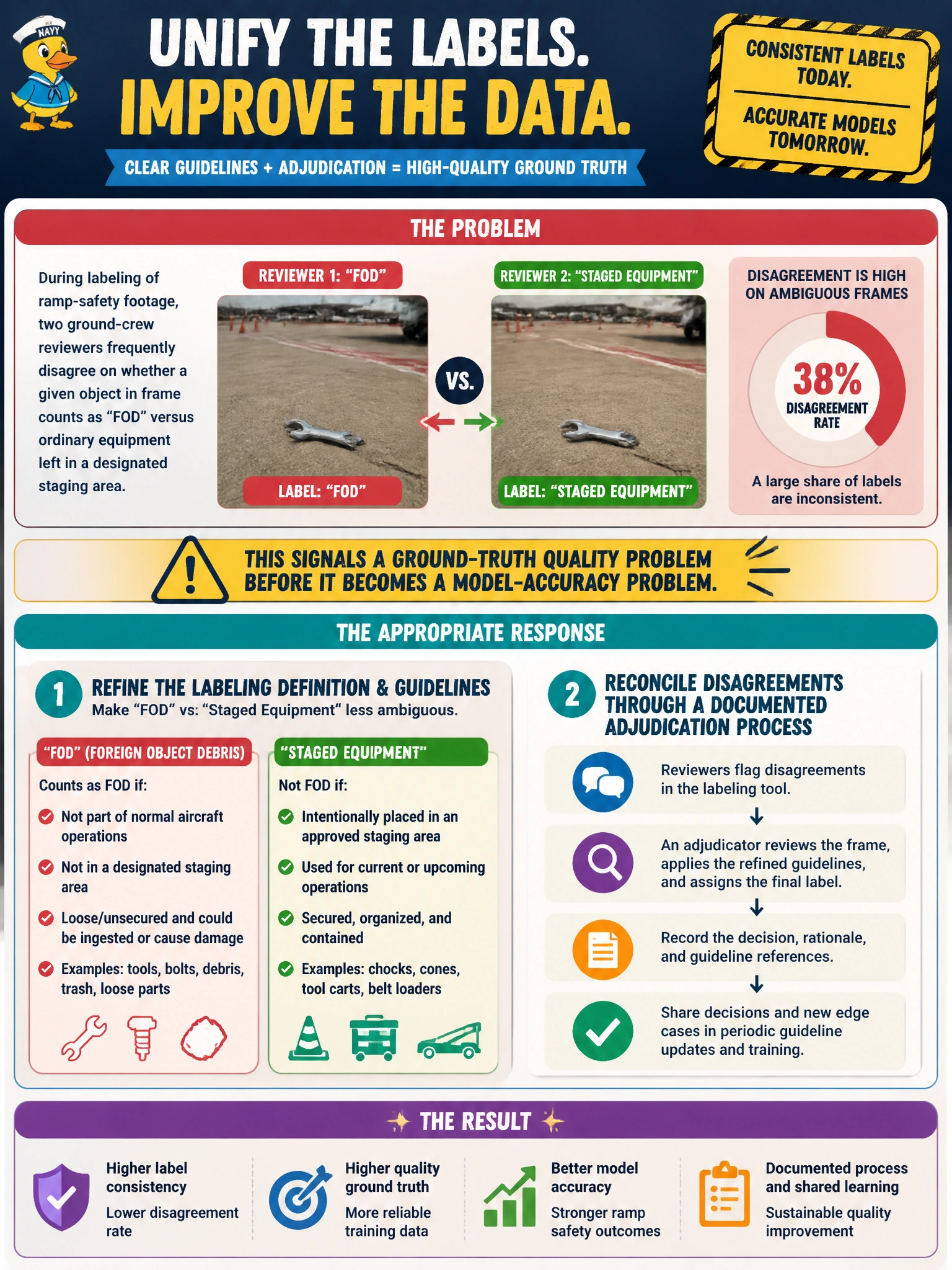
During labeling of ramp-safety footage, two ground-crew reviewers frequently disagree on whether a given object in frame counts as "foreign object debris" versus ordinary equipment left in a designated staging area. The project manager notices this disagreement is happening on a large share of ambiguous frames. What is the appropriate response?
Select an answer to reveal the explanation.
Short Explanation
A high disagreement rate between labelers isn't a footnote — it's the data telling you the label definition itself is fuzzy. Tighten the definition and adjudicate the disputes now, before that ambiguity gets baked into the model.
Full Explanation
This scenario is a ground-truth validation problem surfacing during Data Preparation: a large share of inter-annotator disagreement signals that the labeling definition itself is ambiguous, and the correct response is to refine the definition of what counts as FOD versus legitimately staged equipment, then run a documented adjudication process so reviewers reconcile disputed cases consistently — catching this now protects ground-truth quality before it becomes baked-in model inaccuracy. Letting each reviewer's judgment stand unexamined normalizes inconsistency into the training labels, which the model will then faithfully learn to reproduce, including the confusion. Discarding all ambiguous frames throws away exactly the boundary cases a safety-critical detection model most needs to learn to handle correctly — the edge cases are often the most instructive examples, not disposable noise. The nearly identical third option describes refining guidelines and adjudicating disagreements correctly but omits naming why it matters at this stage — that a high disagreement rate is a warning sign of a ground-truth quality problem specifically, and that catching it here is cheaper than catching it after a flawed model is trained; the fully credited option makes that reasoning explicit.