
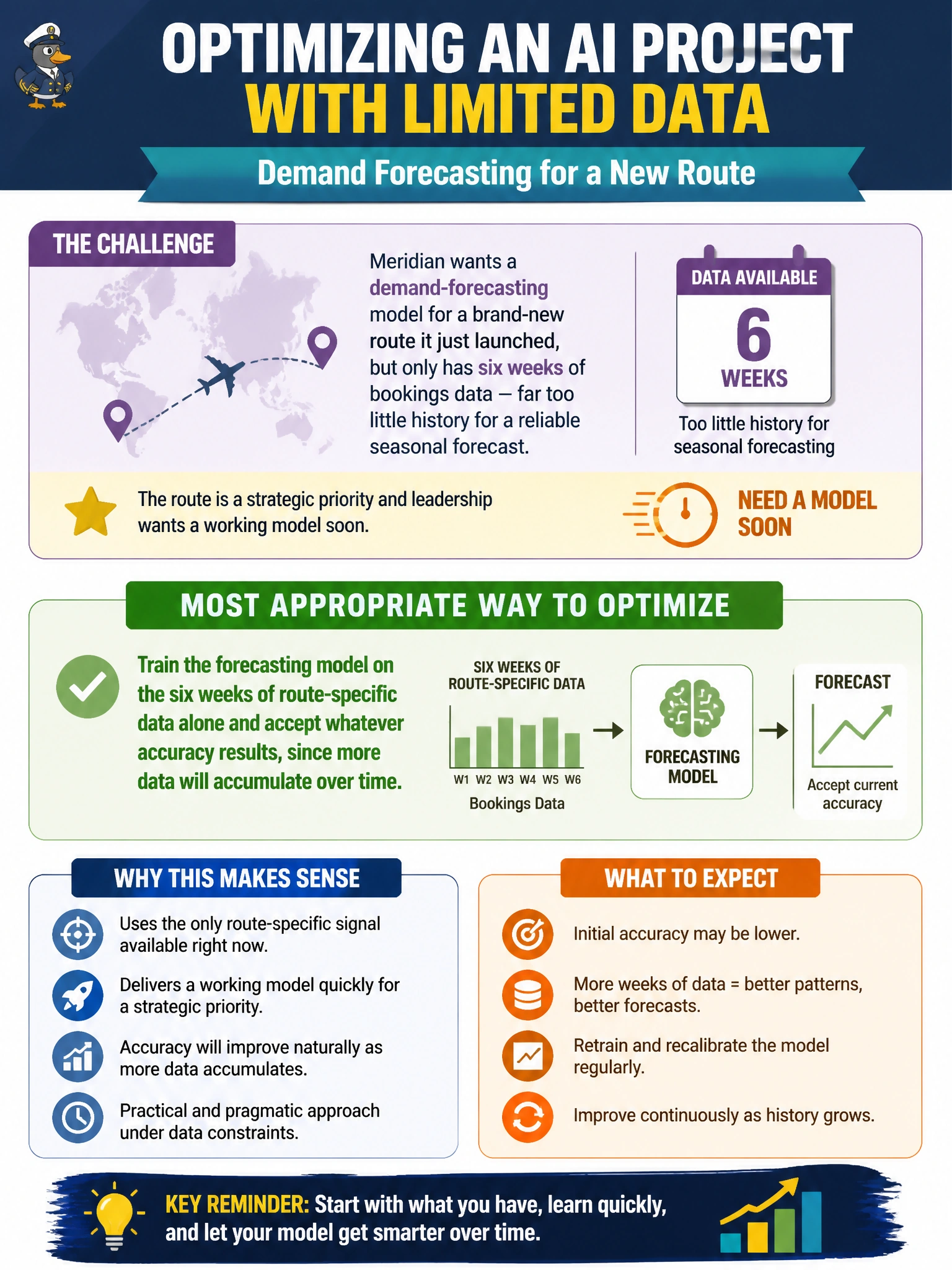
Meridian wants a demand-forecasting model for a brand-new route it just launched, but only has six weeks of bookings data — far too little history for a reliable seasonal forecast. The route is a strategic priority and leadership wants a working model soon. What is the most appropriate way to optimize this AI project given limited data availability?
Select an answer to reveal the explanation.
Short Explanation
When you don't have enough of your own history, borrow it responsibly — pull in data from comparable routes and be honest that confidence rises as real history accumulates. Don't just power through on six weeks and call it done, and don't fabricate data to make the spreadsheet look better.
Full Explanation
Optimizing an AI project with limited data availability is a named CPMAI Data Understanding competency, and the practical answer is to borrow relevant signal responsibly: use data from comparable existing routes with similar market and seasonal profiles as a proxy/prior, while being transparent that forecast confidence is limited until real route history accumulates. Training only on six weeks and accepting whatever accuracy results ignores the fact that six weeks cannot capture seasonality at all — the model would be confidently wrong in ways leadership won't see coming, which is exactly the kind of overpromising CPMAI methodology exists to prevent. Postponing indefinitely fails the business need; CPMAI favors iterative, pragmatic delivery (start with an appropriately scoped pilot) over an all-or-nothing multi-year wait. Fabricating additional records to pad the dataset is a data-integrity violation, not a data-scarcity solution — it manufactures false confidence and is never an acceptable answer on this exam. The comparable-route approach also illustrates a recurring CPMAI theme: limited data is common in real AI projects, and the professional response is transfer of relevant context plus honest expectation-setting, not brute force or fabrication.