
A defense contractor stores government documents marked Secret alongside others marked Top Secret, and a new hire asks how the two markings relate. Which statement correctly describes the relationship between these classification levels?
Select an answer to reveal the explanation.
Short Explanation
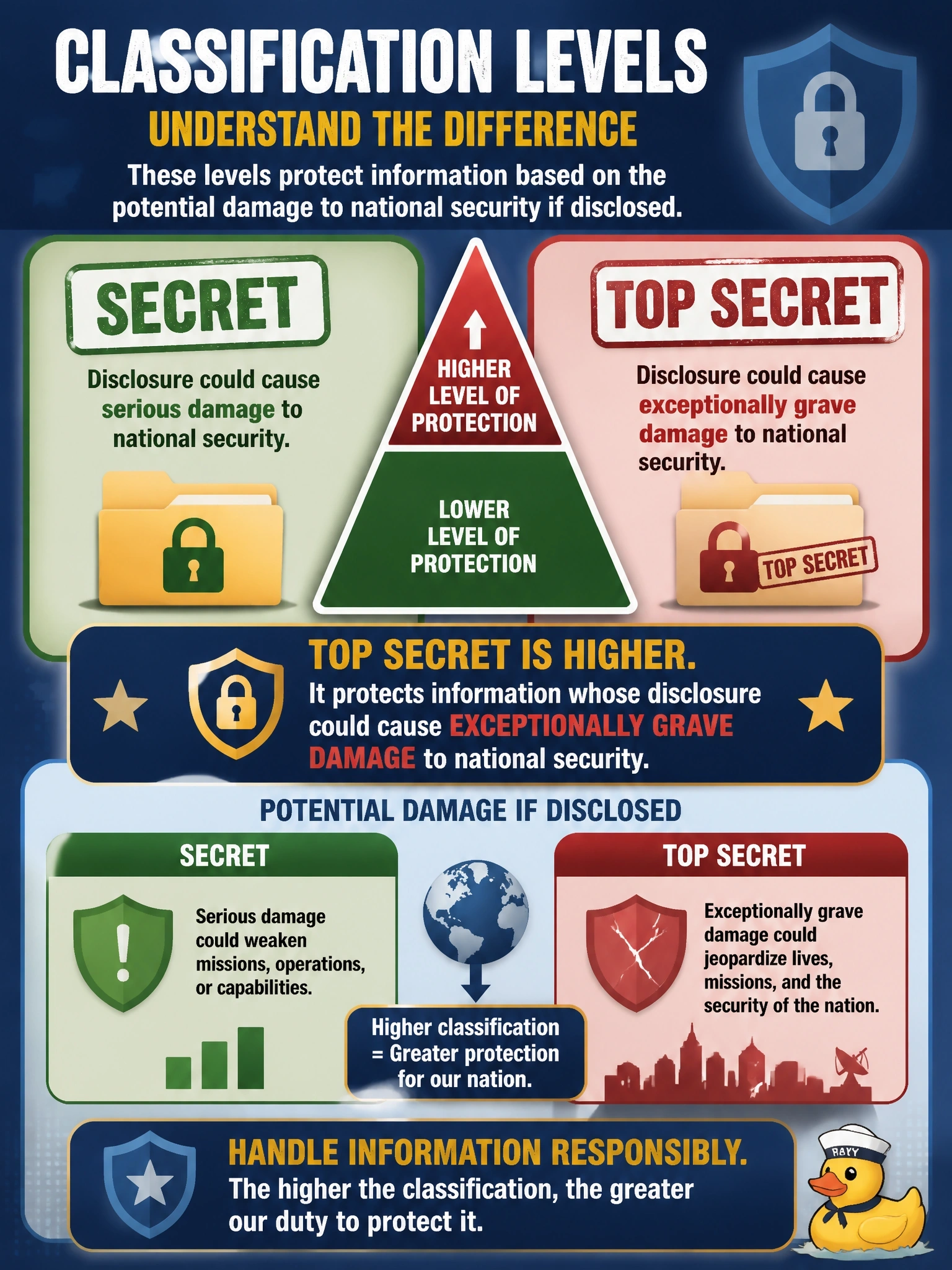
Picture a ladder: confidential on the bottom rung, secret in the middle, top secret at the top. The higher you climb, the worse the damage if it leaks, and top secret is the 'exceptionally grave' rung. Watch for answers that flip the ladder or call the two rungs equal.
Full Explanation
Government classification systems are hierarchical and rank information by the damage its unauthorized disclosure could cause. In the common three-tier scheme, confidential covers information whose disclosure could cause damage, secret covers serious damage, and top secret covers exceptionally grave damage to national security. Top secret therefore sits above secret, requires a higher clearance, and carries stricter handling, storage and transmission rules. Claiming that secret is higher and that top secret is a legacy marking mapped to the confidential tier inverts the hierarchy; top secret remains the highest of the three standard levels. Describing the two as equal levels separated only by a compartment confuses classification with need-to-know controls: compartments narrow access within a level, they do not create or merge levels. Asserting that secret is higher because it is reserved for intelligence sources and methods is also wrong, because sensitivity of sources is handled through compartments and caveats layered on top of a classification, not by reordering the levels. Exam caveat: commercial labels such as confidential, restricted and critical are organization-defined and do not map one-to-one onto government levels. Operational check: confirm that each document's marking matches its level, that personnel hold a clearance at or above that level, and that storage and transfer procedures follow the stricter rules for top secret material.