
A manufacturer's security team learns that the programmable logic controllers on a production line have a published vulnerability. Applying the vendor's firmware update requires stopping the line, and an unplanned stop creates safety hazards. Which approach BEST fits the priorities of this operational technology environment?
Select an answer to reveal the explanation.
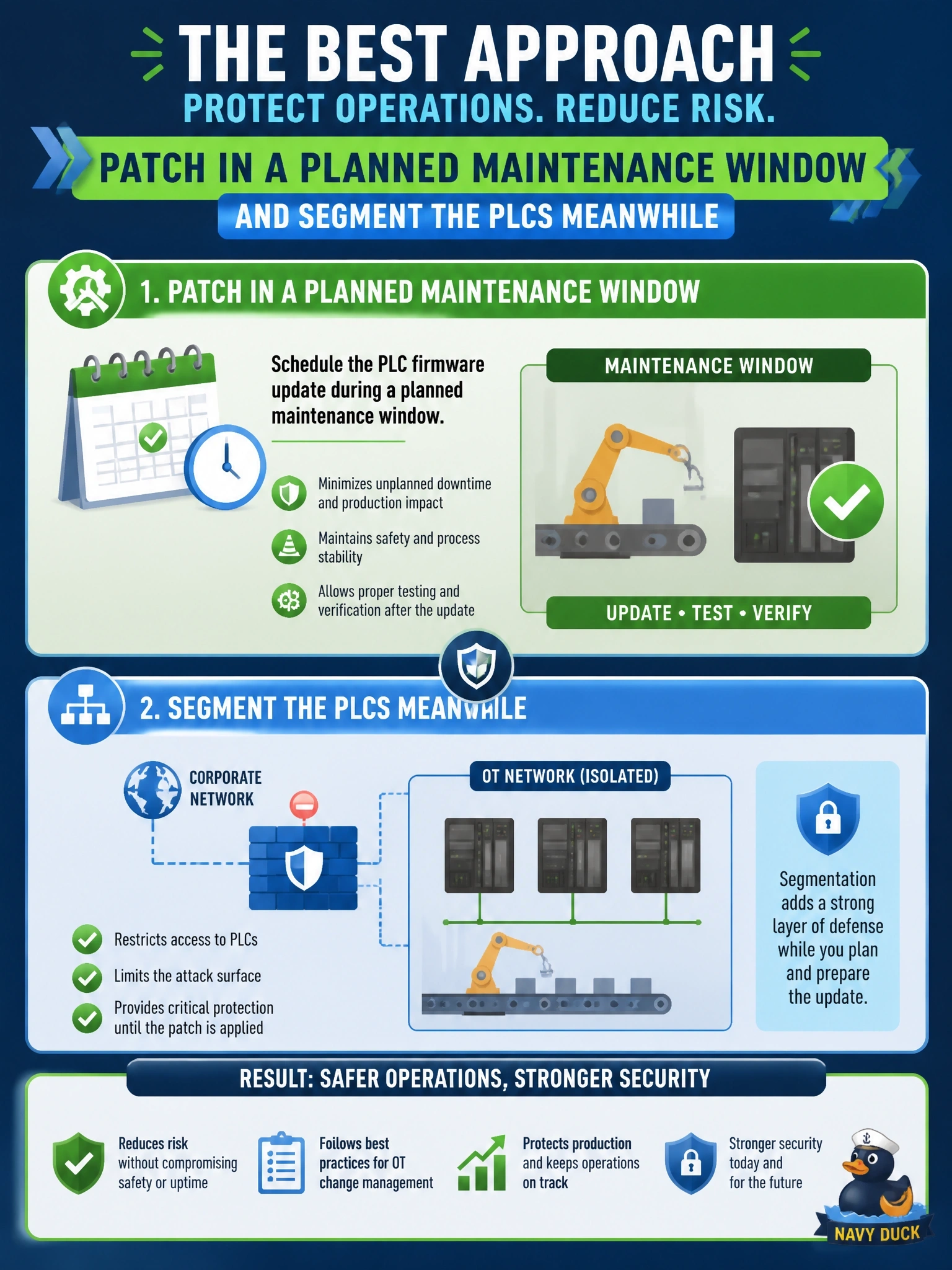
Short Explanation
On a factory floor, you can't just reboot the machine that's pouring molten metal. OT puts availability and safety first, so you patch in a planned window and wall off the PLCs with segmentation until then. The trap is treating OT like an office laptop, or assuming it's safe because it's 'isolated'.
Full Explanation
Operational technology environments such as industrial control systems prioritize availability and physical safety, because an unexpected stop can damage equipment, halt production, or endanger people. The appropriate approach is to schedule the firmware update during a planned maintenance window coordinated with operations, and in the interim apply compensating controls such as network segmentation, strict access control to the controllers, and monitoring of industrial protocol traffic. Patching immediately during production reverses OT priorities; confidentiality is generally the lowest concern for a controller, and an uncoordinated stop creates the safety hazard the team must avoid. Replacing controllers with general-purpose servers ignores the deterministic real-time functions PLCs perform and is not a practical security fix; general-purpose systems would also bring a broader attack surface. Deferring patching indefinitely on the assumption that OT networks are isolated is unsafe, because many plants are connected to business networks or remote support paths and isolation is frequently incomplete. Exam caveat: OT questions usually reward the answer that preserves safety and availability while still reducing risk through compensating controls, rather than the fastest patch. Operational check: confirm the controllers sit in a segmented zone with restricted conduits, verify who can reach them, and book the update into the next maintenance outage.