
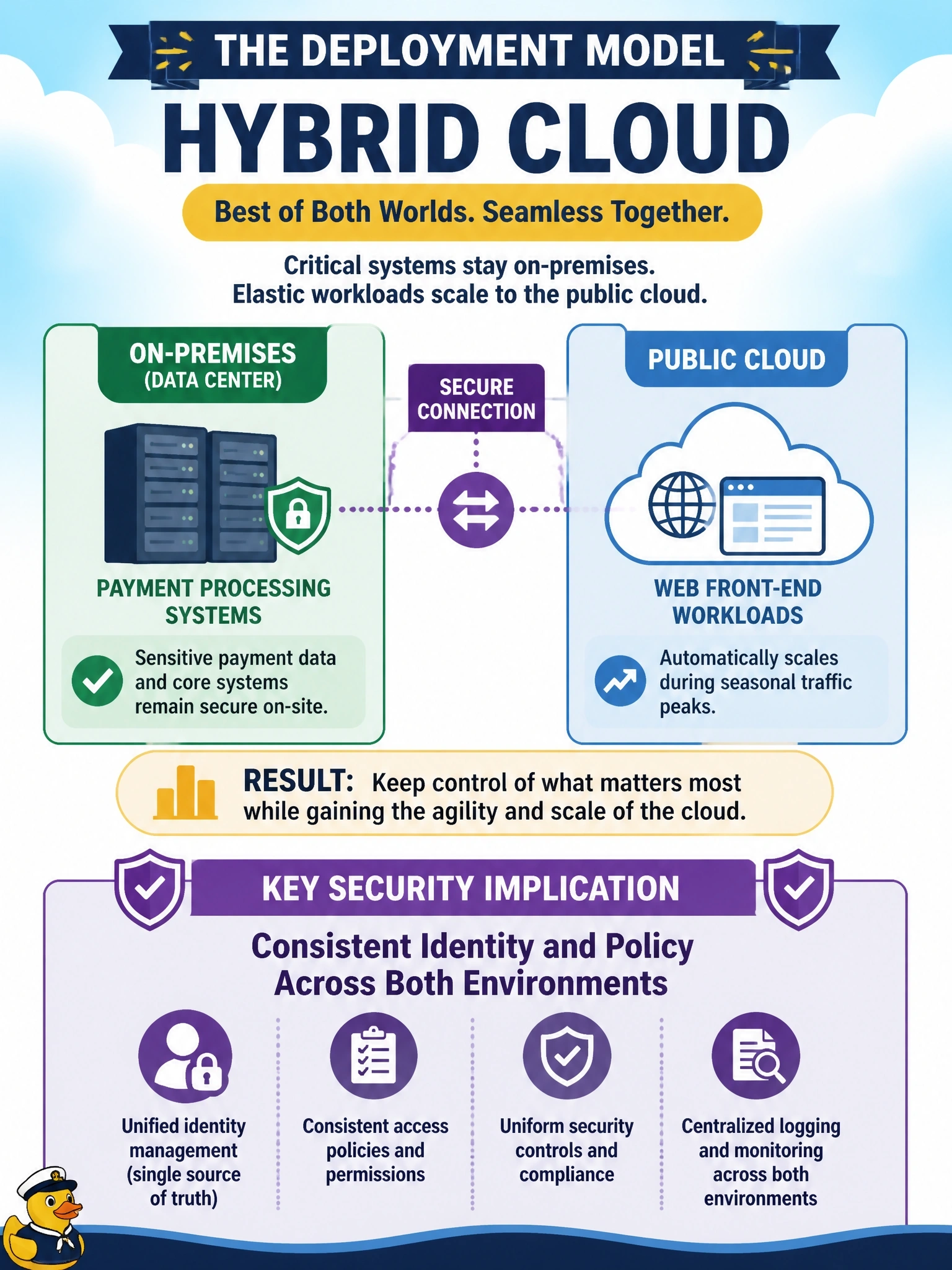
A retailer keeps its payment-processing systems in its own data center but automatically shifts web front-end workloads to a public cloud provider during seasonal traffic peaks. Which deployment model is this, and what is a key security implication?
Select an answer to reveal the explanation.
Short Explanation
One foot on your own floor, one foot in the public cloud: that's hybrid. The security headache is keeping identity, policy and monitoring the same on both sides so nothing slips through the seam. Don't confuse it with multicloud, which is about using more than one provider.
Full Explanation
A hybrid cloud combines on-premises or private infrastructure with public cloud resources and connects them so workloads can move between environments, which is exactly what cloud bursting during traffic peaks does. The main security implication is consistency: identities, access policies, encryption, logging, and configuration standards must be applied uniformly across both environments, and the interconnection itself becomes an attack surface that must be secured. A community cloud is shared by several organizations with common requirements, and no other organizations are involved in this retailer's arrangement. A private cloud is dedicated to one organization, but the scenario explicitly moves workloads onto a public provider during peaks, so not all workloads remain under single-organization control. Multicloud refers to using more than one cloud provider, and it does not require duplicating every workload; this design uses a single public provider combined with on-premises systems. Exam caveat: hybrid designs often fail at the seams, through inconsistent identity federation, divergent firewall rules, or unmonitored connections, rather than within either environment. Operational check: federate identity across both environments, apply the same baseline configurations and logging to burst workloads, encrypt the interconnect, and verify that payment data cannot flow to the public side.