
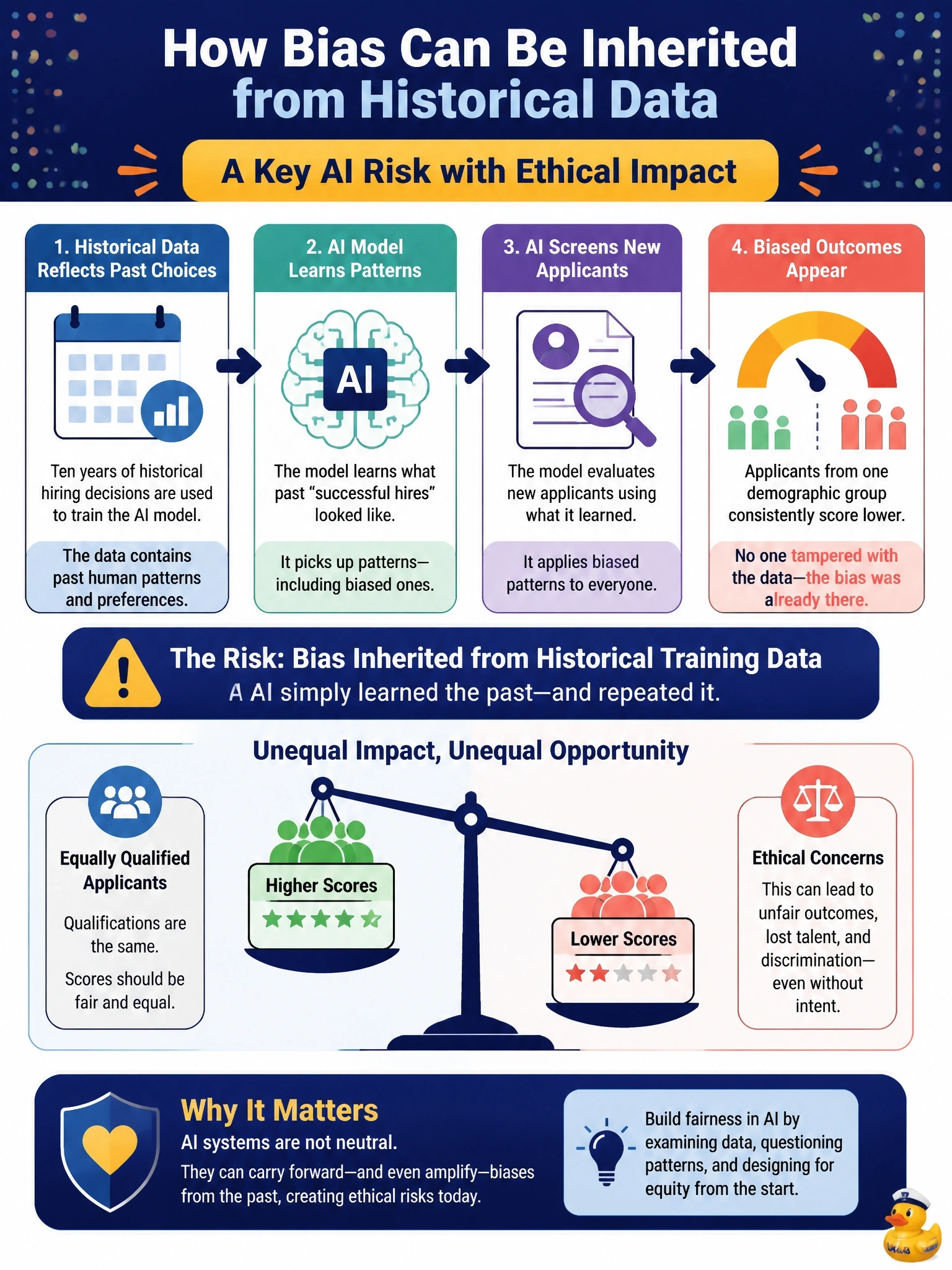
An AI model used to screen job applicants was trained on ten years of the company's historical hiring decisions. An internal audit finds that it consistently scores applicants from one demographic group lower than equally qualified applicants from others. No one tampered with the training data. Which AI risk does this BEST illustrate?
Select an answer to reveal the explanation.
Short Explanation
A model is only as fair as the history you feed it. If past hiring decisions leaned one way, the model learns that lean and repeats it, and that's bias with real ethical and legal weight. Don't jump to poisoning; nobody attacked the data, it was skewed all on its own.
Full Explanation
Bias in AI systems occurs when a model produces systematically unfair outcomes for particular groups, frequently because its training data reflects historical patterns or imbalances. A screening model trained on years of past hiring decisions learns whatever preferences those decisions contained, and it then applies them consistently and at scale. This creates ethical concerns as well as potential legal and regulatory exposure. Data poisoning is a deliberate attack in which an adversary corrupts training data to change model behavior; the stem states the data was not tampered with, and the skew came from authentic historical records. Hallucination describes generative models fabricating content; a scoring model that consistently disadvantages a group is behaving according to learned patterns rather than inventing unrelated output. Jailbreaking is an attempt to bypass a model's safety controls through crafted prompts, and applicants submitting resumes are not manipulating a conversational interface to produce disparate scores. Exam caveat: bias can persist even after removing explicit protected attributes, because other features can act as proxies for them. Operational check: test model outcomes across demographic groups before and after deployment, review features for proxy variables, document fairness criteria, require human review of adverse decisions, and suspend automated scoring until the disparity is remediated.