
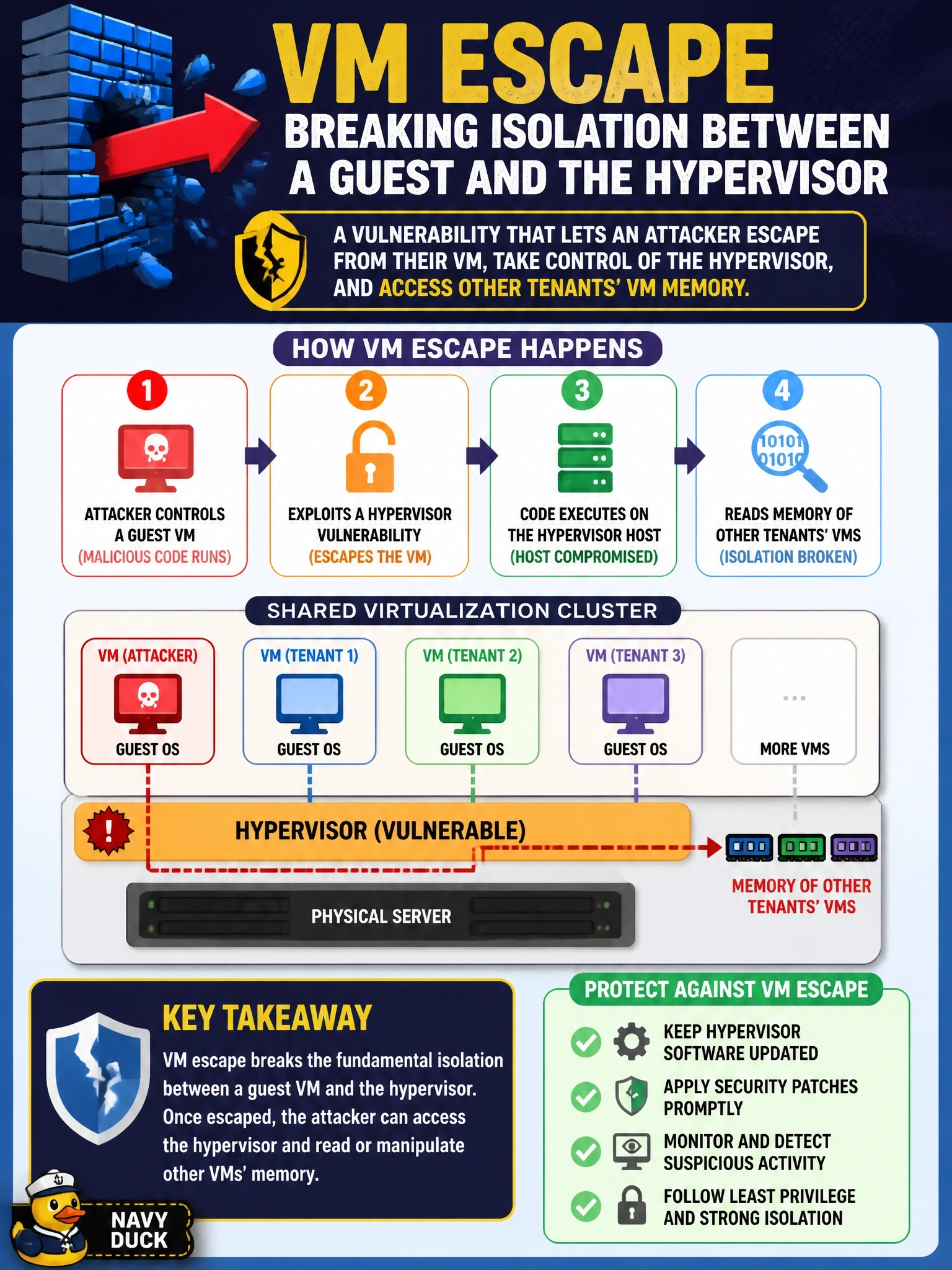
In a shared virtualization cluster, an attacker controlling one guest VM runs code that executes on the underlying hypervisor host and then reads memory belonging to other tenants' VMs. Which vulnerability does this describe?
Select an answer to reveal the explanation.
Short Explanation
Think of apartment walls: VMs are supposed to be tenants who can't see into each other's units. A VM escape is the tenant tunneling into the building's basement and getting into every apartment. Once the hypervisor's breached, every guest you run on that host is exposed.
Full Explanation
Virtualization relies on the hypervisor to isolate guest virtual machines from each other and from the host. A VM escape exploits a flaw in the hypervisor or its virtual hardware so that code running inside a guest breaks out and executes on the host. From there, the attacker can reach other guests' memory, storage and network traffic, which is why VM escape is among the most serious virtualization vulnerabilities, especially in multi-tenant environments. VM sprawl is a management problem in which virtual machines multiply without tracking, leaving unpatched or forgotten guests; it does not describe code breaking out of a guest. Resource reuse refers to data remaining in memory or storage that is reassigned to another guest without being cleared; it can expose data, but it does not involve executing code on the hypervisor as described. Shadow IT involves unapproved systems or services adopted outside IT oversight, and the scenario concerns breaking isolation, not who approved the guest. Exam caveat: the defining sign of a VM escape is execution on the host or access to other guests from inside one guest. Operational check: apply hypervisor security updates promptly, reduce virtual devices exposed to guests, separate sensitive workloads onto dedicated hosts, and monitor the host for unexpected processes.