
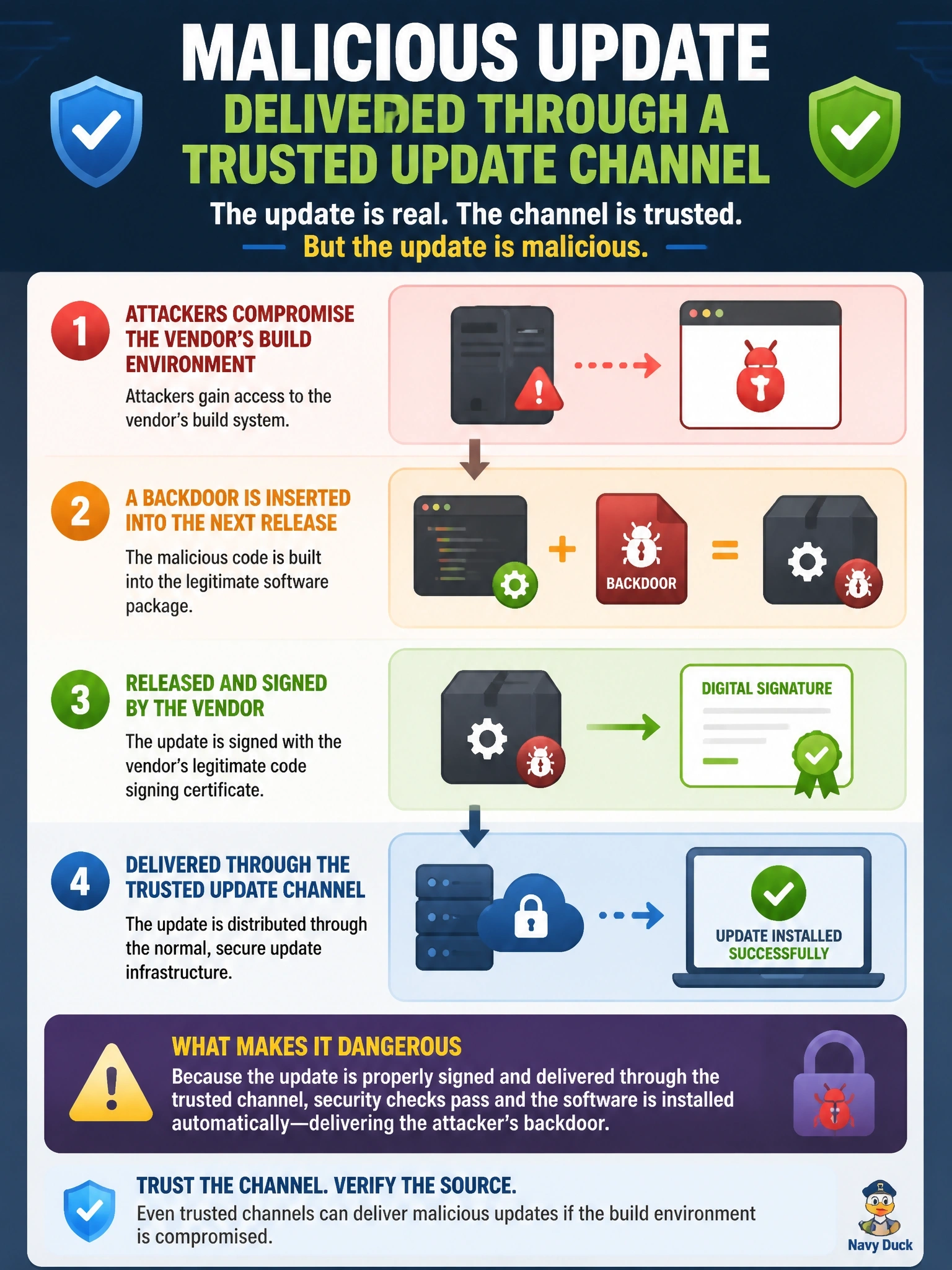
Attackers breach a software vendor's build environment and insert a backdoor into the next release. Customers receive the properly signed update through the product's normal automatic update channel and install it as usual. Which vulnerability does this describe?
Select an answer to reveal the explanation.
Short Explanation
Here's what makes this one nasty: the customers did everything right. They patched promptly, the signature checked out -- and the patch itself was the attack. That's a malicious update, and it's why you can't treat "trusted" as "verified forever."
Full Explanation
Applications depend on their update mechanisms, and a malicious update occurs when an attacker compromises that path so that legitimate-looking updates carry harmful code. When the vendor's build environment is breached, the malicious code is compiled and signed by the vendor's real process, so signature checks pass and automatic update systems install it without suspicion. The weakness exploited is the trust customers place in the update channel. Describing it as a zero-day exploit against customer firewalls misplaces the attack: the customers' firewalls were not exploited at all, and the code arrived as authorized software. Calling it an unpatched system reverses the situation, because the customers were affected precisely because they applied the newest update. A misconfigured update server at each customer site would be a local configuration problem, while here the compromise occurred once at the vendor and propagated to everyone through the official channel. Exam caveat: this vulnerability overlaps with supply chain risk, but the objectives list malicious update specifically as an application vulnerability. Operational check: subscribe to vendor security advisories, stage updates in a test environment before broad rollout where possible, monitor newly updated software for unexpected outbound connections, and keep an inventory showing which hosts run each version.