
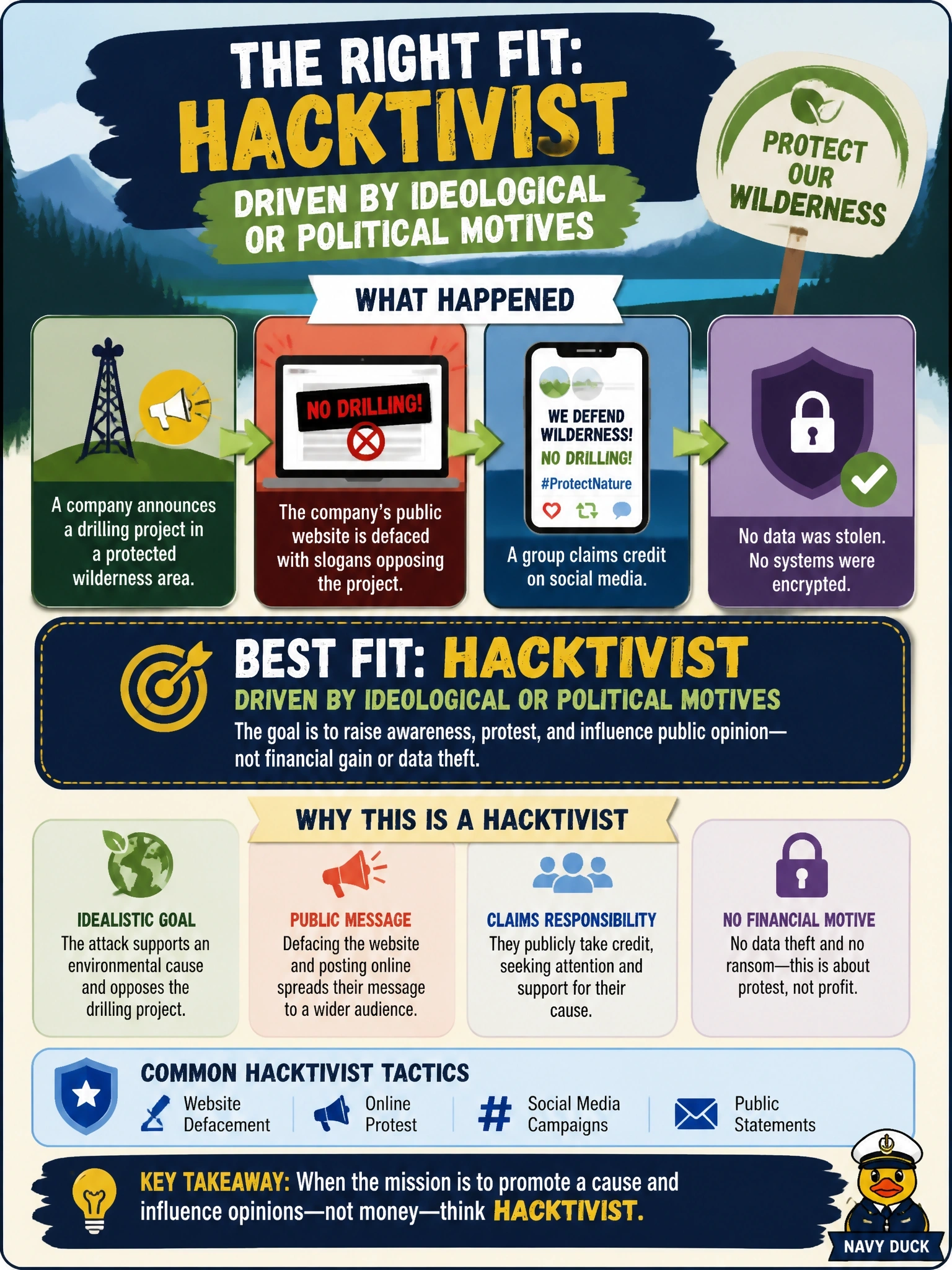
Shortly after a company announces a drilling project in a protected wilderness area, its public website is defaced with slogans opposing the project. A group claims credit on social media, and no data was stolen or encrypted. Which actor and motivation best fit?
Select an answer to reveal the explanation.
Short Explanation
Think of a protest banner, just hung on the company's website instead of a fence. Defacement plus a public claim of credit tied to a cause is the hacktivist's signature. If you're tempted to pick crime, stop -- with no money demanded and nothing stolen, profit isn't the point.
Full Explanation
Hacktivists use attacks to advance an ideological, political or social cause, and their methods emphasize visibility: website defacement, denial-of-service campaigns and leaks timed to news events. In this scenario the trigger is a public announcement, the content opposes the project, the group claims credit publicly, and nothing is taken for profit, which together match the hacktivist profile and its ideological motivation. An insider seeking revenge acts out of a personal grievance with the employer; the attack here is tied to an environmental cause and claimed by an outside group, not to an employee's treatment. A competitor seeks intellectual property or market advantage and would avoid public attention while taking data, yet no data was stolen. A crime syndicate is financially motivated and would demand payment, encrypt data or steal information it could sell, none of which occurred. Exam caveat: hacktivists vary widely in skill, so do not assume low sophistication just because the impact was visible rather than deep. Operational check: restore the site from a known-good source, identify and close the vulnerability used to change content, review web server and content management logs, and monitor for follow-up actions such as denial-of-service attempts.