
An organization encrypts sensitive project files with keys issued to individual employees. Legal requires that the company be able to recover the encrypted data if an employee leaves or loses a key. Which mechanism meets this requirement?
Select an answer to reveal the explanation.
Short Explanation
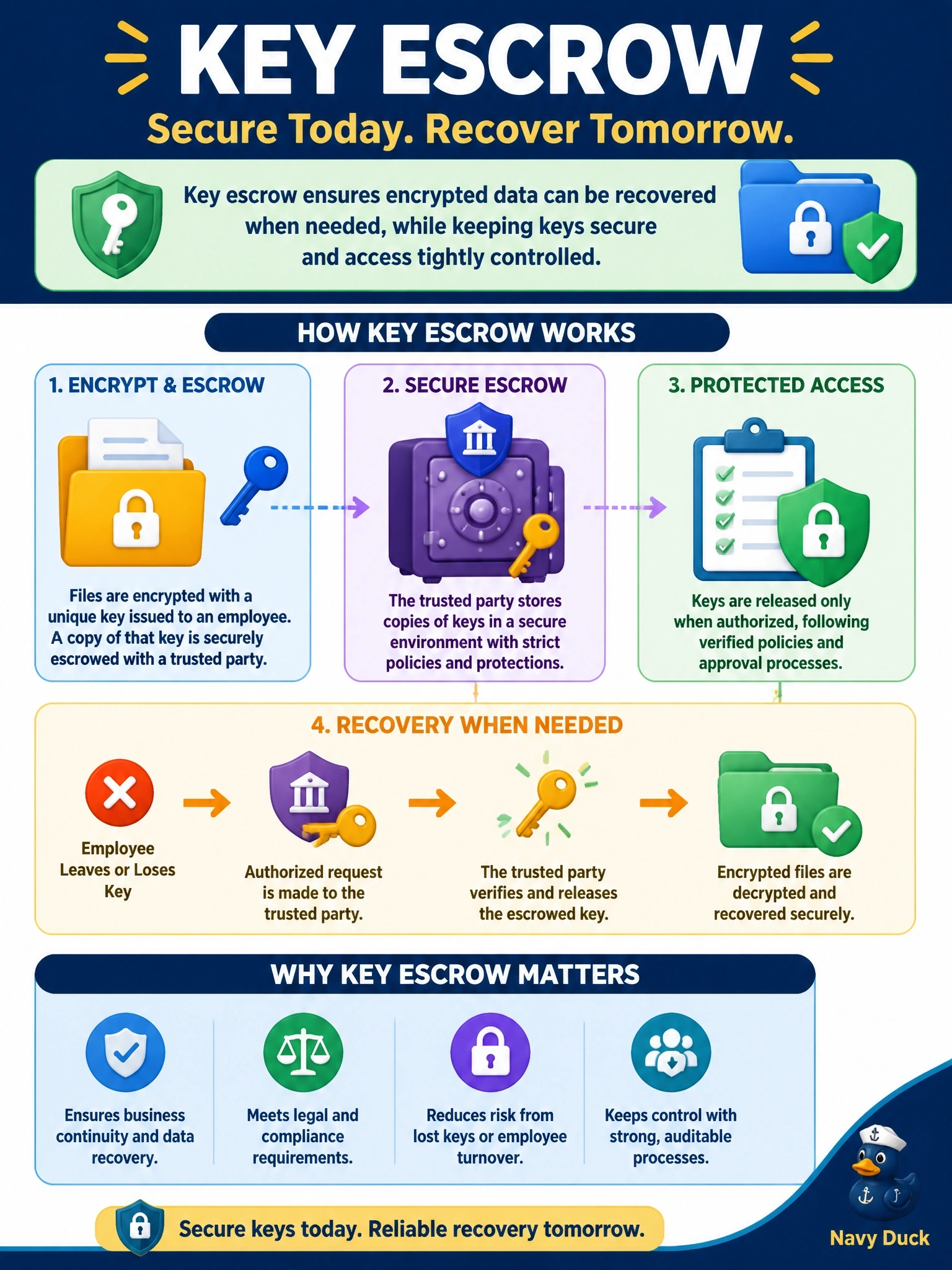
Key escrow is like leaving a spare house key with a trusted neighbor. If you lose yours, or you move away, somebody responsible can still open the door. Revocation does the opposite; it just makes the old key useless.
Full Explanation
Key escrow stores copies of encryption keys with a trusted party, which may be an internal security function or an external agent, so that authorized personnel can recover encrypted data when the original key holder is unavailable. Access to escrowed keys is governed by strict procedures, often requiring multiple approvers, so that recovery is possible for legitimate business or legal needs without giving anyone casual access. Certificate revocation marks a certificate as no longer trustworthy, which is appropriate when an employee departs, but it does nothing to recover data already encrypted with that key; it can actually make recovery harder if the key is destroyed. Key stretching applies repeated hashing or a deliberately slow function to strengthen passphrases against guessing attacks; it improves security but provides no recovery path. Perfect forward secrecy generates ephemeral session keys so that compromise of a long-term key does not expose past sessions; it is designed to make recovery of past data impossible, the opposite of the requirement. Exam caveat: key escrow introduces its own risk, because the escrow store becomes a high-value target, so it must be protected with strong access control and auditing. Operational check: confirm that every issued encryption key is escrowed at creation, test a recovery under dual control, and review escrow access logs regularly.