
A data center installs bollards and a perimeter fence to keep vehicles and pedestrians away from the building and posts signs warning of video surveillance. Which control type do the bollards PRIMARILY provide?
Select an answer to reveal the explanation.
Short Explanation
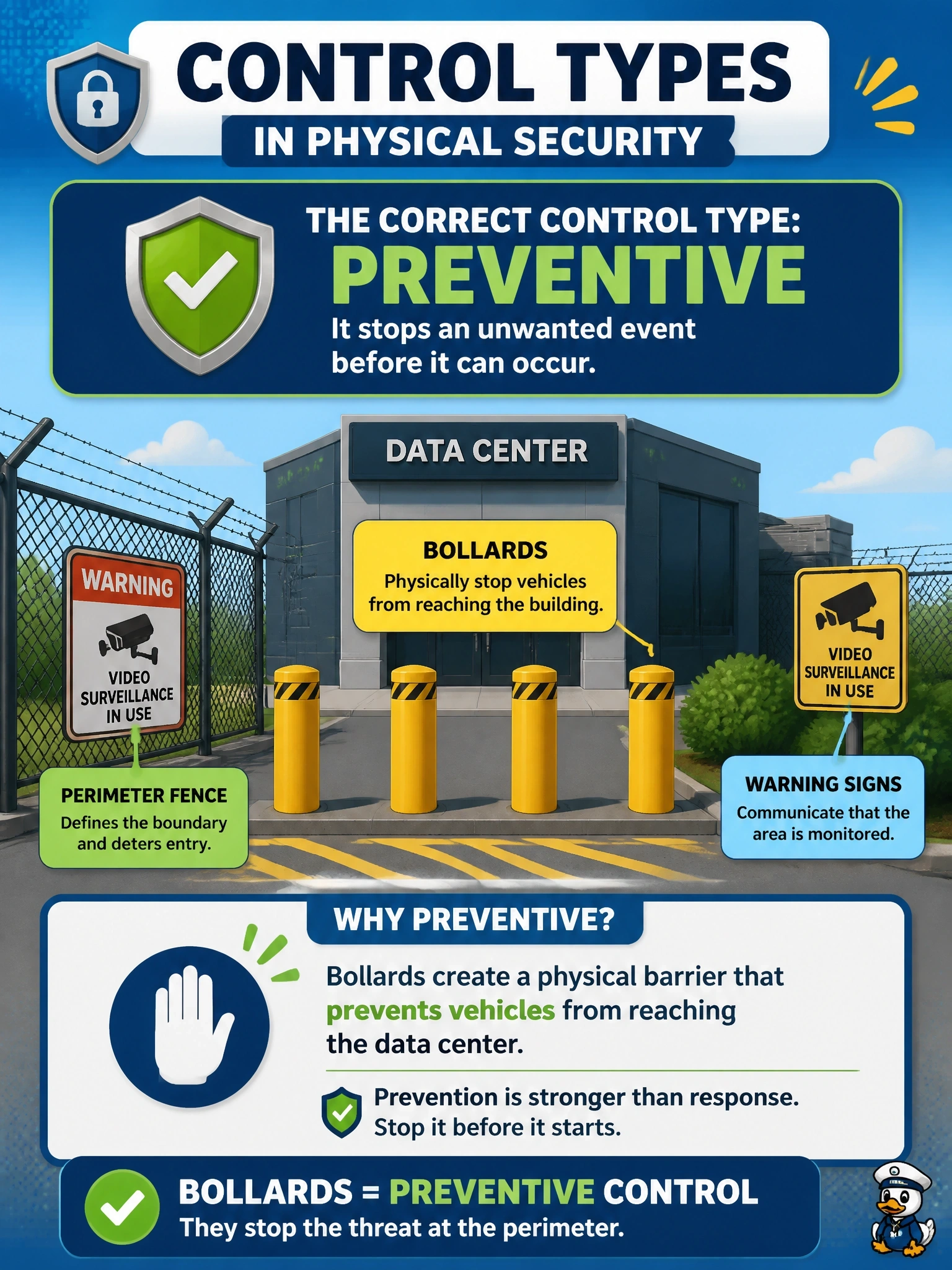
Try driving a truck through a bollard and you'll see what it's for. It doesn't just warn you off; it physically stops you cold. The warning signs are the deterrent here, and the trap is lumping the bollards in with them.
Full Explanation
Preventive controls block an undesired action from succeeding. Bollards are short, sturdy posts designed to stop vehicles from reaching a building, entrance, or equipment, which makes them primarily preventive physical controls. A vehicle that strikes them is halted regardless of the driver's intent or awareness. The deterring description understates their function; while any visible barrier may discourage an attempt, bollards do more than discourage, they physically prevent passage, whereas the surveillance signs in the scenario are the true deterrent. Detective controls identify and record events, such as cameras, sensors, and alarms; a bollard records nothing and generates no alert. Compensating controls substitute for a control that cannot be implemented, but bollards address vehicle approach, not door access, and badge readers remain necessary to authenticate people at entrances. Exam caveat: many physical controls have secondary effects, so choose the primary function; fences and bollards are preventive, signs are deterring, cameras can be deterring or detective, and guards may serve several types at once. Operational check: walk the perimeter to confirm bollard spacing leaves no vehicle-width gap, verify that the fence line has no unmonitored openings, and confirm that surveillance signage matches actual camera coverage to avoid misleading notice.