
A manager approved a large wire transfer by email and later claims he never sent the approval. The organization wants future approvals to be provably attributable to the person who gave them. Which control provides this?
Select an answer to reveal the explanation.
Short Explanation
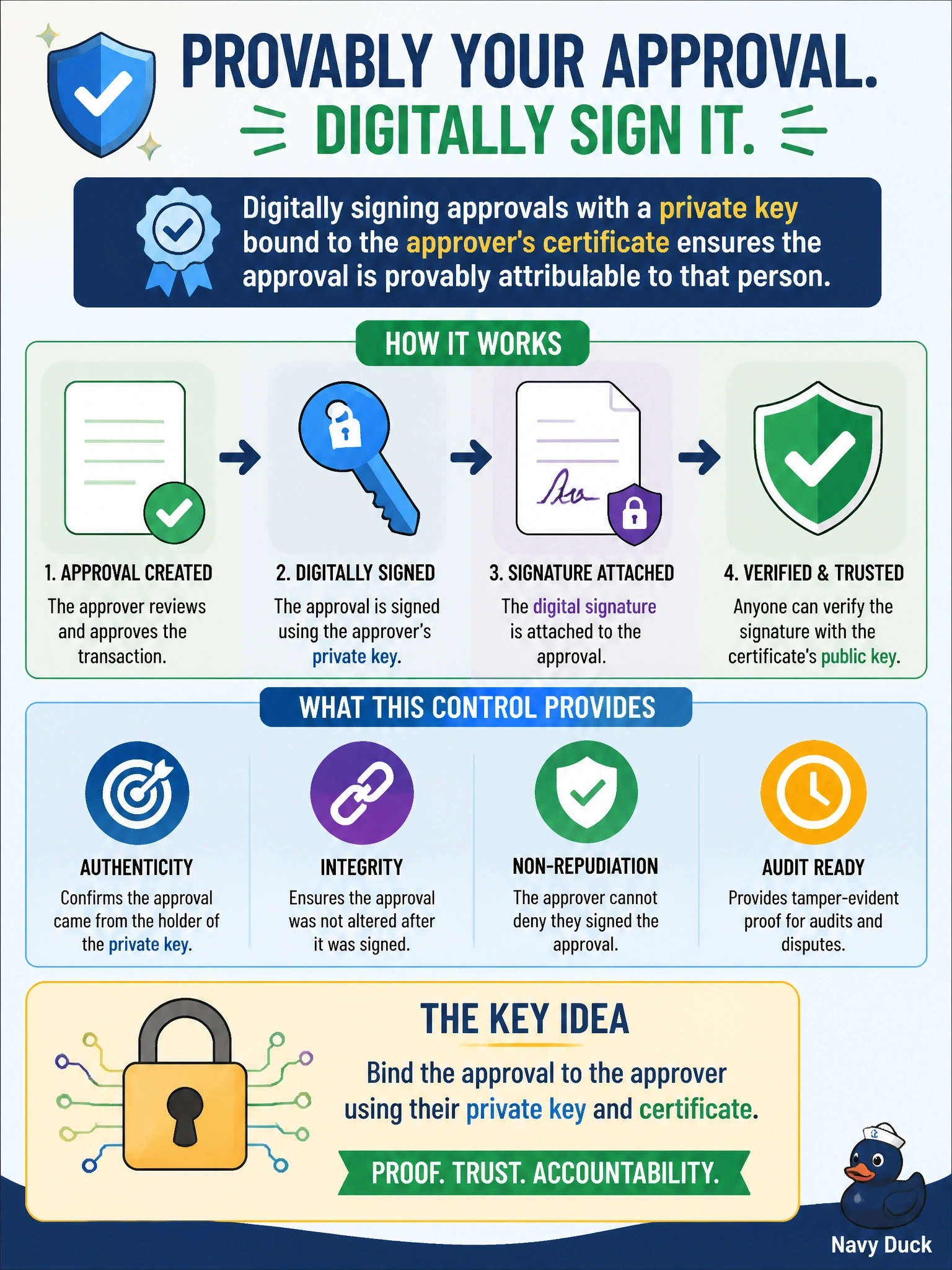
A digital signature is like a notarized signature that only you can produce. Since only your private key can make it, you can't later say "wasn't me." Encryption keeps the message secret, and that's the trap: secrecy doesn't prove who sent it.
Full Explanation
Non-repudiation means the originator of an action cannot credibly deny it. A digital signature delivers this by hashing the message and encrypting that hash with the signer's private key, which only the signer controls. Anyone can verify the signature with the matching public key from the signer's certificate, and a successful check proves both that the content is unchanged and that the holder of that private key produced it. Encrypting with the recipient's public key provides confidentiality: only the recipient can read the message, but anyone could have created it, so authorship remains deniable. A stored hash proves the message has not changed since the hash was taken, yet a hash has no key bound to a person, so it cannot show who wrote the approval. Restricting approvals to the corporate domain checks the sending domain, which is easily spoofed or used from a compromised account, and it identifies an organization rather than an individual. Exam caveat: integrity alone and confidentiality alone are not non-repudiation; the property requires a key that is uniquely bound to one identity. Operational check: issue approval-signing certificates to authorized approvers with private keys protected on smart cards or hardware tokens, require signed approvals in the payment workflow, and verify the signature and certificate status before releasing any transfer.