
Network engineers share a single root login on all core switches. After an outage caused by a configuration change, an auditor cannot determine which engineer made the change. Which remediation addresses the gap?
Select an answer to reveal the explanation.
Short Explanation
If five people share one house key, the door log just says "someone with the key came in." You can't hold anyone accountable that way. Give everyone their own credential and log what each one does; that's the accounting piece of AAA, and stronger shared passwords don't touch it.
Full Explanation
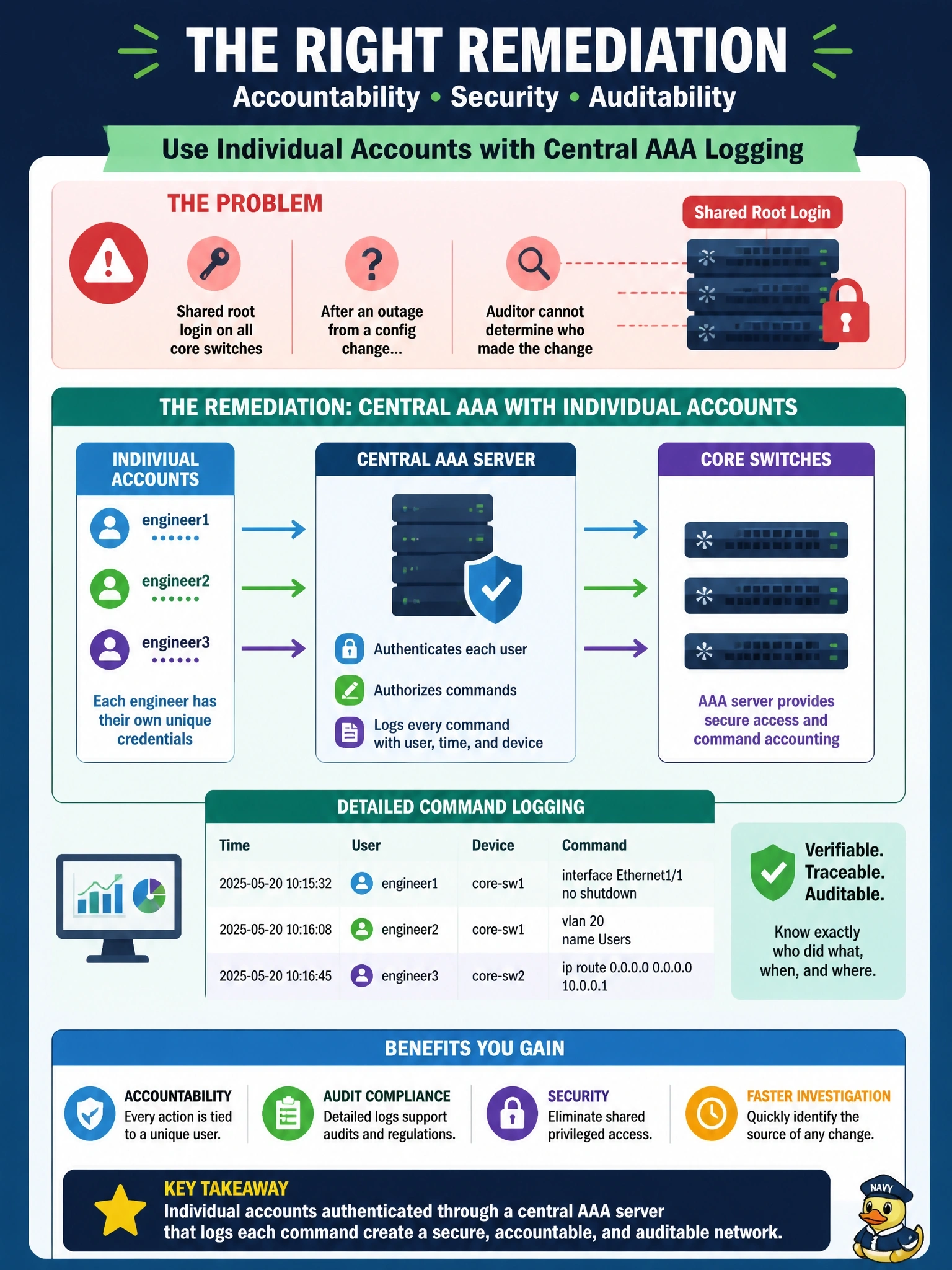
Authentication, authorization, and accounting work together: authentication establishes who someone is, authorization decides what that identity may do, and accounting records what it actually did. A shared root login collapses every engineer into one identity, so accounting records exist but cannot be tied to a person. Issuing individual named accounts and authenticating them through a central AAA server, such as one using RADIUS or TACACS+, restores attribution, and command logging on that server shows exactly who changed which configuration and when. Rotating the shared password and vaulting it improves credential hygiene, but every rotation still hands the same identity to the whole group, so the audit trail remains anonymous. Limiting the root login to the management VLAN reduces exposure to network locations, which is a sensible access restriction, yet it says nothing about which engineer typed the command. A longer passphrase hardens the credential against guessing while leaving the attribution problem untouched. Exam caveat: shared and generic accounts are an accounting and non-repudiation problem first; credential strength is a separate concern. Operational check: disable or vault the local root account for emergency use only, confirm that every administrative session on the switches appears in the AAA server's accounting log with a unique username, and review a sample change against the log to verify it can be traced.