
A lab's clients must stay IPv6-only, and they still need to reach one server that has only an IPv4 address. Which translation lets them?
Select an answer to reveal the explanation.
Short Explanation
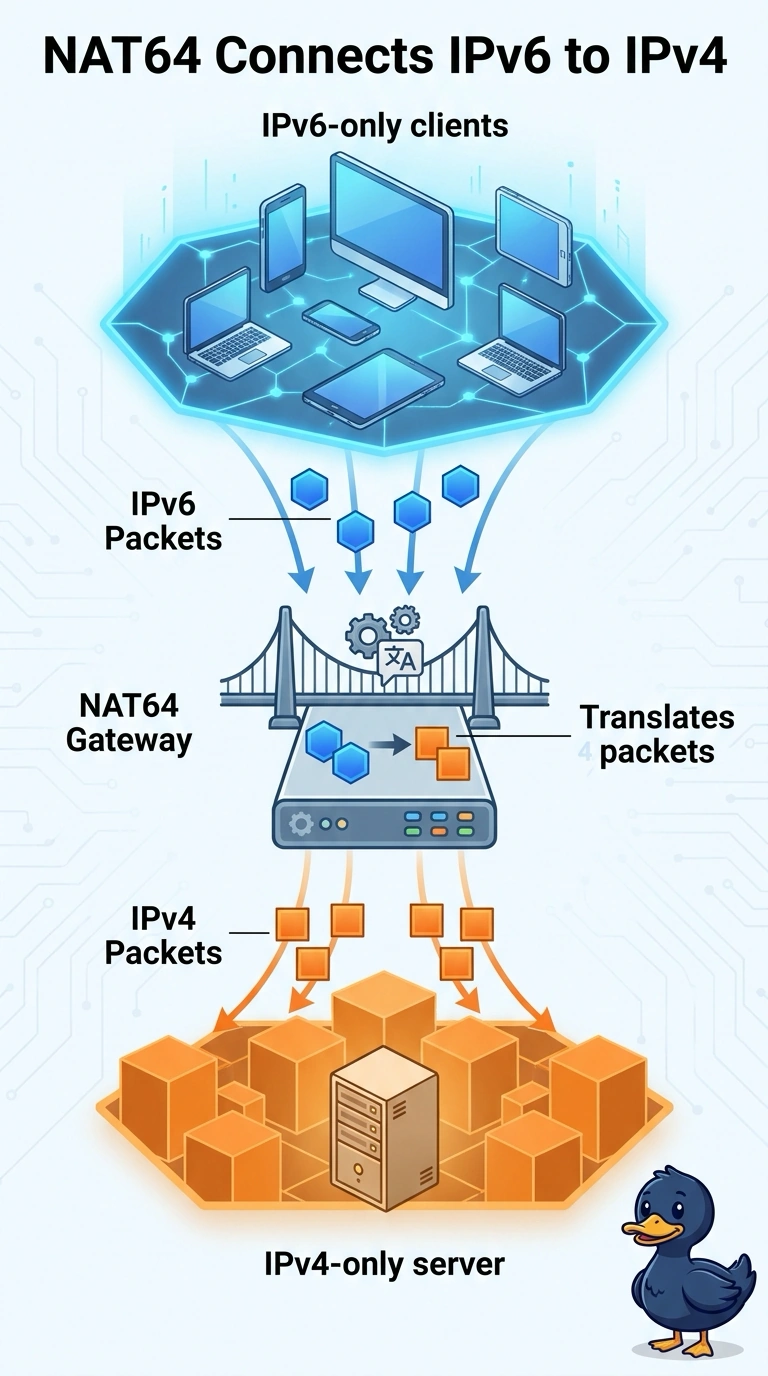
The clients speak only the new language, and the server speaks only the old one, so you put a translator between them. That translator, for IPv6 clients reaching an IPv4 server, is NAT64. Giving the clients a second language would break the rule that they stay IPv6-only, and a link-local IPv4 habit or a name file is not the translator.
Full Explanation
NAT64 translates between IPv6 clients and IPv4 servers so an IPv6-only host can open a session to an IPv4-only address. The lab requires the clients to stay IPv6-only and still reach one IPv4 server, which is the case NAT64 is built for. Dual stack would add IPv4 to the clients. That reaches the server and violates the requirement that the clients stay IPv6-only. An automatic private IPv4 address is what a host assigns itself when IPv4 DHCP fails. It does not translate IPv6. A hosts file supplies a local name-to-address mapping. It does not translate between IP versions. Exam caveat: NAT64 is usually paired with DNS64 so the IPv6 client receives a synthesized address for the IPv4 destination. The translation function the question asks for is NAT64. Operational check: from an IPv6-only client, open the IPv4 server through the translator and confirm the server sees a translated IPv4 source. Confirm DNS64, if you use it, returns a synthesized address and that the IPv4 server logs the translated source.