
A university announces the same DNS resolver address in three cities, and routing sends each campus to the nearest copy. The address is not a multicast group and is not delivered to every host. Which method is this?
Select an answer to reveal the explanation.
Short Explanation
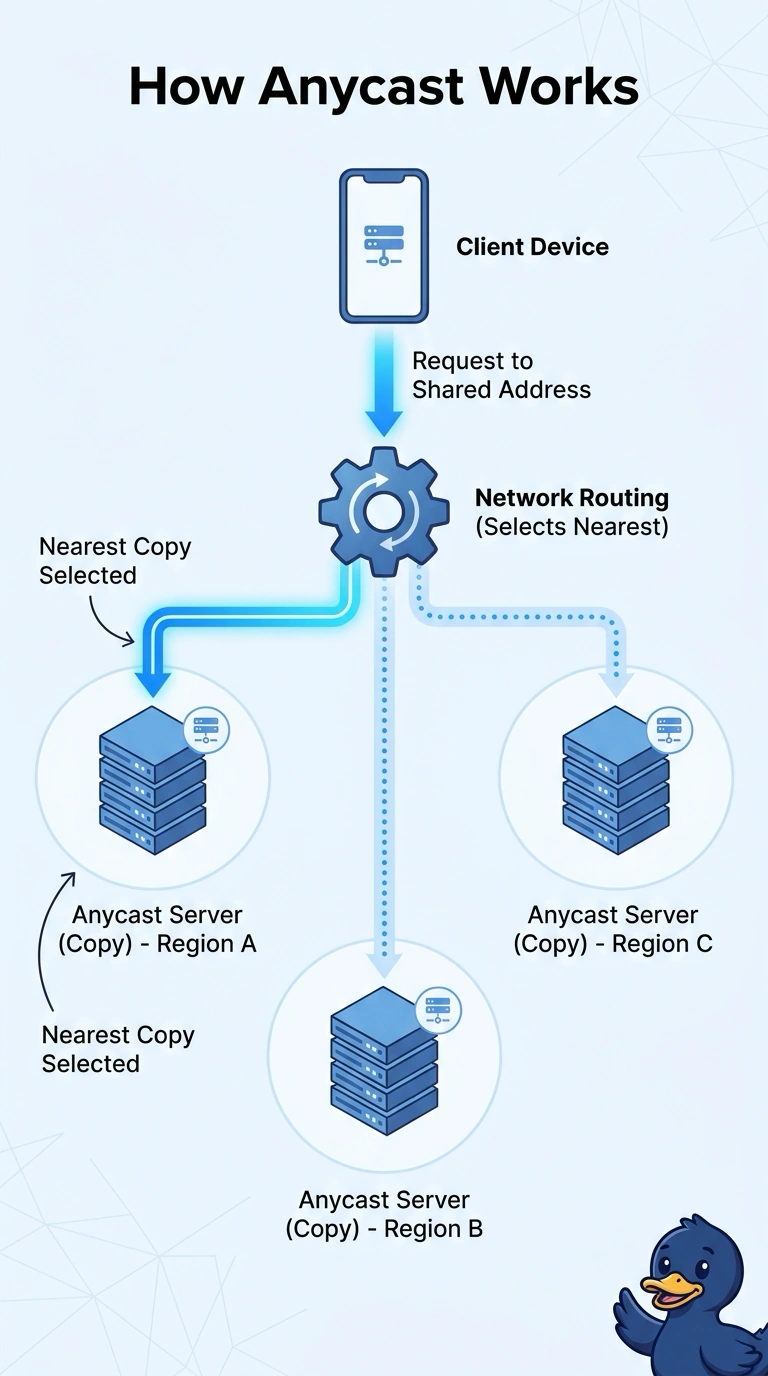
Imagine one street address printed on three clinics, and the road system always turns you into the nearest clinic. That is anycast. Broadcast would shout into every house, multicast would invite only a subscribed group, and the loopback address on your own machine is never the route between cities.
Full Explanation
Anycast advertises the same IP address from more than one location and lets the routing system deliver a client's packet to the nearest advertisement. The university's resolver address behaves that way across three cities, and the stem rules out a multicast group and a transmission to every host. Broadcast delivers a frame or packet to every node in the local broadcast domain. It is not how a campus is steered to the nearest of three distant resolvers. Multicast delivers to hosts that have joined a group. The stem says the address is not a multicast group, and nearness here is a routing choice rather than a group membership. The IPv4 loopback range, including 127.0.0.1, is answered by the local host stack and is not routed between cities. Exam caveat: anycast is ordinary unicast routing pointed at multiple copies. It does not require a special client configuration the way multicast group membership does. Operational check: from each campus, trace the path to the resolver address and confirm the path ends in the local city rather than always in the same data center.