
A campus DHCP server sits on the same VLAN as the clients and must receive their discovers and return offers. Which ports carry that exchange?
Select an answer to reveal the explanation.
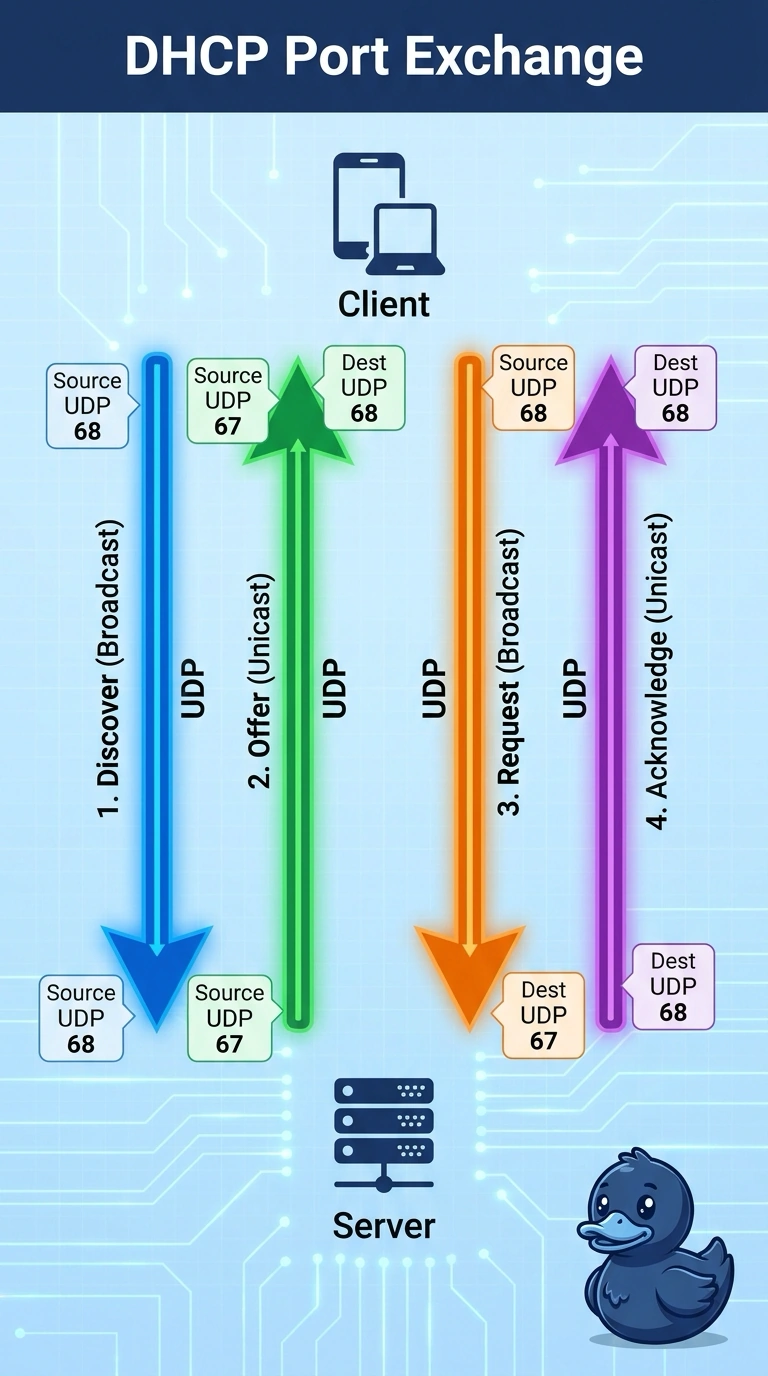
Short Explanation
Getting an address is a short UDP conversation, not a reliable session and not an IPv6 lease. You are looking at DHCP, and that exchange uses UDP ports 67 and 68 between the server and the client. The same numbers on TCP, or only the server port, drop half of the exchange.
Full Explanation
DHCP discovers and offers are UDP. The server listens on UDP port 67 and the client uses UDP port 68, including when both sit on the same VLAN and no relay is required. A client that has no address yet can still send a broadcast discover, and the server answers with an offer using that pair. TCP ports 67 and 68 are the near miss, because the numbers are right and DHCP does not ride a connection-oriented transport. UDP 546 and 547 are the DHCPv6 client and server ports. This campus exchange is IPv4 DHCP on the client VLAN, so the IPv6 pair is the wrong generation. Using only UDP 67 drops the client port. The discover leaves the client from UDP 68, and the offer returns to it. Exam caveat: a relay still uses UDP 67 and 68. It forwards the broadcast as a unicast toward the server and does not move the service onto the DHCPv6 ports. Operational check: capture on the VLAN while a client boots, filter for UDP 67 and 68, and confirm a discover from the client is followed by an offer from the server.