
A data center carries most of its traffic between servers inside the building, and the design should put every access switch the same number of hops from every other access switch. Which architecture matches that goal?
Select an answer to reveal the explanation.
Short Explanation
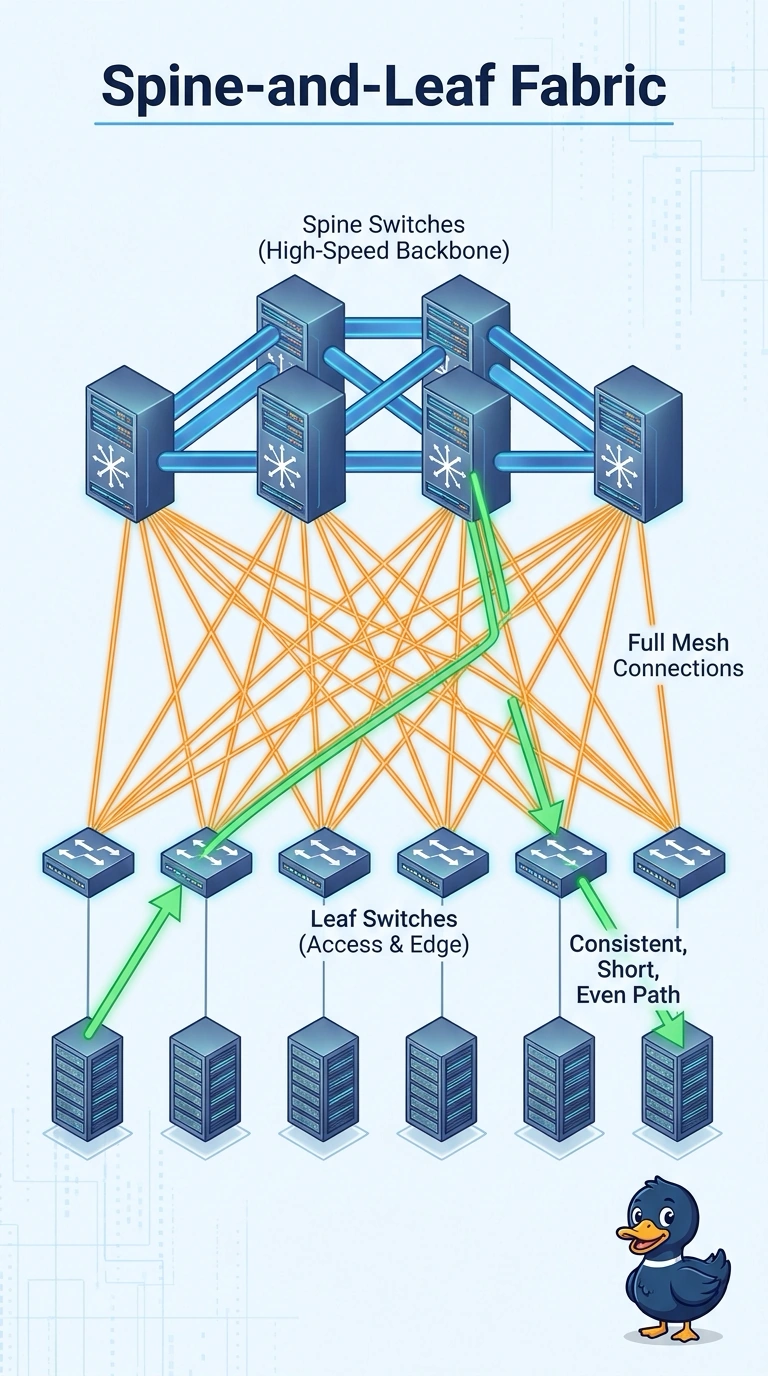
You want server-to-server traffic on a street grid, not a single downtown bridge. A spine-and-leaf fabric links every leaf to every spine so one access switch is the same distance from any other. A collapsed core shortens a three-tier drawing, and every flow still hairpins through that core pair.
Full Explanation
In a spine-and-leaf fabric, every leaf switch connects to every spine switch and leaves do not interconnect directly. Traffic from a server on one leaf to a server on another leaf crosses one spine and arrives in the same number of hops no matter which pair of leaves is involved. That even path is what this data center asked for. A collapsed core is the near miss. It removes the distribution tier and looks flatter, and every server-to-server flow still passes through one core pair, so the hop count is not an equal leaf-to-leaf grid. A hub-and-spoke design that peers every row only to the internet-edge router turns internal traffic into a trip through that edge and does not give the rows an even path to one another. A three-tier design with a single core forces access and distribution traffic through that chassis and keeps the choke point. Exam caveat: spine-and-leaf still needs enough uplink bandwidth on every leaf. Equal hop count does not help if one leaf is uplinked at a fraction of the others. Operational check: trace paths between several server pairs and confirm each crossing uses a leaf-spine-leaf path of the same length, with no pair forced through a single core device.