
A retail contact center must carry live agent audio. A late packet is useless, and pausing the stream to recover a lost one would be worse than a brief gap. Which transport behavior fits that requirement?
Select an answer to reveal the explanation.
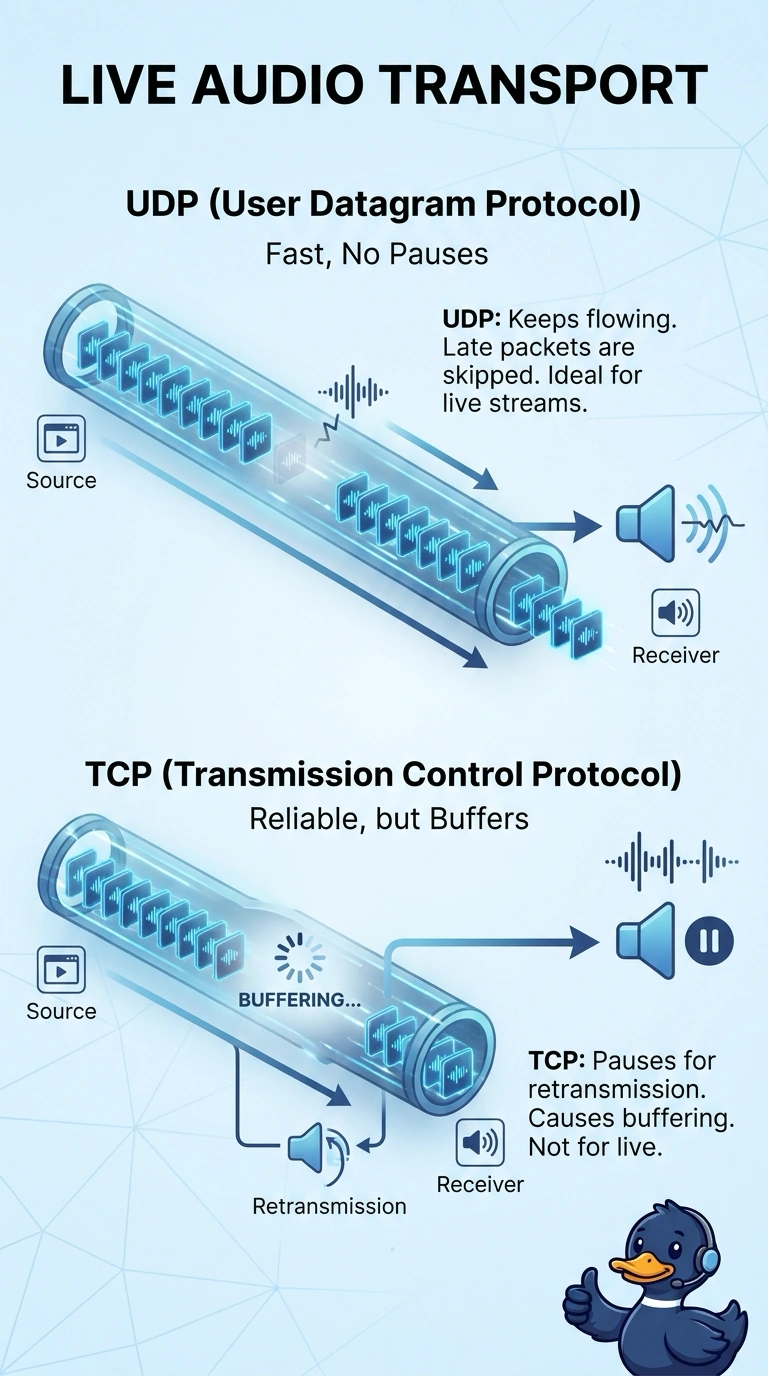
Short Explanation
A live conversation is like a phone call, not a registered letter. You would rather drop a syllable than have the whole sentence wait while a lost word is mailed again. That's UDP for the media, and TCP's retransmission, even under a voice header, is the wrong kindness when the listener needed that packet already.
Full Explanation
User Datagram Protocol sends datagrams without holding later packets until an earlier gap is filled. Live audio has a playback deadline. A packet that arrives after that deadline cannot be played, and waiting for a retransmission would stall the packets that are still useful. UDP lets the application conceal a short gap and keep going, which is the behavior the contact-center stream needs. Transmission Control Protocol guarantees ordered delivery and retransmits loss. That protection is right for an order file and wrong for a stream that would rather skip ahead. Carrying RTP over TCP looks like the careful version of the same design, because RTP is the usual media header, and it still makes playback wait on retransmission. The stem forbids that wait. SIP sets up and tears down the call. It does not carry the voice media, and it does not replay a late packet. Confusing the signaling protocol with the media transport is the other trap. Exam caveat: signaling may use SIP over TCP or UDP, while the media stream is the part that wants UDP. Do not treat the whole phone system as one protocol. Operational check: capture a short call and confirm the media packets are UDP with no retransmission of lost sequence numbers, while any file transfer on the same network remains TCP.