
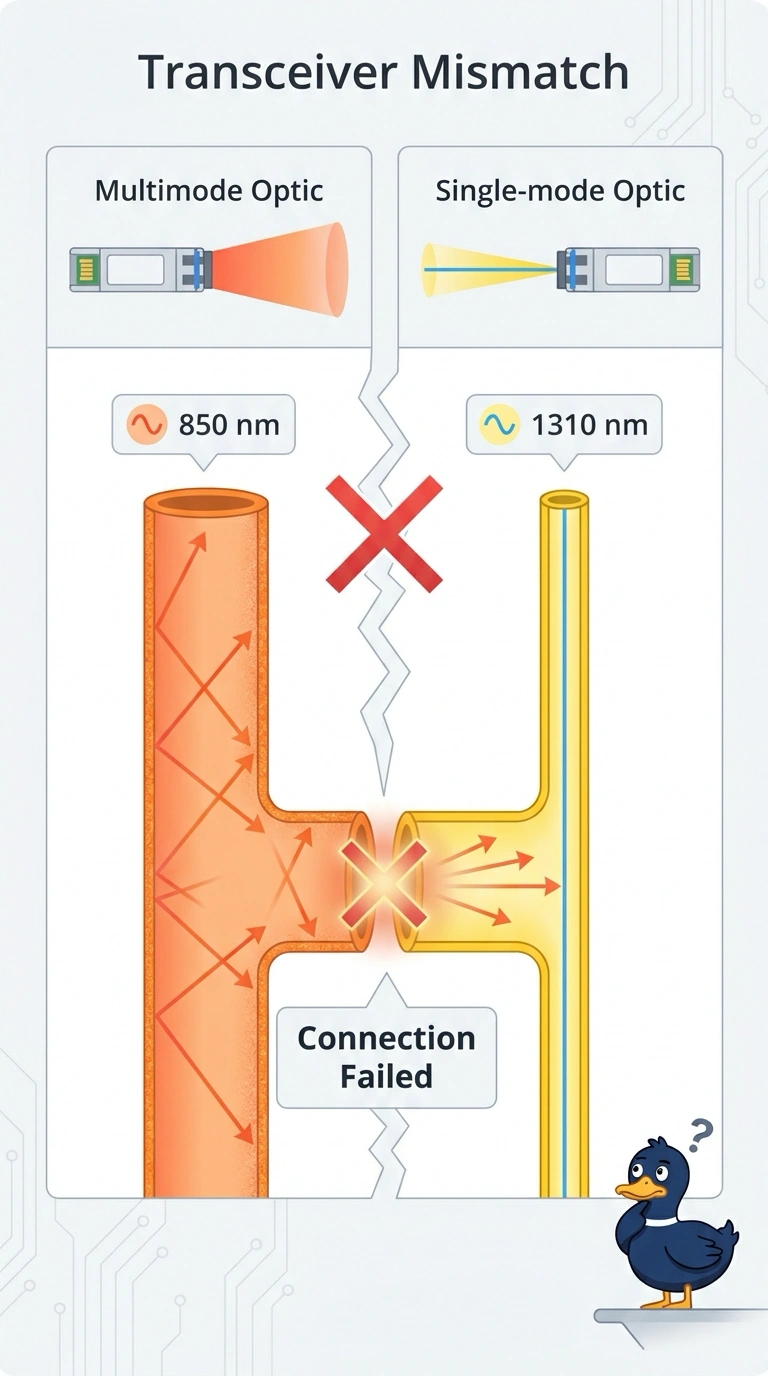
A factory fiber link stays down. One end has a multimode 850 nm optic and the other end has a single-mode 1310 nm optic. Which fault is this?
Select an answer to reveal the explanation.
Short Explanation
Two flashlights that speak different colors will not hold a conversation through the same hose. You paired a multimode 850 nm optic with a single-mode 1310 nm optic, so the link stays down from a transceiver mismatch. A swapped pair, a dirty end, or a tight bend all assume the two optics were a match to begin with.
Full Explanation
A fiber link comes up only when the two optics agree. Multimode optics at 850 nm expect a matching multimode receiver. Single-mode optics at 1310 nm use a different core and wavelength. One of each on this factory run means neither receiver is the partner the other transmitter was built for. A crossed transmit and receive pair is the tempting twin, because it also leaves a fiber dark. It does that to a matched pair, and these ends are not a matched pair. A dirty connector can drop a link that was otherwise the right optic on both ends. Bend loss reduces light on a pair that could have worked. Neither one pairs 850 nm multimode with 1310 nm single-mode. Exam caveat: matching the printed wavelength is not enough when one side is multimode and the other is single-mode. Operational check: read both optic labels, replace one so the type and wavelength match the fiber, and confirm the link light comes up. Cleaning a connector is worth doing after the optics match, not instead of matching them.