
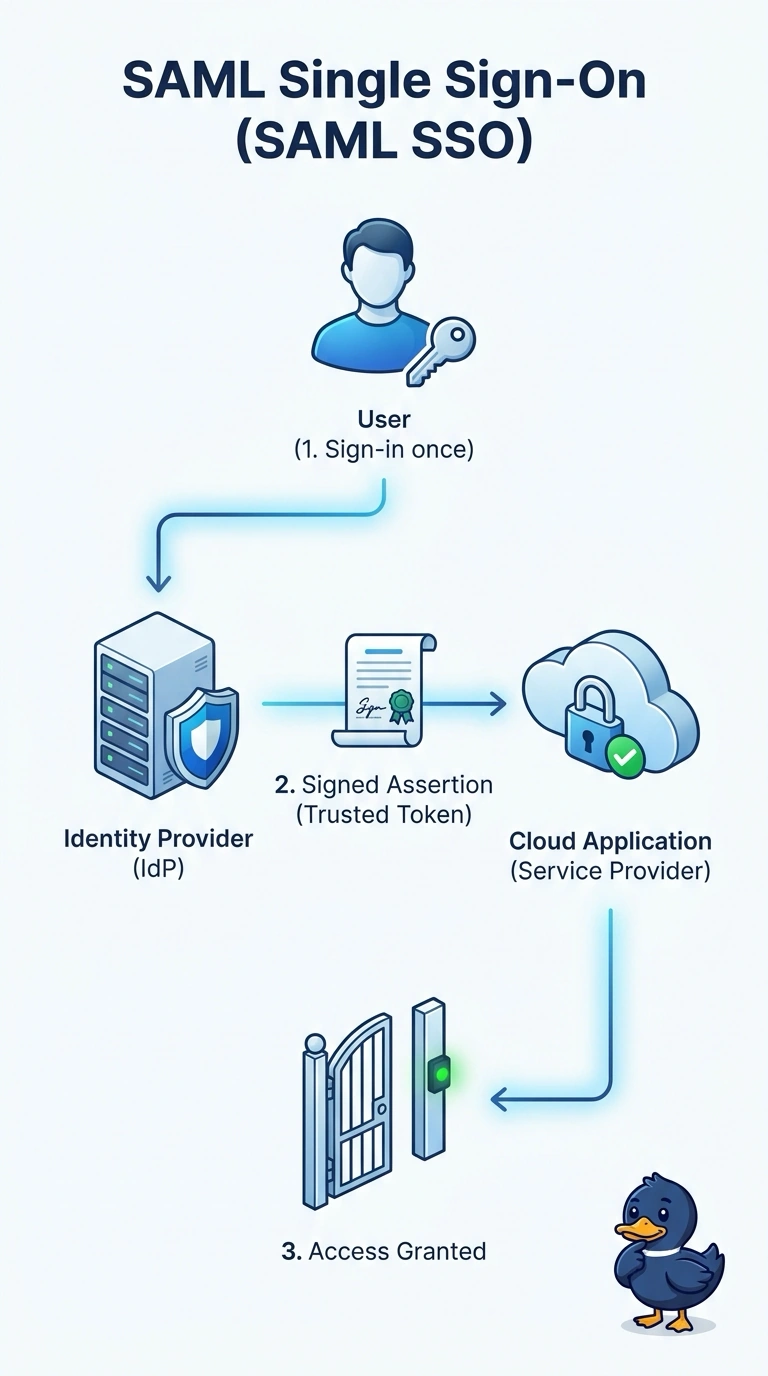
A city-hall employee signs in once at an identity provider, and a cloud permitting application accepts the signed assertion without asking for a second password. Which technology carries that assertion?
Select an answer to reveal the explanation.
Short Explanation
You can think of the identity provider’s signed assertion as a letter of introduction that the permitting application accepts, so you don’t have to prove yourself with another password. That sign-in pattern is SAML. TACACS+ administers network devices, a DHCP reservation keeps an address tied to a computer, and a tone generator and probe locate a copper cable; none carries the assertion.
Full Explanation
Security Assertion Markup Language (SAML) lets an identity provider authenticate you and hand the cloud application a signed assertion of that sign-in. The permitting application trusts the assertion, so you can sign in once at the identity provider without entering a second password in the application. TACACS+ authenticates and authorizes administrators on network devices such as routers and switches, often with command-level accounting; it does not issue the signed assertion that a cloud application consumes for user single sign-on. A DHCP reservation maps a MAC address to a chosen IP address so a computer keeps a stable lease. It proves nothing about you, and the permitting application does not read that reservation when it skips the password prompt. A tone generator and probe trace a copper pair from a jack to a patch panel. They identify a cable, not a user, and play no role in cloud sign-in. Exam caveat: SAML is one federation method; a signed assertion accepted by the application is the SAML pattern. Practical check: review a successful sign-in and confirm that the identity provider issued the assertion, the permitting application accepted it, and you were not prompted for a separate application password.