
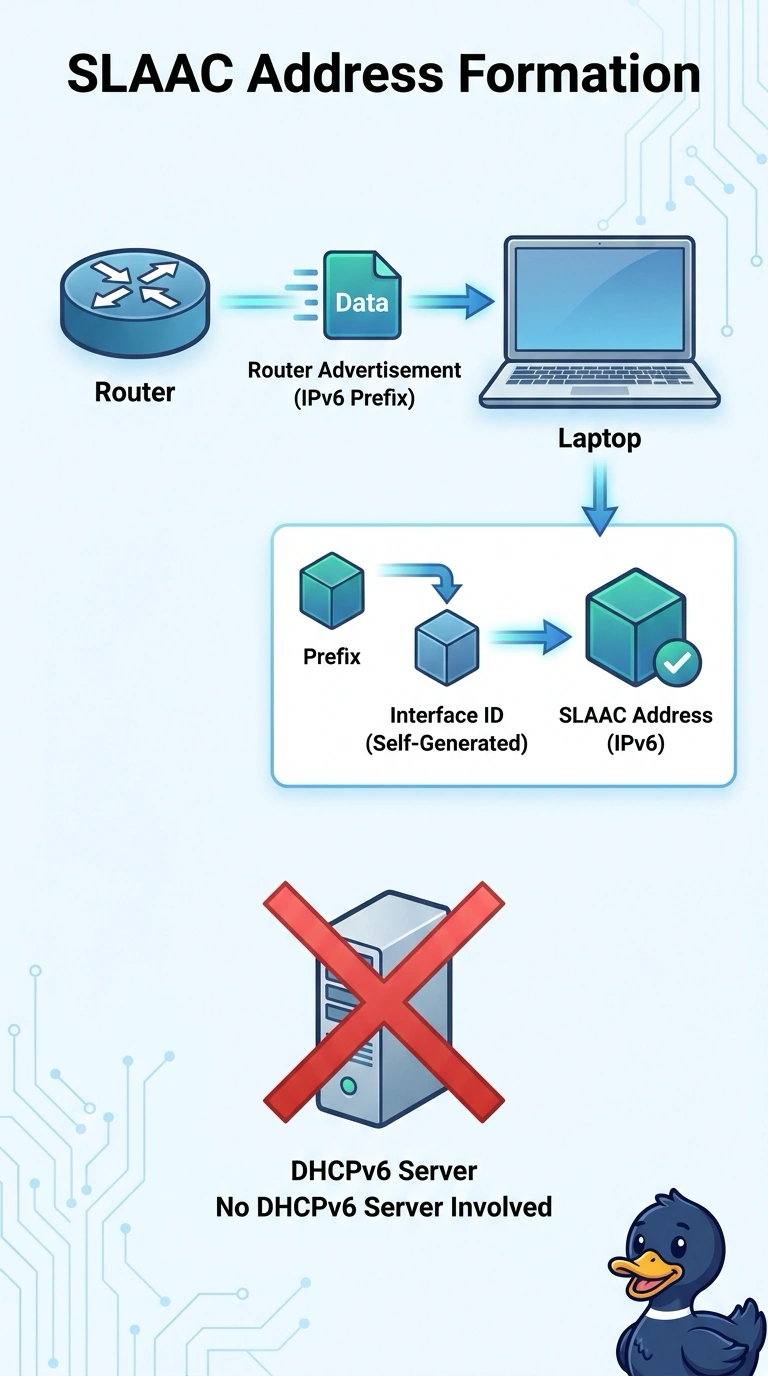
School laptops build IPv6 addresses from the prefix inside a router advertisement, and no DHCPv6 server exists. Which method is forming those addresses?
Select an answer to reveal the explanation.
Short Explanation
The router is holding up a street sign, and each laptop paints its own house number from that sign. You are watching SLAAC: the prefix arrives in a router advertisement, and no DHCPv6 server is handing out the address. A stateful address server, a service that only passes options, or an IPv4 reservation is not building these addresses.
Full Explanation
Stateless address autoconfiguration lets an IPv6 host build its own address from the prefix in a router advertisement, with no DHCPv6 server present. The school laptops are doing that. Stateful DHCPv6 is the tempting twin because it also produces an IPv6 address, and it needs the server the stem says does not exist. Stateless DHCPv6 can supply options such as DNS after the host already has an address. It does not build that address from the advertisement. An IPv4 reservation binds a hardware address to an IPv4 lease. It does not read an IPv6 router advertisement. Exam caveat: SLAAC forms the address. How the laptop learns DNS can still be stateless DHCPv6, and this question asks only how the address itself is built. Operational check: capture the router advertisement, confirm the prefix matches the addresses the laptops installed, and confirm no DHCPv6 reply is handing out those addresses. A laptop that also asks for DNS options is still using SLAAC for the address itself. Do not reclassify it as stateful DHCPv6 because a DNS server name arrived later.