
Security requires that a remote laptop's internet traffic and its corporate traffic both pass through headquarters for inspection. Which VPN design meets that requirement?
Select an answer to reveal the explanation.
Short Explanation
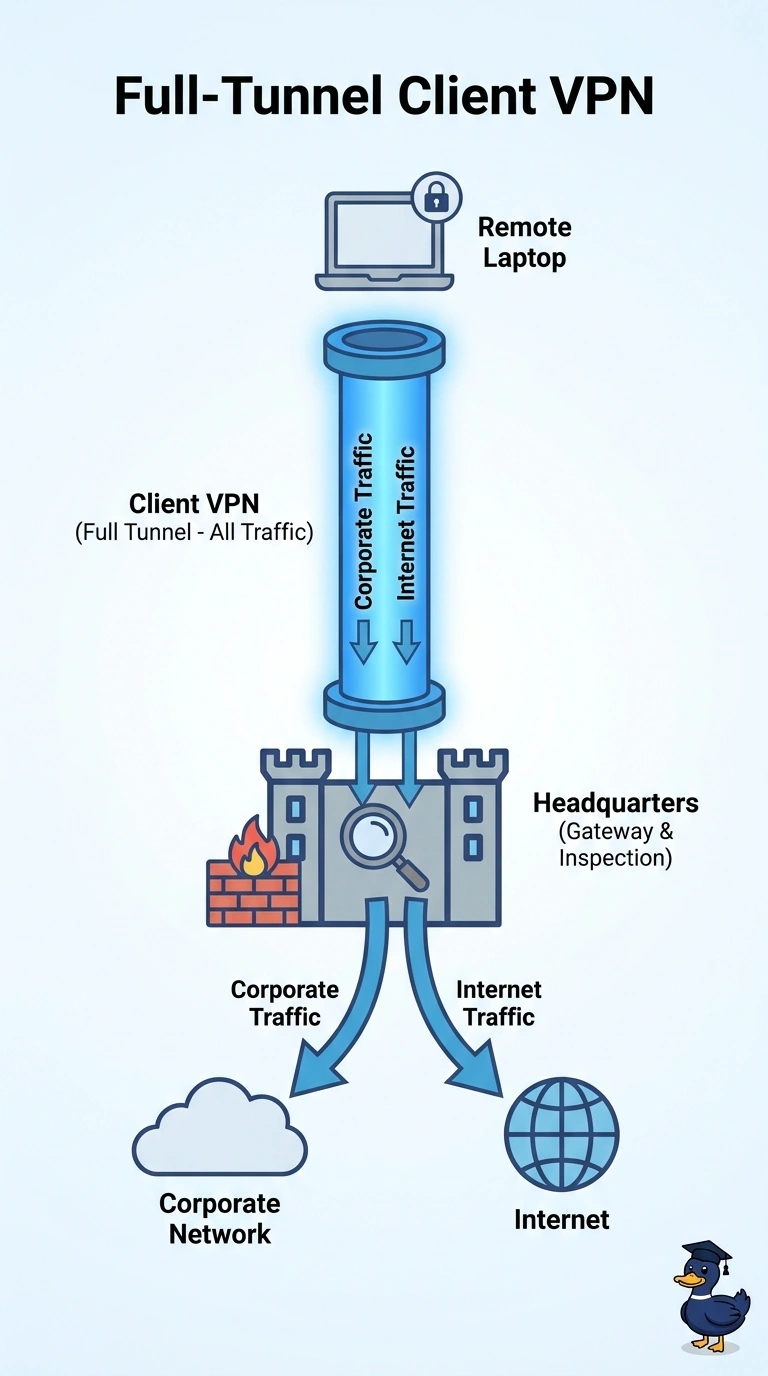
A full tunnel is a single driveway that both the company mail and the personal errands have to use. You send the laptop's internet traffic and its corporate traffic through headquarters so both can be inspected. A split that lets internet leave from the laptop is the gap security just refused.
Full Explanation
A full-tunnel client VPN sends all of the laptop's traffic, corporate and internet alike, into the tunnel toward headquarters. Headquarters can inspect both before internet traffic leaves by the corporate path. That matches a rule that refuses a direct internet path from the laptop. A split tunnel sends only corporate prefixes through the VPN and lets internet use the laptop's local gateway. Corporate applications still work, and the internet never passes inspection. Calling it a full tunnel for corporate traffic plus a local internet breakout is the same split under a friendlier name. The stem wants both kinds of traffic at headquarters. A site-to-site VPN joins two networks. A roaming laptop is a client, not a site with its own gateway. Exam caveat: full tunnel moves the laptop's internet breakout to headquarters, so that path's latency and bandwidth now apply to ordinary browsing. Operational check: with the VPN up, trace an internet address and a corporate address and confirm both enter headquarters first.