
Two routers in a store share a virtual gateway address. DHCP gives clients router A's physical address. When A fails, clients do not follow router B. Which change fixes the handoff?
Select an answer to reveal the explanation.
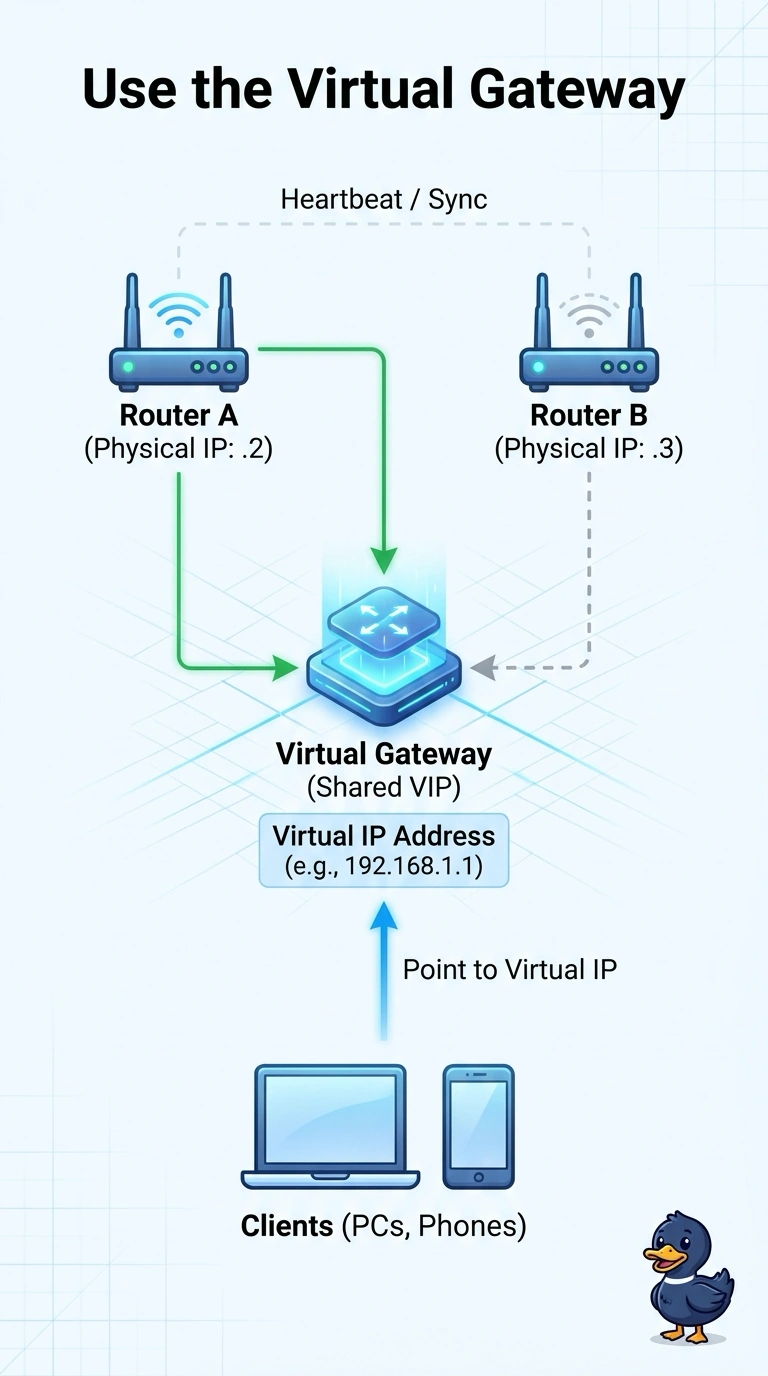
Short Explanation
You handed people the home address of one guard instead of the desk that either guard can staff, so when that guard leaves nobody walks over to the desk. Give clients the virtual gateway address. Listing two home addresses as one gateway, deleting the desk, or adding a mail record does not create the handoff.
Full Explanation
First-hop redundancy works only if hosts use the virtual address that can move between the routers. DHCP is handing out router A's physical address, so when A fails the clients still aim at an address that is down, even though router B has taken the virtual address. Changing the DHCP router option to the virtual address is the fix. A host has one default gateway, not a pair of physical addresses stuffed into a single field, and the virtual address is what provides the handoff. Removing the virtual address deletes the mechanism that lets B take over. An MX record directs inbound mail. It does not change a client's default gateway when a router fails. Exam caveat: the virtual address has to be inside the clients' subnet, or the clients will not use it as an on-link gateway. Operational check: set the scope's router option to the virtual address, renew a client, shut router A, and confirm the client still reaches the network through router B. Renew two clients after the scope change and shut router A only in a maintenance window.