
A logistics auditor asks where the field adjusted miles came from and which cleaning rule changed the raw odometer reading into that stored value. The pipeline team needs the record that answers both parts. What should they open?
Select an answer to reveal the explanation.
Short Explanation
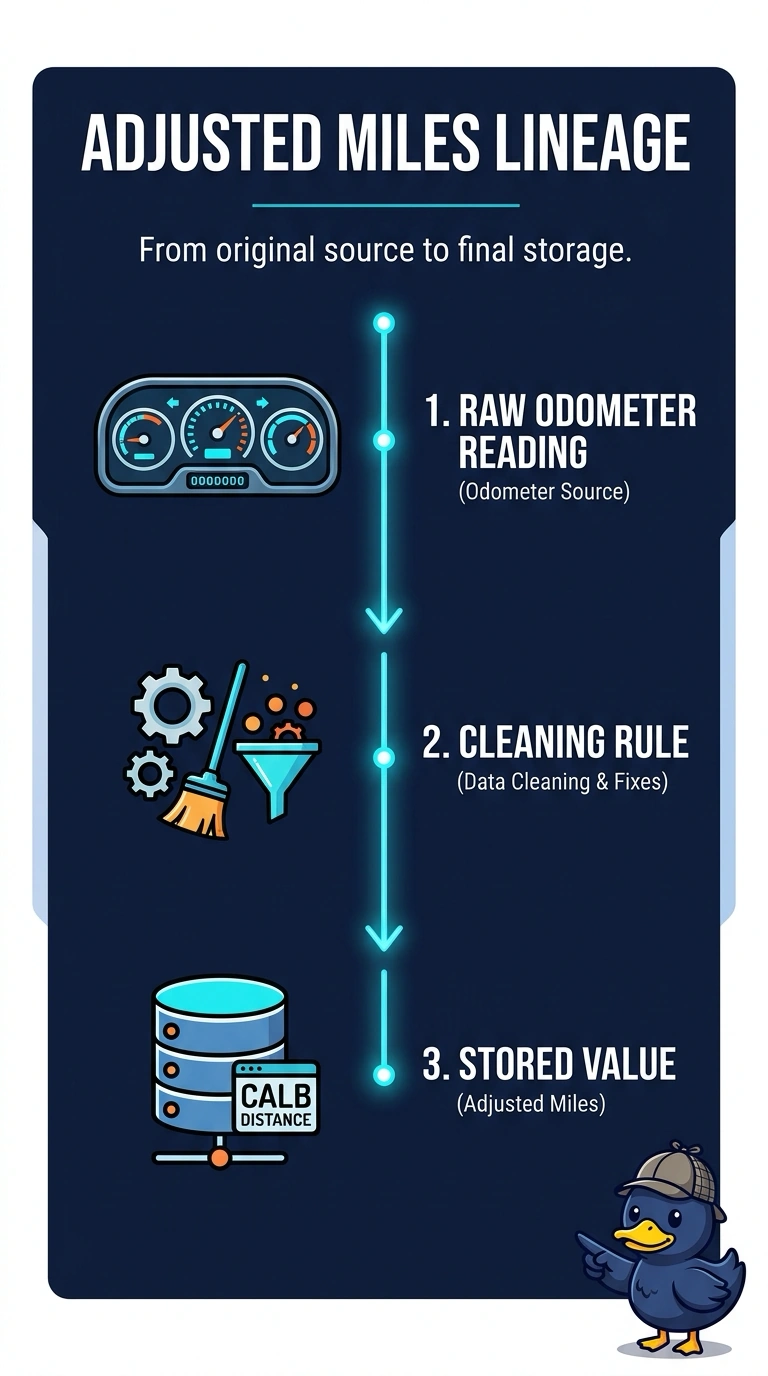
Follow the family tree of a number if you want to know its parents and what changed it. Lineage for adjusted miles names the raw odometer and the cleaning rule that produced the stored field. The trap is the refresh schedule, which only tells you how often the table is reloaded.
Full Explanation
Lineage records provenance: the upstream source of a field and the transformations that produced the stored value. For adjusted miles, that record names the raw odometer and the cleaning rule applied to it, which is both parts of the auditor's question. The refresh cycle states how often the mileage table is reloaded and says nothing about which rule changed the odometer. The orchestration graph orders pipeline steps and records retries; step order is not the identity of the source field or the cleaning logic. The file layout describes how miles are physically stored, in columns or in rows, and not where the number came from. Reload timing, step order, and physical layout can all be written down and still leave both of the auditor's questions unanswered. Exam caveat: a useful lineage entry names both the source field and the transform; a note that only says the value came from the odometer system leaves the cleaning rule unanswered. Operational check: open the lineage entry for adjusted miles and confirm it shows the raw odometer field and the specific cleaning rule that wrote the stored value.