
An assembly plant emails a voluntary safety survey to every shift. Workers who distrust management tend not to answer, and the replies that arrive are mostly favorable. What limitation does this survey have?
Select an answer to reveal the explanation.
Short Explanation
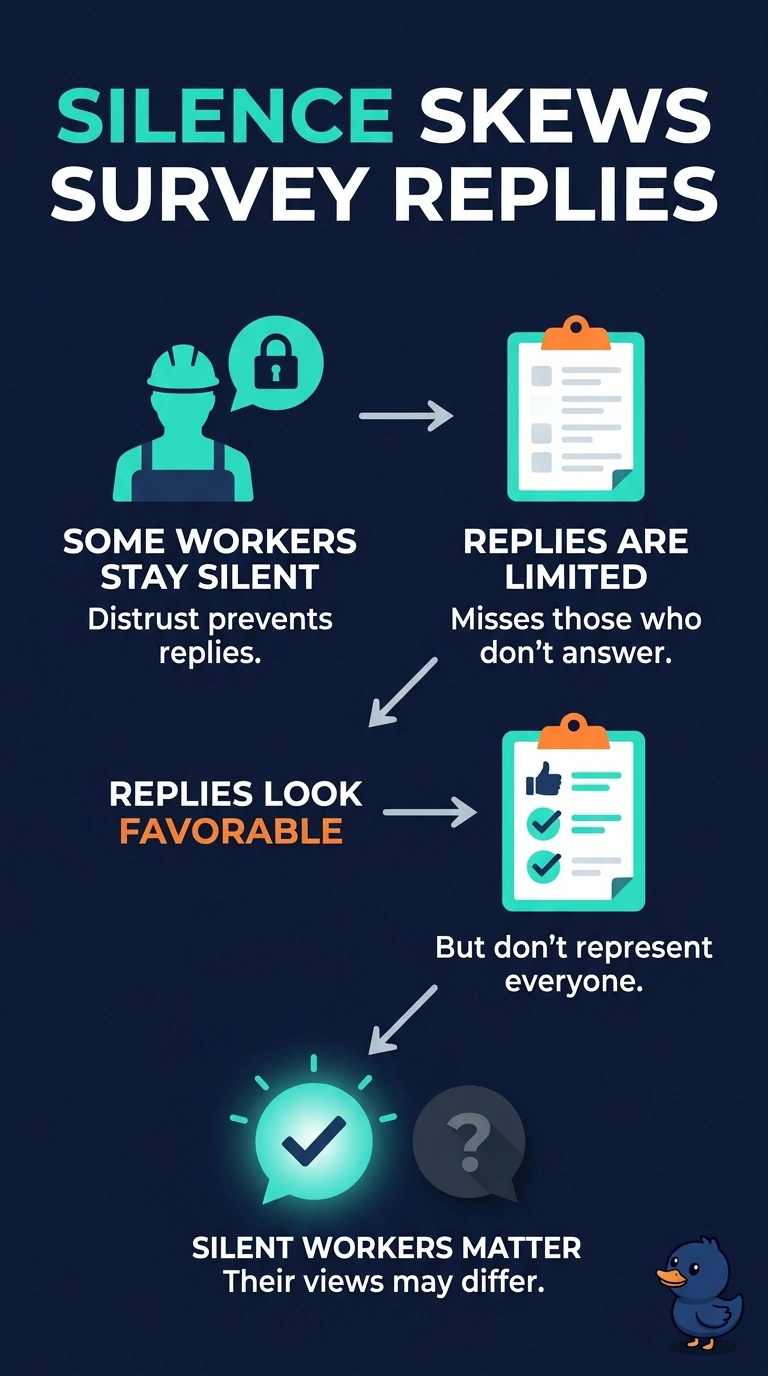
A survey only hears from the people who walk in, and you learn nothing about the workers who never answer. Emailing every shift does not turn the replies into a census when distrustful workers stay silent. The trap is treating a complete mailing list as a complete set of answers.
Full Explanation
The survey records only the workers who choose to reply. Workers who distrust management tend not to answer, and the replies in hand are mostly favorable, so the silent group may differ from the group that spoke. The limitation is nonresponse: the survey can miss the people who never answer, and the answers may not represent them. A sensor stream would be measurements from a device; skipped survey replies are people who did not respond, not gaps in an instrument log. Sending the email to every shift creates a complete invitation list, not a census of views. A census would observe every worker, and the workers who stay silent are unobserved. A voluntary format does not remove response bias. When the choice to answer is related to the attitude being measured, the replies are a biased slice of the workforce, not a cleaned one. Exam caveat: nonresponse is repairable only to the extent the silent workers can be described or followed up; reweighting respondents does not help if nothing is known about how they differ. Operational check: report the share of each shift that replied, and do not present the favorable replies as the view of workers who never answered.