
A utility wants a short code for each feeder's daily load curve and trains a network so the original curve can be rebuilt from that code. Which model is this?
Select an answer to reveal the explanation.
Short Explanation
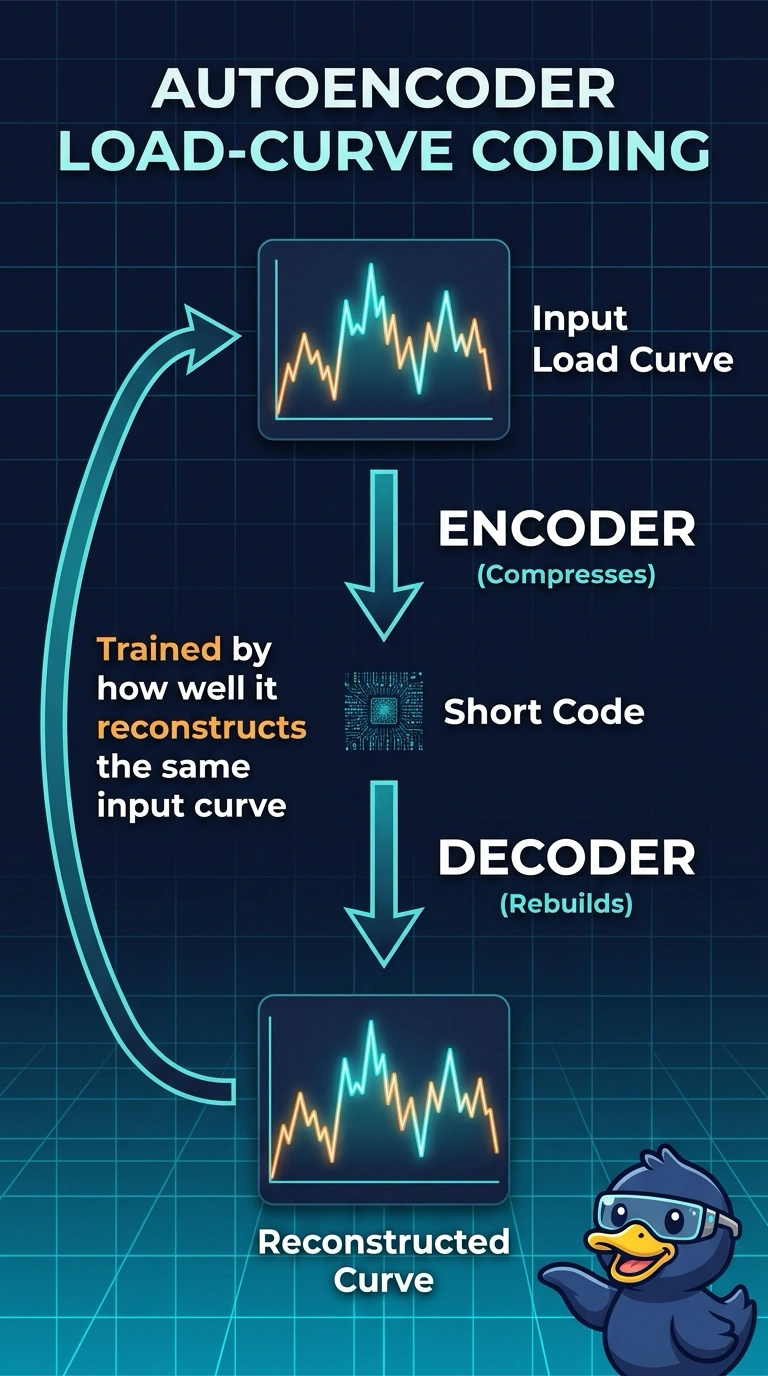
An autoencoder is a packer who must also prove your original clothes come back out of the suitcase. You compress each load curve into a short code and train on how well that curve is rebuilt. The trap is a forecaster aimed at tomorrow, or a classifier that only names an outage.
Full Explanation
The utility wants two things at once: a short code for a daily load curve, and a reconstruction of that same curve from the code. An autoencoder trains an encoder to compress the input and a decoder to rebuild it, and the loss compares the rebuilt curve with the original input. That reconstruction target is what makes the code carry the curve rather than an unrelated label. A generative adversarial pair learns to invent curves that fool a judge; it is not trained to rebuild a designated input from its code. A classifier maps a curve to an outage name and is scored on labels, so a correct label can coexist with a code that cannot restore the curve. A forecaster scores the next day against a future curve, which is a different target than reconstructing the input that was just encoded. Exam caveat: a short code that is never asked to rebuild the input is just a compression guess; the training signal here is reconstruction. Operational check: confirm the loss compares the decoder output with the same feeder-day curve that entered the encoder.