
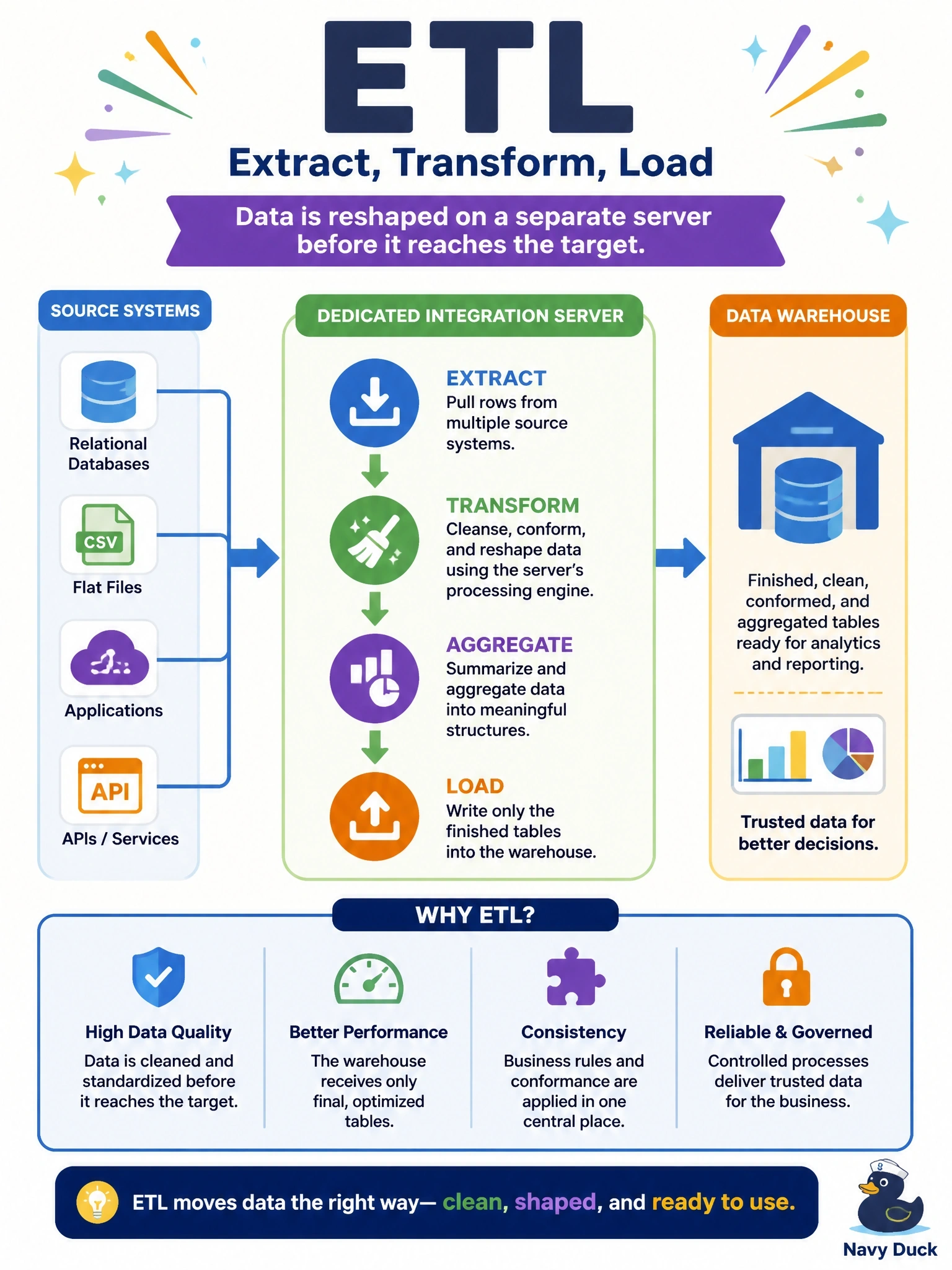
A legacy data warehouse is fed by a dedicated integration server that pulls rows from several source systems, cleanses and conforms them in its own processing engine, aggregates them and then writes only the finished tables into the warehouse. Which data integration approach does this describe?
Select an answer to reveal the explanation.
Short Explanation
Follow the order of the letters and you've got it. In ETL, the cooking happens in a separate kitchen and only the finished plate goes on the warehouse table. If the raw ingredients were dumped into the warehouse and cooked there, that'd be ELT, so watch where the transform step actually runs.
Full Explanation
Extract, transform, load (ETL) extracts data from sources, transforms it in an intermediate engine, and then loads the transformed result into the target. The defining trait is where and when transformation happens: on a dedicated integration server, before the data reaches the warehouse. That matches the scenario, in which cleansing, conforming and aggregation all occur in the integration server's engine and only finished tables are written. ETL was the dominant pattern when warehouse compute was expensive and limited, because it kept heavy processing off the warehouse. Extract, load, transform (ELT) reverses the last two steps: raw data lands in the target first and is transformed there using the target's own compute, which is not what the scenario describes. Change data capture is a technique for detecting and reading only changed rows, often from transaction logs; it can feed either ETL or ELT, but it describes how changes are identified, not where transformation occurs, and the scenario says nothing about incremental capture. Data virtualization queries sources in place without copying them, whereas this design physically stores finished tables in the warehouse. Exam caveat: many modern pipelines mix the patterns, so identify the approach from where the transformation runs. Operational check: trace one table's lineage from source to warehouse and confirm the transformation logic lives in the integration tier rather than in warehouse SQL.