
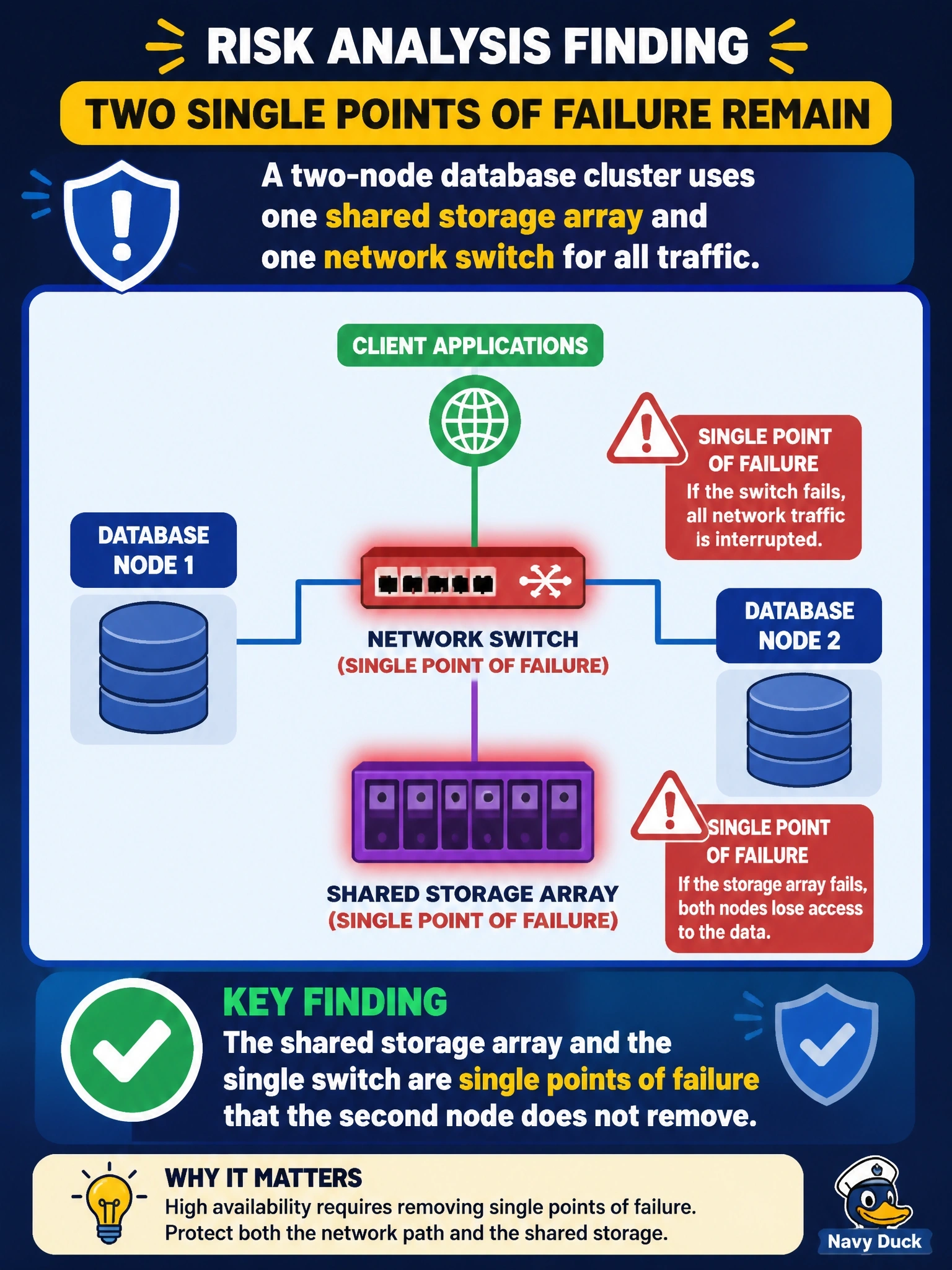
A two-node database cluster was built for high availability. Both nodes connect to one shared storage array, and all of their network traffic passes through a single network switch. Which risk analysis finding is accurate?
Select an answer to reveal the explanation.
Short Explanation
A two-node cluster on one storage array and one switch is like a two-engine plane with a single fuel tank; lose the tank and both engines quit. You find single points of failure by asking 'if this one thing dies, does everything stop?' Here, the array and the switch both fail that test.
Full Explanation
A single point of failure is any component whose failure stops the whole service. Risk analysis for a high-availability design traces every dependency and asks whether the service survives the loss of each one. Two database nodes protect against the failure of a server, but both depend on one storage array and one network switch; if either fails, both nodes lose their data or their connectivity together and failover has nowhere to go. Remediation includes redundant switches with multiple network paths and either a highly available storage configuration or a design in which each node has its own storage kept synchronized through replication or mirroring. Calling the second node the single point of failure misreads the design; losing either node is exactly what the cluster tolerates. Claiming there is none because there are two nodes confuses redundancy of one layer with resilience of the whole stack. Identifying the shared database software version as the only single point of failure focuses on a different category, a common-mode software risk managed through testing and staged patching, while ignoring the obvious shared hardware dependencies. Exam caveat: redundancy must exist at every layer the service depends on, including power, network and storage. Operational check: map each dependency and simulate a switch or storage path failure in a test environment to confirm the service survives.