
A company has two systems to protect. A trading platform must resume within minutes of a site failure, whatever the cost. A historical reporting system can be offline for several days, and the budget for it is minimal. Which disaster recovery site approach fits each system?
Select an answer to reveal the explanation.
Short Explanation
Hot, warm and cold sites are like having a spare car running in the driveway, one in the garage, or just a parking spot you'd have to fill. Minutes of downtime needs the car running; several days lets you go buy one later. You match the heat to the recovery time and the budget.
Full Explanation
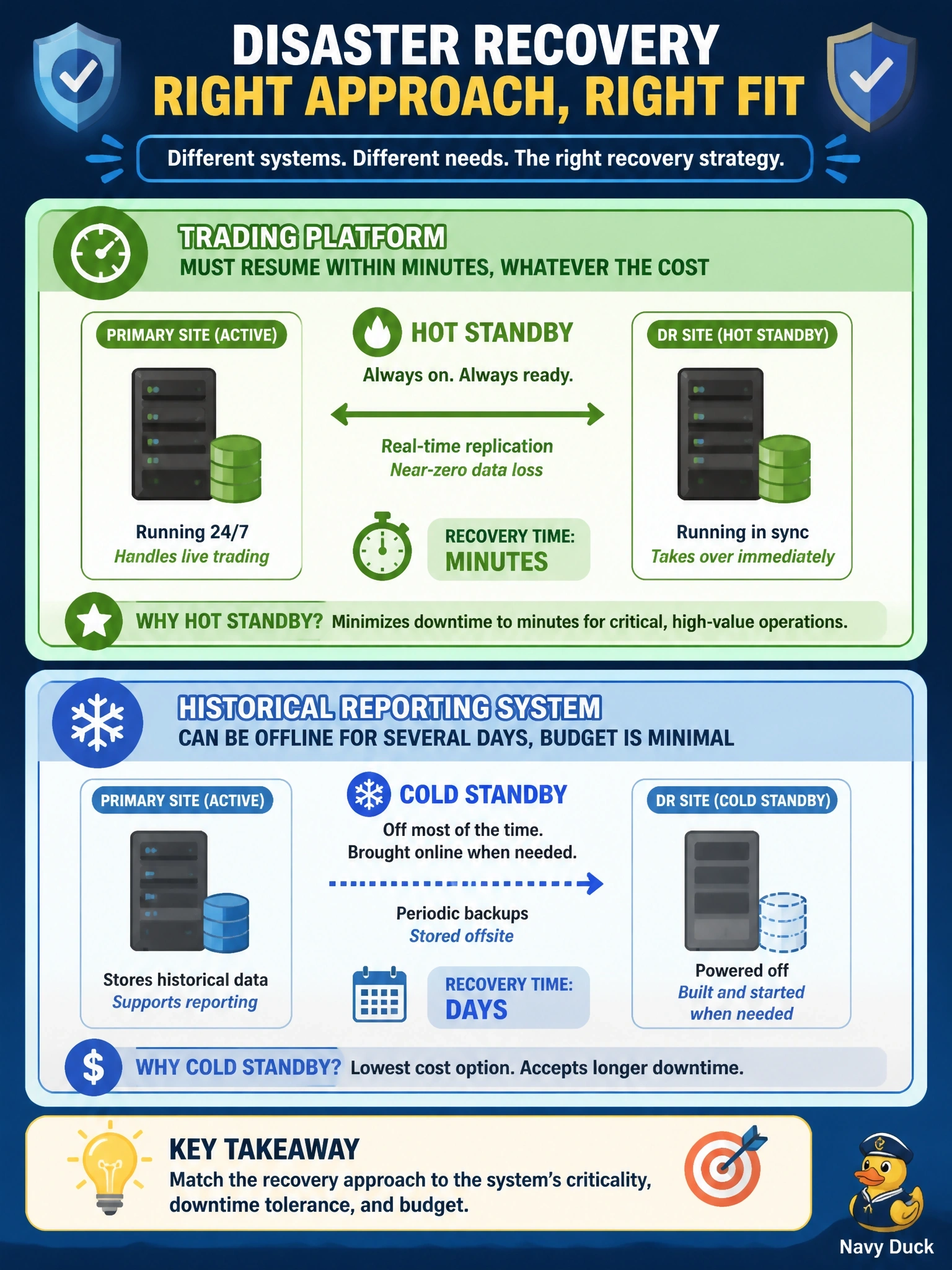
Disaster recovery sites trade cost against recovery time. A hot site or hot standby has running infrastructure with current or near-current data, usually through replication, so service can resume within minutes; it is the most expensive option. A warm standby has infrastructure and some data in place but needs additional restoration or configuration, giving recovery in hours. A cold standby provides space and possibly hardware, but systems must be built and data restored from backups, so recovery takes days, at the lowest cost. The trading platform's minutes-level recovery time objective and willingness to pay call for a hot standby, while the reporting system's multi-day tolerance and minimal budget fit a cold standby. Reversing them leaves the critical platform down for days and spends money protecting a system that can wait. A warm standby for both fails the trading platform's requirement of minutes and overspends on the reporting system. A hot standby for both meets the trading requirement but pays premium costs for a system whose recovery time objective does not justify them, contradicting the minimal budget. Exam caveat: the recovery time objective drives the choice, and cost is the constraint that keeps every system from being hot. Operational check: test each standby and confirm the measured recovery time fits that system's objective.