
A company's database disaster recovery plan has not been exercised in two years, and several staff named in it have changed roles. Management wants a first test that checks whether the plan's steps, contacts, and assumptions are still valid without any risk to production systems. Which test fits?
Select an answer to reveal the explanation.
Short Explanation
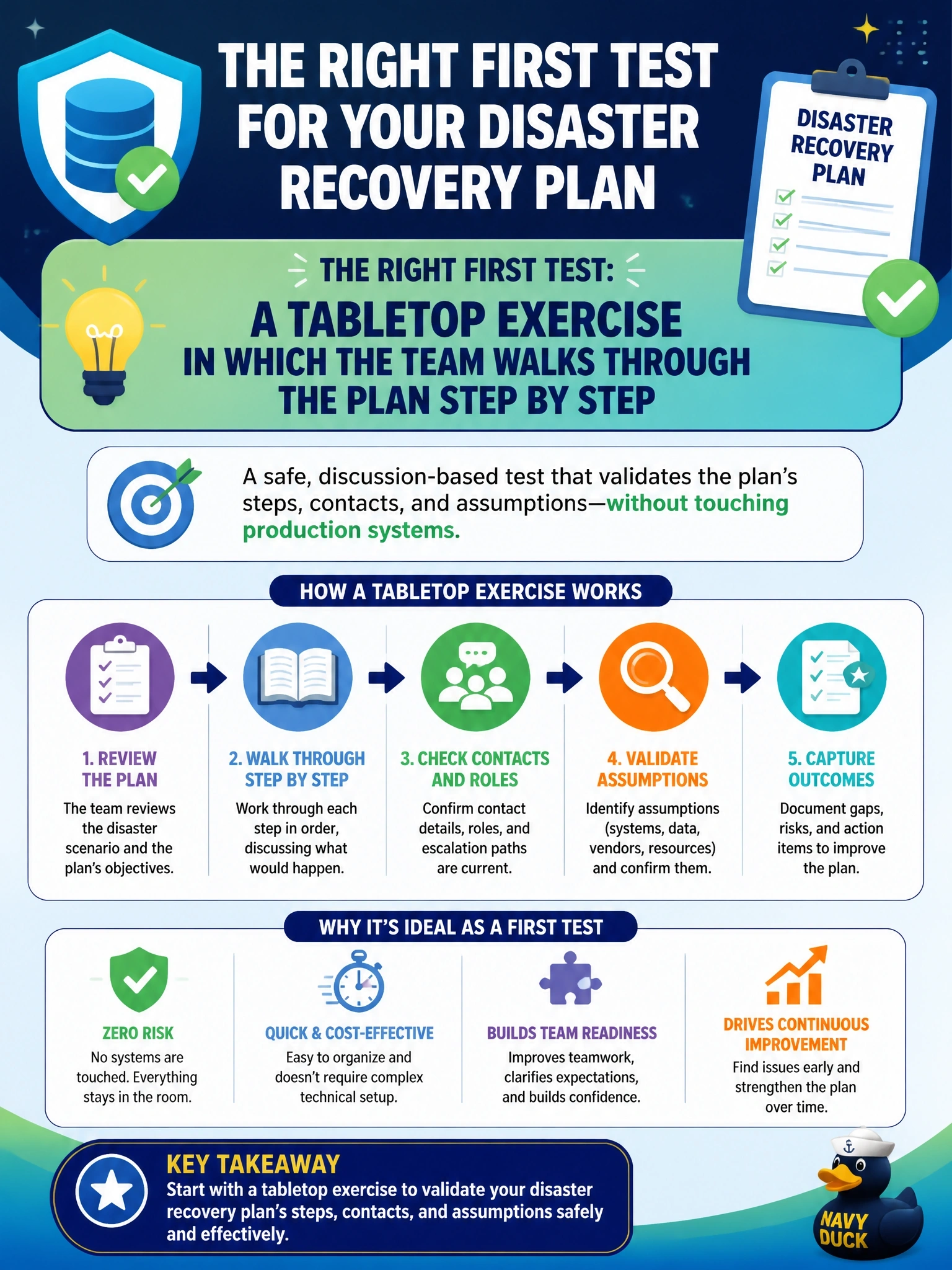
A tabletop is a dress rehearsal around a conference table: everybody talks through their part, and you find the gaps before anything's on fire. It's the safe first step when a plan's gone stale. Pulling the plug on production is the final exam, not the warm-up.
Full Explanation
DR plan testing ranges from discussion-based exercises to full operational tests, and the appropriate starting point depends on the plan's maturity and the risk the organization can accept. A tabletop exercise gathers the people named in the plan to walk through a scenario step by step, confirming roles, contact details, decision points, dependencies and assumptions without touching any system. For a plan untested for two years with staff changes, it exposes outdated contacts and missing steps at no risk to production, and its findings are fixed before more invasive tests. A full interruption test shuts down the primary and proves the DR site can carry production, which is the most realistic test but carries the highest risk and is inappropriate before the plan itself is validated. An unannounced failover during peak hours combines production risk with maximum business impact, violating the stated constraint. Restoring one random backup tests a single backup, which is worthwhile, but it does not exercise the plan's sequence, communications or roles, so marking the plan tested would be misleading. Exam caveat: tests usually progress from tabletop to simulation or parallel tests to full interruption as confidence grows. Operational check: record each gap found in the tabletop, assign an owner and date, and schedule the next, more realistic test.