
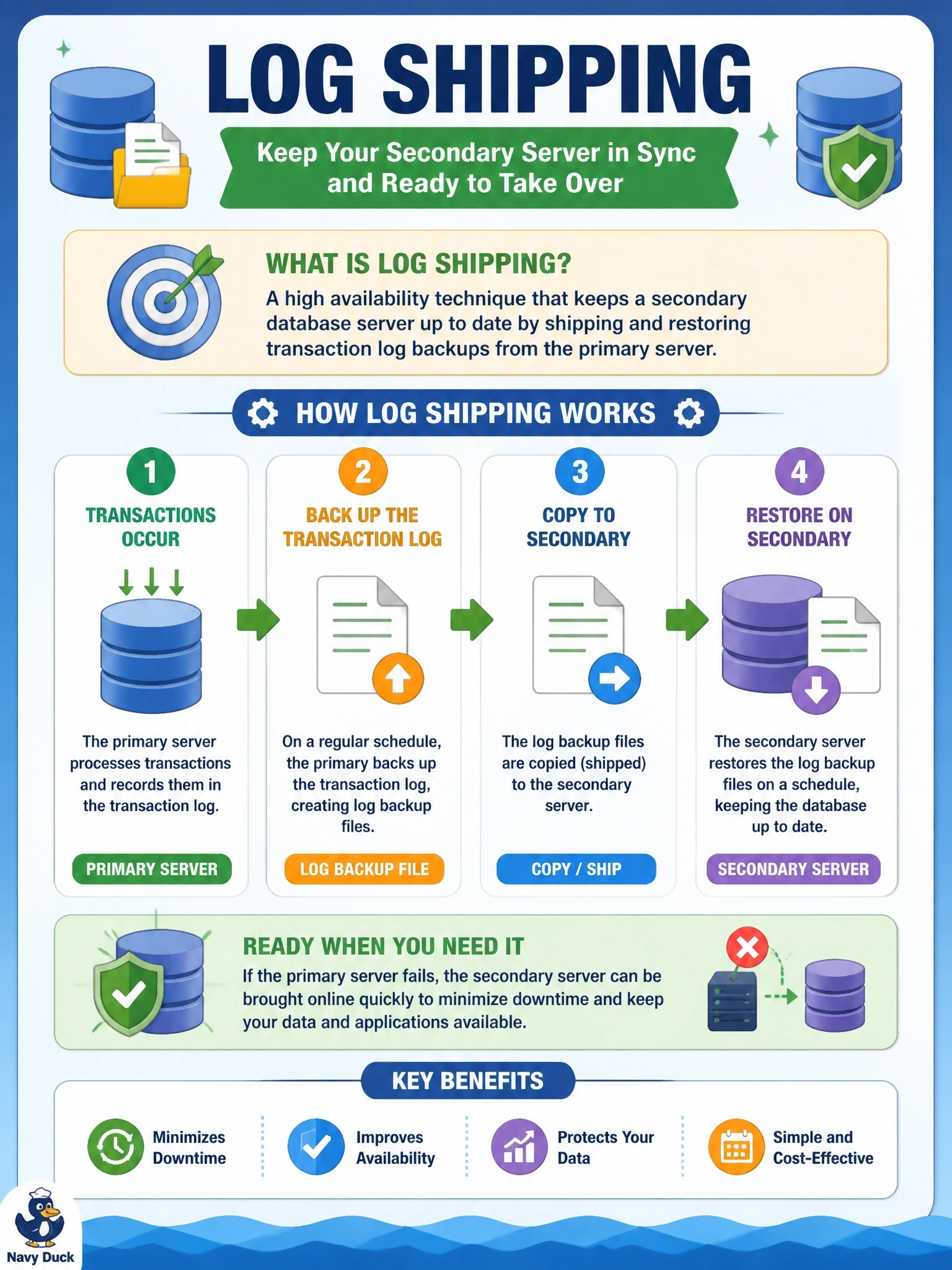
A secondary database server is kept up to date by regularly backing up the primary's transaction log, copying each log backup file to the secondary, and restoring it there on a schedule. The secondary can be brought online if the primary fails. Which technique is this?
Select an answer to reveal the explanation.
Short Explanation
Log shipping is literally what it sounds like: you back up the log, ship the box to the secondary, and unpack it there on a schedule. It's simple and reliable, but the secondary is always a little behind. Mirroring, by contrast, sends every change as it commits.
Full Explanation
Log shipping maintains a warm standby by automating three steps: backing up the primary's transaction log on a schedule, copying the log backup files to one or more secondary servers, and restoring them there in sequence. The secondary stays close to the primary, behind by roughly the backup, copy and restore intervals, and can be recovered and brought online if the primary fails, usually with a manual failover and client redirection. Synchronous mirroring transmits changes as transactions commit and typically requires the mirror to harden the change before the commit completes, which keeps the copies identical rather than lagging behind by scheduled log restores. Storage snapshots capture volume states at points in time on the storage layer; they do not involve backing up and restoring transaction logs on a second server. A multizone region deployment spreads database instances across separate zones within a region for fault tolerance, an architectural placement decision rather than a log backup and restore process. Exam caveat: log shipping is a disaster recovery technique with some data-loss exposure, not a zero-loss high availability solution. Operational check: monitor the time since the last log backup, copy and restore on the secondary, and alert when any of them exceeds the agreed threshold.