
A DBA must move one schema, including its tables, indexes, views, and data, from a production server to a newer major version of the same database product on a different operating system. The copy must be portable and loadable with standard client tools. Which method fits best?
Select an answer to reveal the explanation.
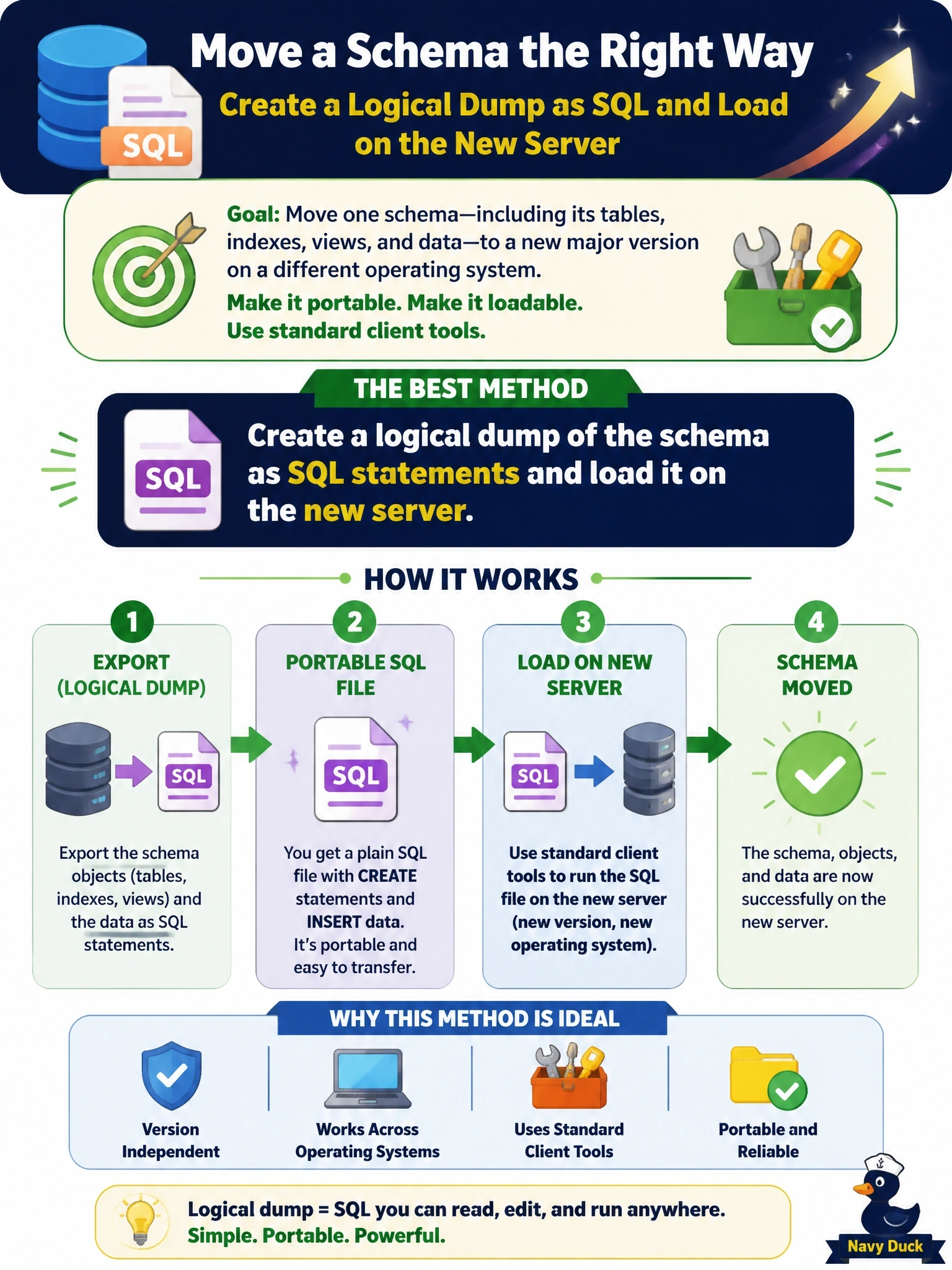
Short Explanation
A logical dump is the recipe, not the cake: it writes out the CREATE and INSERT statements so any compatible server can bake it fresh. Physical files and snapshots are the cake itself, tied to the version and platform that made them. When you're crossing versions or operating systems, you want the recipe.
Full Explanation
Database dumping produces a logical backup: a file of statements, or a portable archive, that recreates objects and data, typically DDL for tables, indexes and views followed by data loads. Because it describes the database logically rather than copying on-disk structures, a dump can be loaded with standard client tools on another server, often a newer version or a different operating system, and it can be limited to a single schema. Copying physical data files ties the copy to the storage format, page layout and often the exact version and platform of the source; attaching files from one version and operating system to another is frequently unsupported, and copying files from a running server risks inconsistency. A storage snapshot captures the volume at the block level, so it inherits the same version and platform dependence and includes every database on the volume, not one schema. Block-level storage replication mirrors disks continuously, which again carries physical structures and is designed for availability rather than migration to a different version. Exam caveat: logical dumps are portable and selective, but large ones can be slow to load because indexes and constraints must be rebuilt. Operational check: load the dump on a test instance of the new version, compare object and row counts, and review any errors before production.