
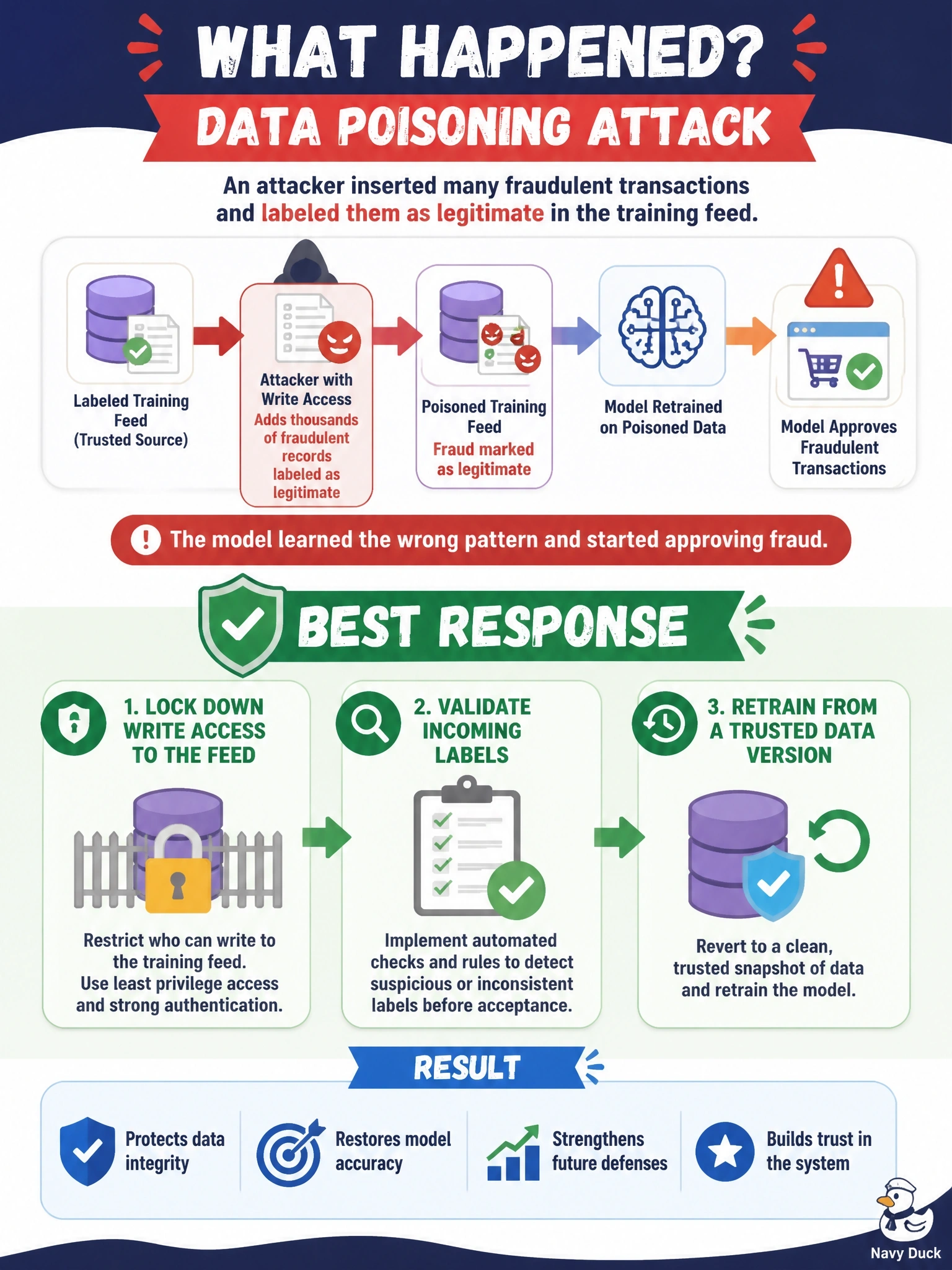
A fraud-detection model starts approving obviously fraudulent transactions. Investigators find that an attacker with write access to the labeled training feed inserted thousands of fraudulent records marked as legitimate before the last retraining. What is this attack, and what response best addresses it?
Select an answer to reveal the explanation.
Short Explanation
If someone sneaks bad ingredients into your pantry, every meal after that tastes wrong, even though the recipe is fine. That's data poisoning: the attacker corrupted what the model learns from. You lock the pantry, check what comes in, and cook again from a clean batch.
Full Explanation
Data poisoning is an attack on the integrity of training data. By inserting or altering records, here fraudulent transactions labeled as legitimate, an attacker teaches the model a behaviour that serves the attacker once the model is retrained. The response targets the data pipeline: restrict and audit write access to training sources so only authorized processes can add data, validate provenance and label distributions before training so unusual shifts are caught, and retrain from a known-good, versioned snapshot of the data after removing the poisoned records. Model hallucination describes generative models producing fabricated content; adjusting prompts or sampling settings does not apply to a classifier trained on corrupted labels and would not remove the poisoned records. SQL injection manipulates query structure through unsanitized input; the attacker here had legitimate write access and inserted well-formed rows, so parameterizing load queries would not have stopped it. Overfitting is a model fitting noise in its training data and generalizing poorly; more epochs typically make overfitting worse, and the root cause here is malicious data rather than training configuration. Exam caveat: on DataSys+, data poisoning sits under preventing attacks because it is a database and pipeline integrity issue. Operational check: confirm who can write to the feed and compare label distributions between training runs.