
A company's database access policy states that any connection originating from the internal corporate network is trusted and may reach any database, while external connections must use a VPN. A security review recommends adopting a Zero Trust architecture. Which change reflects that model?
Select an answer to reveal the explanation.
Short Explanation
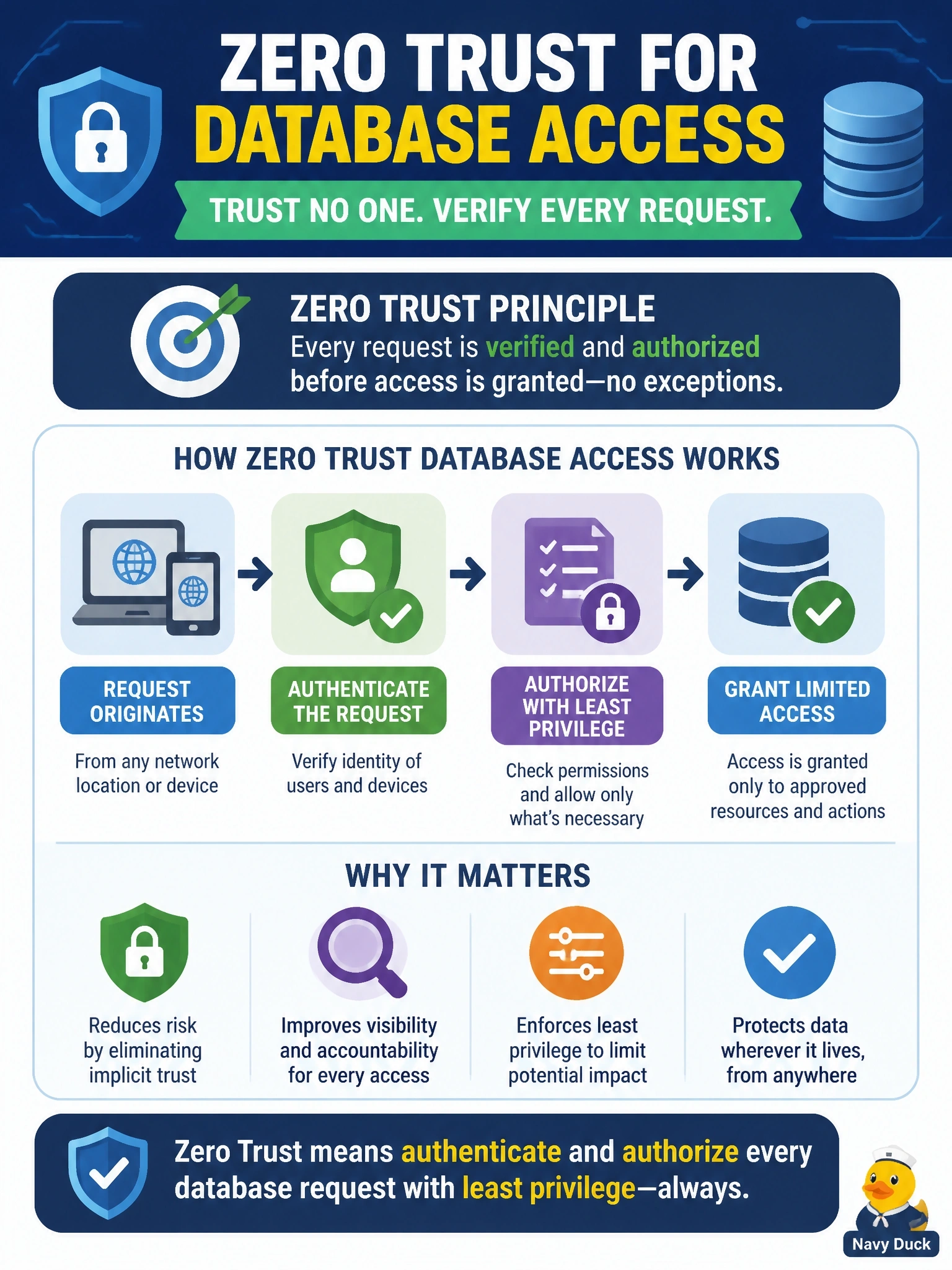
Zero Trust is the 'never trust, always verify' rule: being inside the building doesn't get you into every room. Every request gets checked for who you are, what you're allowed, and whether it makes sense right now. Any answer that still says 'trusted because it's internal' is the trap.
Full Explanation
Zero Trust architecture removes implicit trust based on network location. Every access request is authenticated, authorized against policy and evaluated in context, such as identity, device posture and the specific resource, and each identity receives only the least privilege needed. Applied to databases, an internal workstation is treated the same as an external one: it must prove identity, and its access is limited to the specific databases and actions required, with continuous monitoring. Strengthening the perimeter firewall and VPN reinforces the castle-and-moat model the review is replacing, because anything inside the perimeter is still trusted once it gets there. An IP allowlist of internal subnets is the current policy restated as configuration; it grants trust by location, so a compromised internal host still reaches every database. Moving databases to an isolated segment while trusting any host that reaches it is segmentation, which is useful, but the implicit trust inside the segment is exactly what Zero Trust eliminates. Exam caveat: Zero Trust is about verifying identity and context per request, not about choosing a better boundary. Operational check: confirm that a connection from an internal host without valid credentials or authorization for a specific database is denied and logged.