
A company is placing a three-tier application into a network with an internet-facing perimeter network (DMZ) and an internal network. The tiers are public web servers, application servers, and a database holding customer records. Which placement follows recommended practice for the database?
Select an answer to reveal the explanation.
Short Explanation
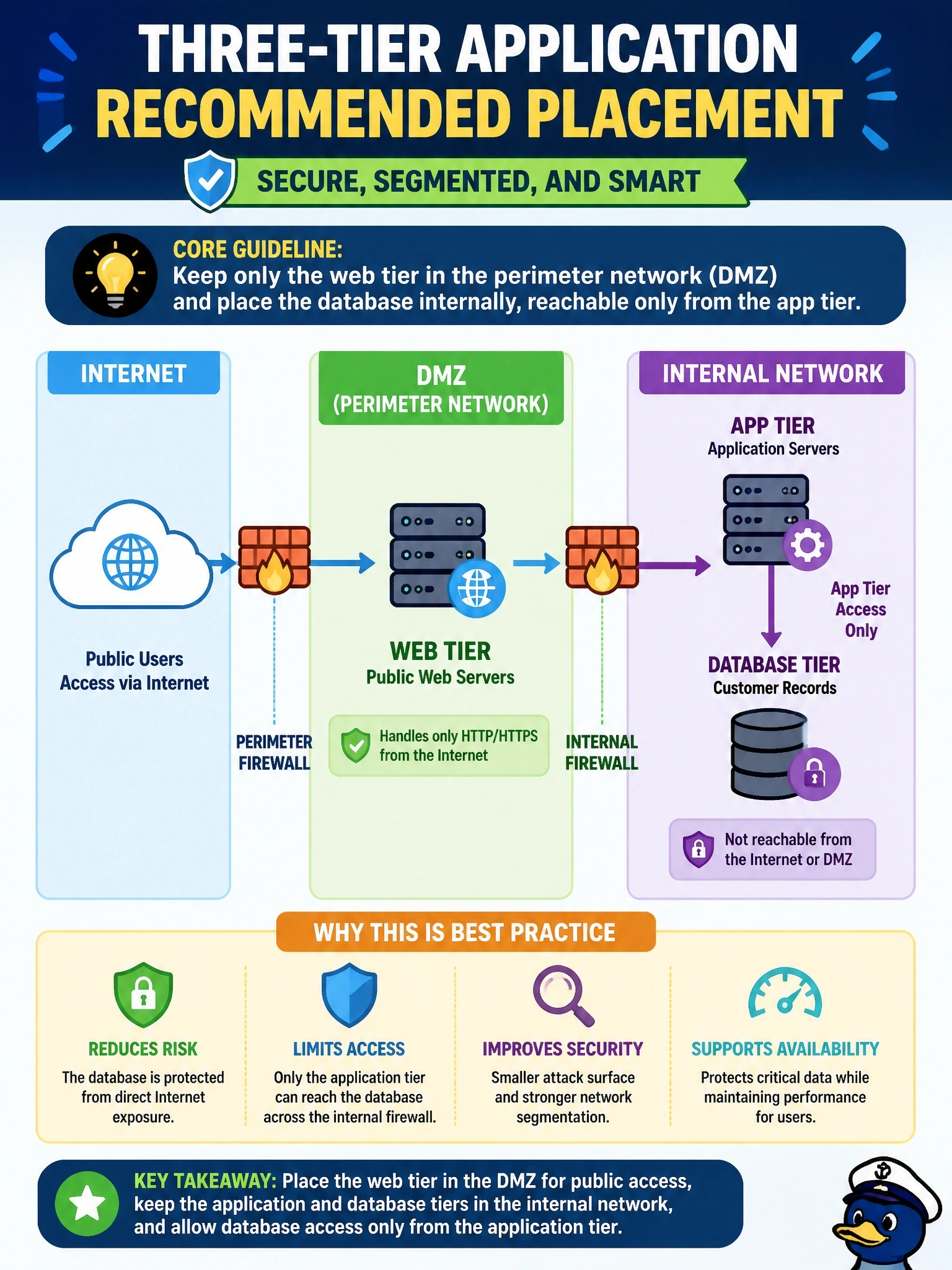
The DMZ is the lobby of the building: visitors are allowed in, so you don't keep the vault there. Only the internet-facing web tier lives in the lobby; the database sits deep inside and talks only to the app tier. Encrypting the vault while leaving it in the lobby still misses the point.
Full Explanation
A perimeter network, often called a DMZ, is a segment that hosts systems that must accept connections from untrusted networks, isolated from the internal network by firewalls. Because those hosts are the most exposed, sensitive data stores belong on the internal side. The recommended layout puts the public web servers in the perimeter network, the application tier behind a second boundary, and the database on an internal segment that accepts connections only from the application servers. A compromise of a web server then gives the attacker no direct path to the database. Placing the database beside the web servers to save firewall hops trades security for a negligible latency gain and exposes the data store to whatever compromises the most-attacked tier. Putting all three tiers in the perimeter network collapses the segmentation entirely, so one breach reaches everything. Leaving the database in the perimeter network with encryption at rest protects stored files from offline theft, but a running database decrypts data for any authenticated session, so network exposure remains the real risk. Exam caveat: the DMZ is for systems that must face untrusted traffic, which a database does not. Operational check: review firewall rules to confirm the database segment accepts connections only from the application tier's addresses.