
A public health report summarizes cases by town and age group. Some cells show counts of one or two people, which could reveal who has the condition in small towns. Which technique should be applied to those cells before publication?
Select an answer to reveal the explanation.
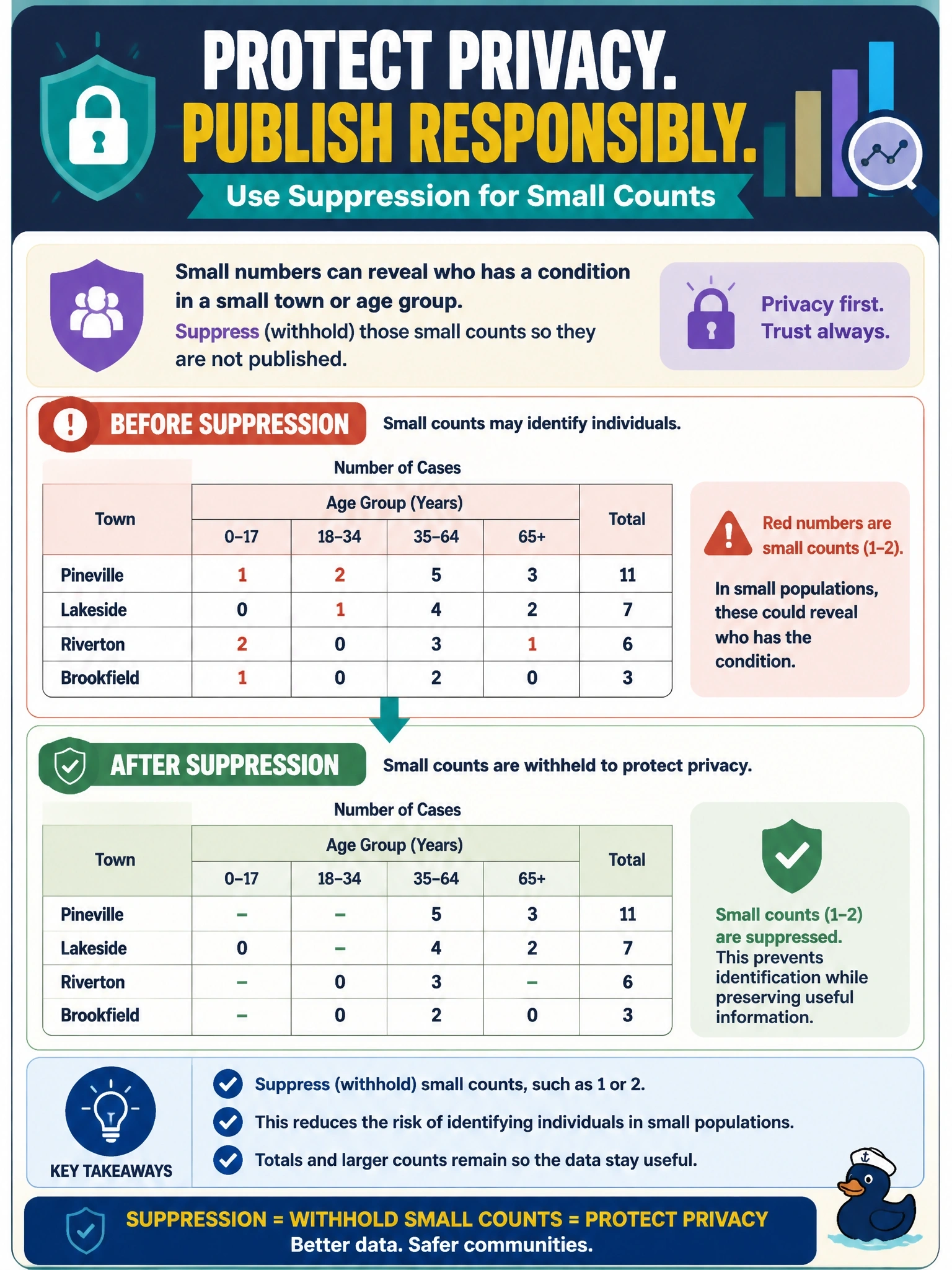
Short Explanation
When a number is small enough to point at a specific neighbor, the safest move is to leave that cell blank. That's suppression, and you'll see it in published statistics all the time. Masking with a made-up number is the trap; you'd be publishing false data instead of protecting it.
Full Explanation
Suppression protects privacy by withholding values that could identify individuals, typically by blanking or marking cells in aggregated output whose counts fall below a threshold set by policy. In a published report, small counts in narrow categories such as a small town and a specific age group can reveal who has a condition, so those cells are suppressed, and sometimes complementary cells are suppressed too, so the hidden values cannot be derived from row or column totals. Masking with substitute numbers in the same format would publish fabricated counts, misleading readers and undermining the report's integrity. Encrypting cells is unsuitable for a public report, and anyone given the key would see the identifying counts anyway. Pseudonymizing town names does little when readers can infer the locality from other context, and the agency retains a mapping that reverses it. Exam caveat: suppression thresholds come from the organization's or regulator's policy, not from a universal number, and suppression must consider totals and other published tables that could be used to back-calculate the hidden values. Operational check: run the report generation with the suppression rule, verify no published cell falls below the policy threshold, and confirm the hidden counts cannot be derived by subtracting visible values from totals.