
Every month-end, transaction volume on a finance database roughly triples for three days, and response times degrade badly during that period. For the rest of the month, performance is fine. What should the DBA do?
Select an answer to reveal the explanation.
Short Explanation
A restaurant that's slammed every Friday night doesn't staff for a Tuesday; it plans for Friday. You use your transaction history to see the month-end rush coming and get ready for it. Restarting before the rush just throws away a warm kitchen right when you need it.
Full Explanation
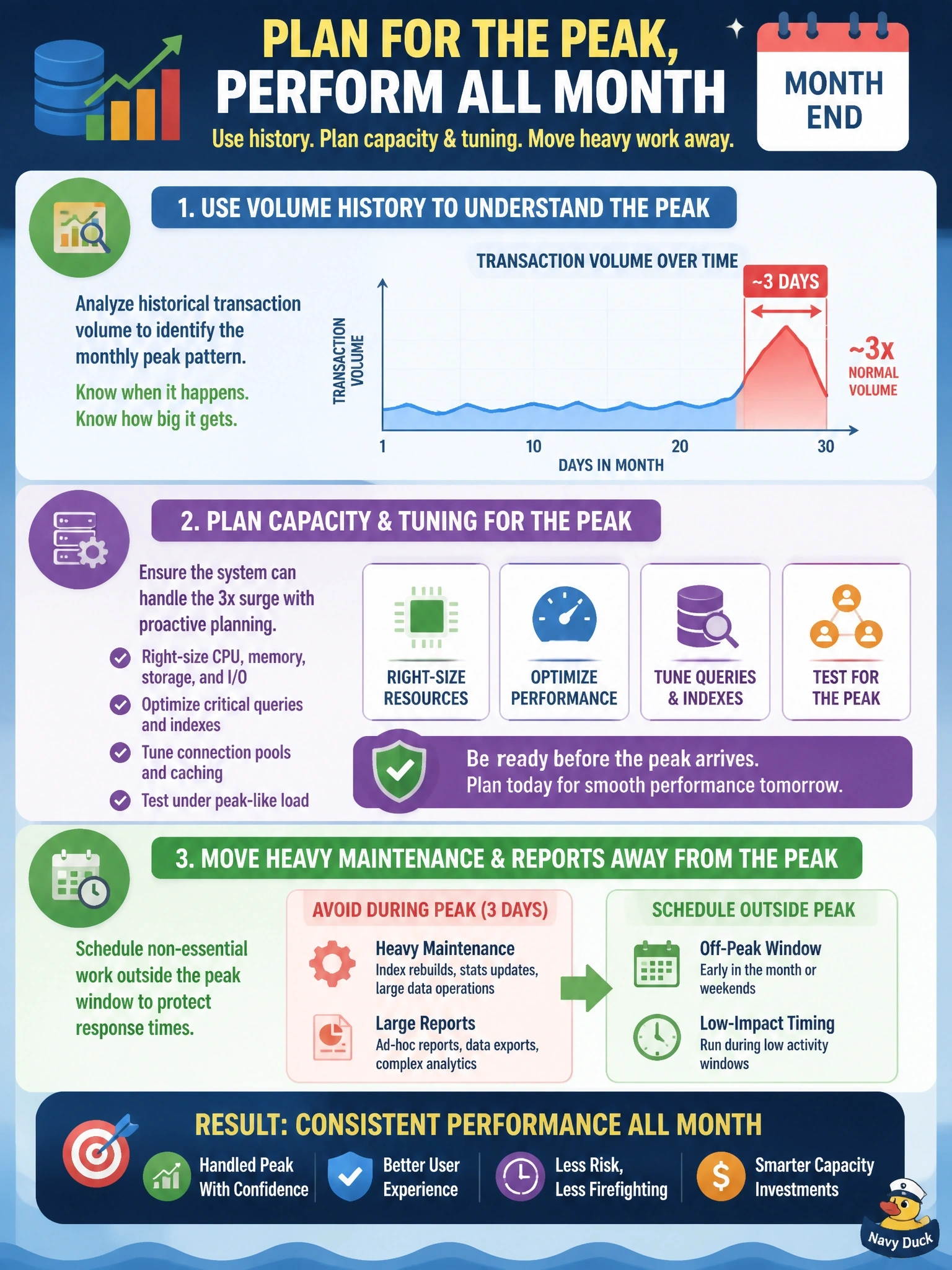
Transaction volume is a performance-tuning input because predictable peaks determine the capacity and configuration a system actually needs. Historical volume data shows the size, timing and duration of month-end peaks, so the DBA can project resources for the peak rather than the average, tune the queries that dominate during those days, schedule index maintenance, integrity checks and heavy reports outside the peak window, and, where the platform allows, scale compute temporarily. Sizing for the average ensures the system is undersized precisely when the business depends on it most; the average hides the peak by definition. Restarting the service before the peak empties the buffer cache and plan cache, so the busiest period begins with cold caches, more disk reads and recompilation, which makes performance worse at the moment it matters. Disabling transaction logging is not a safe or generally available option for a relational database, because the log underpins atomicity, durability and recovery; a financial system in particular cannot sacrifice recoverability to gain speed. Exam caveat: transaction volume trends also feed resource projection and capacity planning in database planning, linking maintenance tuning to deployment decisions. Operational check: chart transactions per second across several month-ends, identify the top queries during peaks, move conflicting jobs, apply tuning in non-production, and compare the next month-end's response times with the previous one.