
A DBA does two kinds of work: one-off exploratory queries while investigating a slow report, and a nightly production export that must run unattended. Which pairing of environments fits best?
Select an answer to reveal the explanation.
Short Explanation
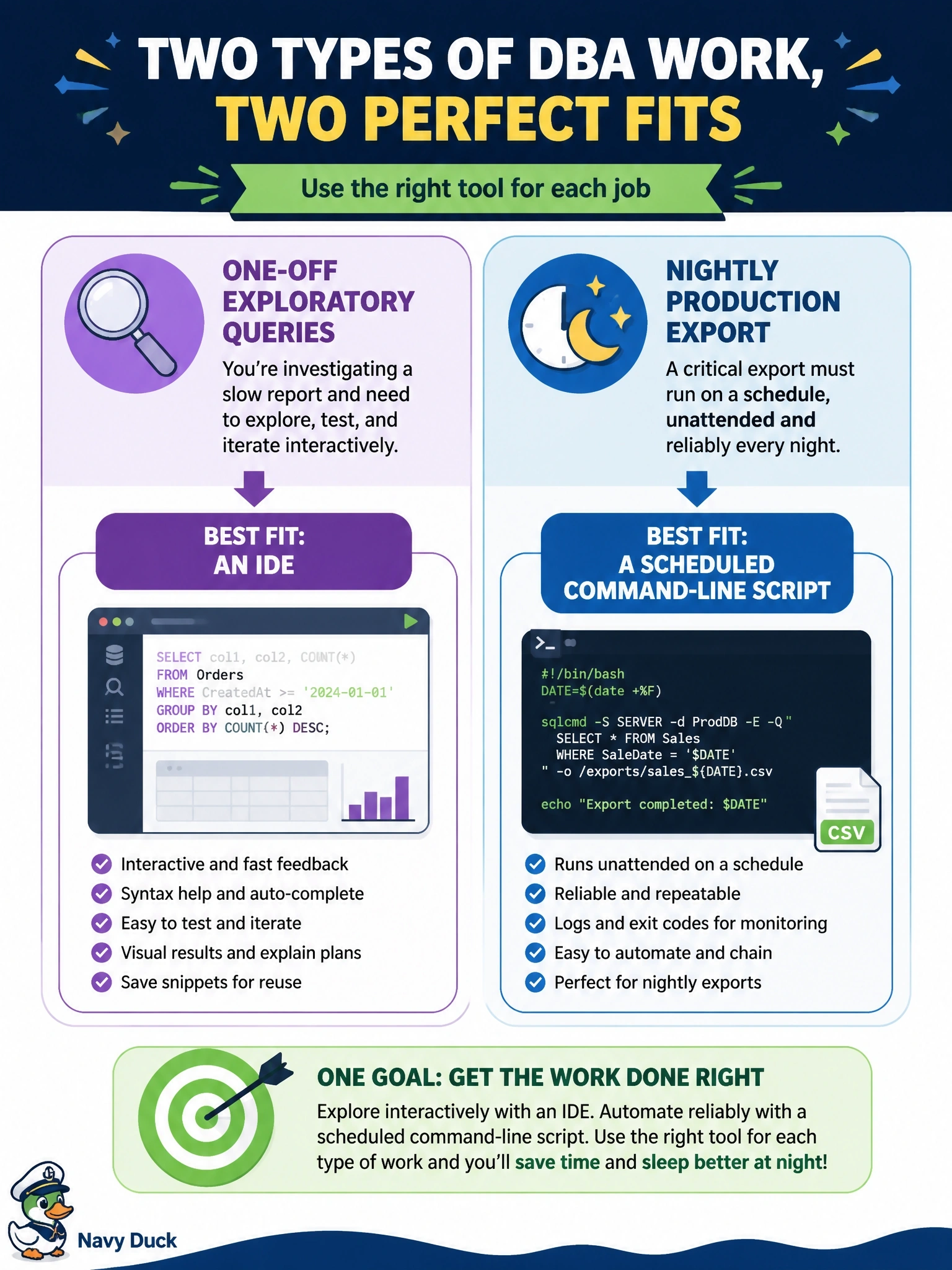
Use the IDE when you're thinking and the command line when you're repeating. Exploring a slow report means trying things and looking at plans, which is IDE work. The nightly export has to run without you, which is a scheduled script's job.
Full Explanation
Interactive and automated work have different needs. Exploratory investigation benefits from an integrated development environment: the DBA can edit queries quickly, see results in grids, inspect execution plans and iterate until the cause of the slow report is clear. A nightly production export needs the opposite qualities: it must be repeatable, run without a person present, use a service identity, log its outcome and raise alerts on failure, which a command-line script launched by a scheduler provides. Reversing the pairing gives the exploratory work a tool that cannot be used interactively and puts the production export in a tool that depends on a person opening it. Leaving an IDE session open overnight makes the export depend on a workstation staying on and logged in, offers no scheduling or alerting and leaves an unattended authenticated session. Running exploratory queries from cron defeats the purpose of exploration, because each change would wait for the next scheduled run and there is no interactive feedback. Exam caveat: queries developed in an IDE often become the body of a later automated script, so the two environments complement each other rather than compete. Operational check: confirm the export script runs successfully when launched manually from the command line under its service account, then verify its first scheduled run appears in the job history with a success status.