
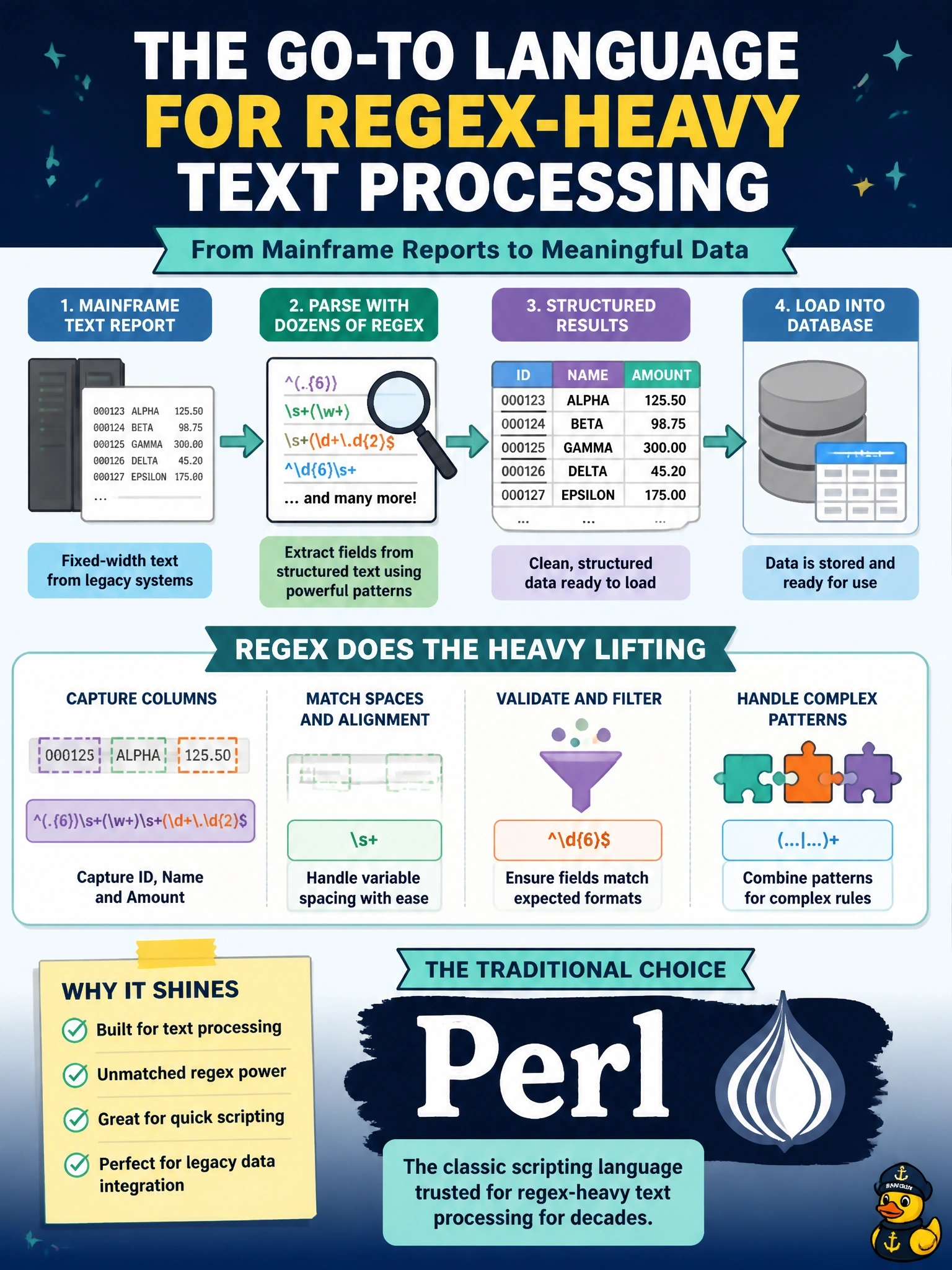
A legacy job parses fixed-width mainframe text reports using dozens of complex regular expressions before loading the results into a database. Which scripting language is traditionally associated with this kind of regex-heavy text processing?
Select an answer to reveal the explanation.
Short Explanation
Perl grew up as a text-report cruncher, and regular expressions are baked right into the language. If you inherit an old job full of pattern matching over report files, odds are good you're looking at Perl. The trap is SQL, which is great once the data's in tables, not while it's still raw text.
Full Explanation
Perl was designed for extracting information from text files and producing reports, and regular expressions are a first-class part of its syntax rather than an add-on library. That made it the traditional choice for parsing logs, fixed-width reports and other semi-formatted text before loading results into databases, and many legacy data jobs still use it. Its strengths include concise pattern matching, substitution and text transformation across large files. PowerShell can use regular expressions and is a strong Windows automation tool, but it is associated primarily with system administration rather than with the long tradition of text-report processing. SQL is a query language for data already stored in tables; it is not designed to parse raw report files before they are loaded, and pattern support in SQL varies by engine. Windows batch files offer very limited string handling and no native regular expression engine, so they are a poor fit for complex parsing. Exam caveat: modern teams often rewrite such jobs in Python, but the objective lists Perl script as a language, and its association is text processing. Operational check: before modifying or migrating the legacy job, run it against a saved sample report and keep the output as a baseline, then confirm any replacement produces identical rows.