
A support portal converts every knowledge-base article into an embedding and must return the articles whose meaning is closest to a user's question, even when they share no keywords. Which database type is built for this retrieval?
Select an answer to reveal the explanation.
Short Explanation
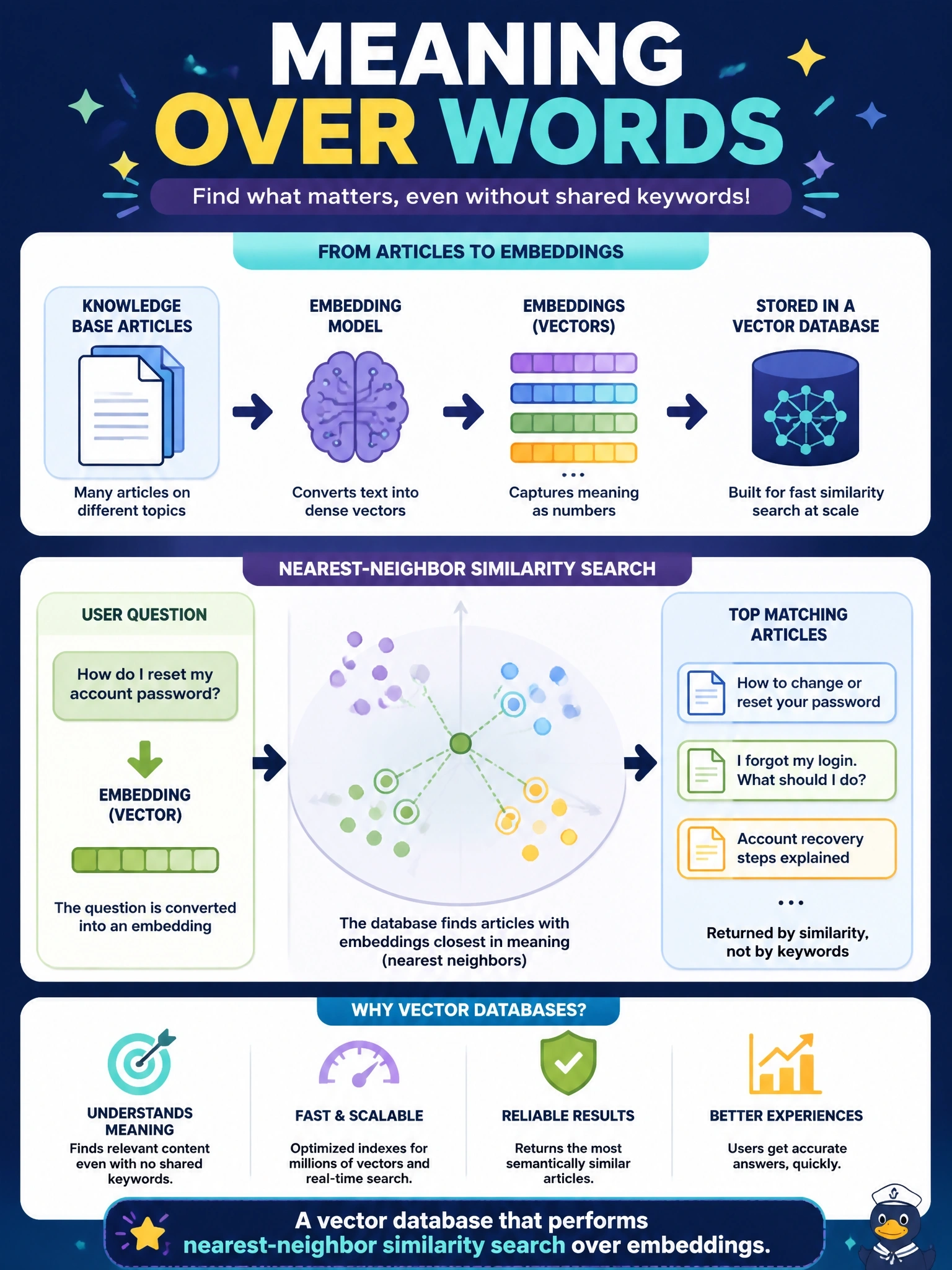
Imagine every article plotted as a dot on a map where similar meanings sit close together. A vector database finds the dots nearest to your question's dot, so matches work even without shared words. The trap is keyword search: it's great until the user phrases things differently from the author.
Full Explanation
A vector database stores high-dimensional numeric vectors, called embeddings, that a model produces from text, images or other content. Items with similar meaning end up close together in that vector space, so retrieval becomes a nearest-neighbor problem: embed the user's question, then find the stored vectors with the smallest distance or highest similarity score. Vector databases provide approximate nearest-neighbor indexes that make this search fast across large collections, which is why they underpin semantic search and retrieval-augmented generation. A full-text keyword index matches tokens, so it fails precisely in the case the stem describes, where the question and the relevant article use different words for the same idea. A key-value store returns a value only when the exact key is known, and the user does not know the article identifier they need. A time-series database orders and aggregates data by timestamp, which says nothing about how semantically close two pieces of text are. Exam caveat: some general-purpose databases now add vector indexes, but the objective treats vector as its own NoSQL type defined by similarity search over embeddings. Operational check: embed a test question that shares no keywords with a known relevant article, run the similarity query, and confirm that article appears among the top results.