
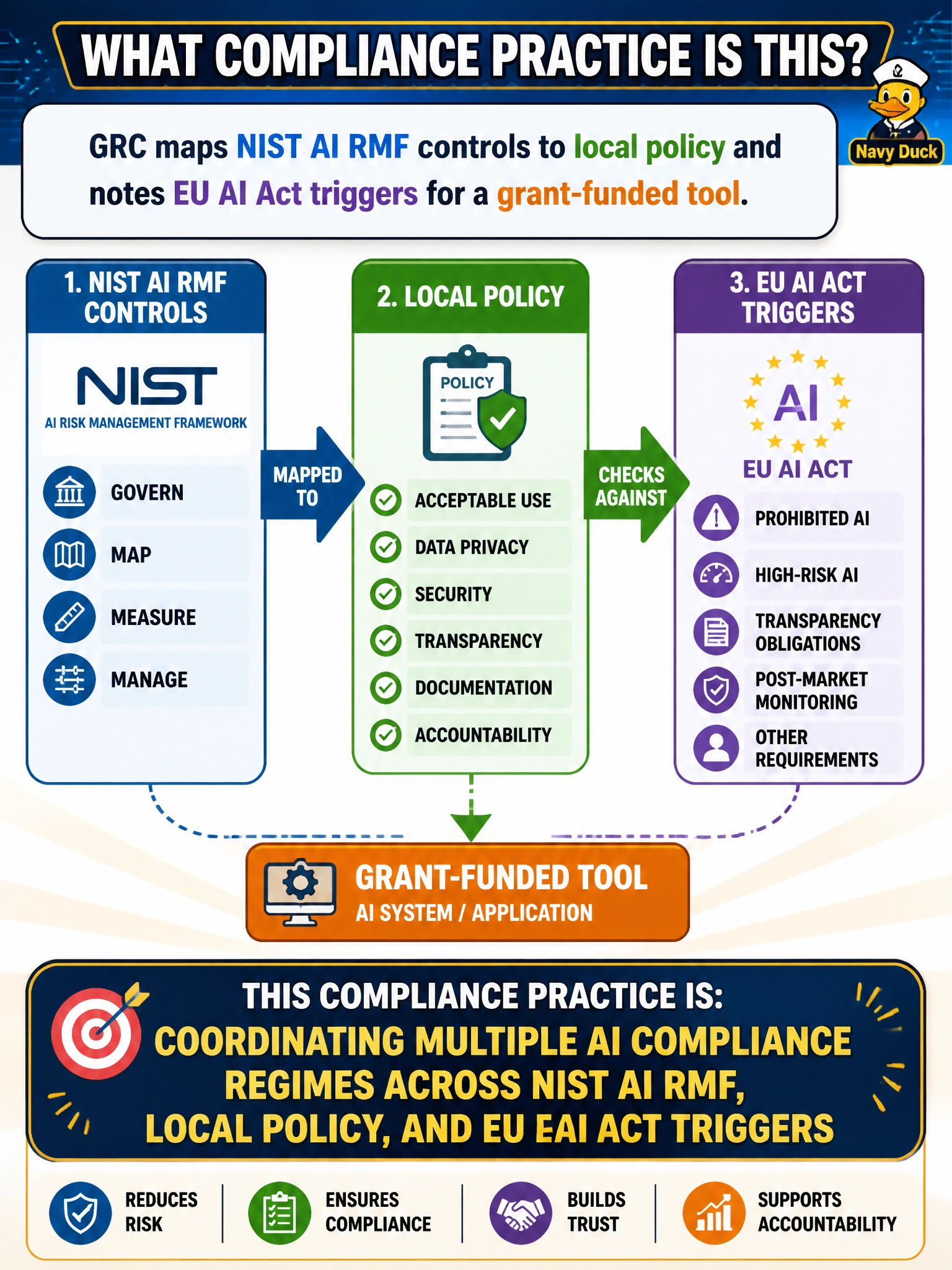
GRC maps NIST AI RMF controls to local policy and notes EU AI Act triggers for a grant-funded tool. Which compliance practice is this?
Select an answer to reveal the explanation.
Short Explanation
Real GRC juggles NIST AI RMF, local policy, and EU AI Act triggers together — especially on grant-funded tools. You can't just map them to procurement vendor reviews, tier them for deployment approval decisions, or consolidate them for grant audit reporting and call that multi-regime compliance.
Full Explanation
Municipal AI programs often must coordinate several regimes—such as NIST AI RMF control mapping, local policy, and EU AI Act triggers—on the same system. Mapping those together for a grant-funded tool is multi-regime compliance practice: consolidating NIST AI RMF evidence, local policy records, and EU AI Act triggers for grant audit reporting does not erase residency, risk, or Act obligations, and GRC's job is to reconcile overlapping requirements into an operable control set. Mapping them only to procurement vendor reviews or tiering them only for deployment approval decisions is not a substitute for that coordination.
Mapping NIST AI RMF controls, local policy rules, and EU AI Act triggers to procurement vendor reviews fails by concept: real programs inherit concurrent duties across NIST, local policy, and the EU AI Act, not just procurement vendor reviews. Tiering NIST AI RMF risks, local policy controls, and EU AI Act triggers for deployment approval decisions fails on scope—limiting the crosswalk to a deployment approval decision does not establish ongoing coordination of NIST, local policy, and Act triggers into an operable control set. Consolidating NIST AI RMF evidence, local policy records, and EU AI Act triggers for grant audit reporting fails differently: grant audit reporting consolidates evidence after the fact and does not reconcile EU AI Act triggers or NIST AI RMF obligations into an operable control set.
Exam caveat: multi-regime coordination means mapping NIST AI RMF, local policy, and applicable EU AI Act triggers together—grant audit reporting does not preempt those duties.
Operational check: maintain a crosswalk of NIST AI RMF controls to local policy and Act triggers for the grant-funded tool, assign owners per regime gap, and refuse production until residual multi-regime risks are accepted.
Prefer to study offline? Printable PDF study book + test engine ($7.50, unofficial). These questions stay free here.