
The AI CoE green-lights a pilot only after fairness, privacy, and accountability checks pass. What practice is this?
Select an answer to reveal the explanation.
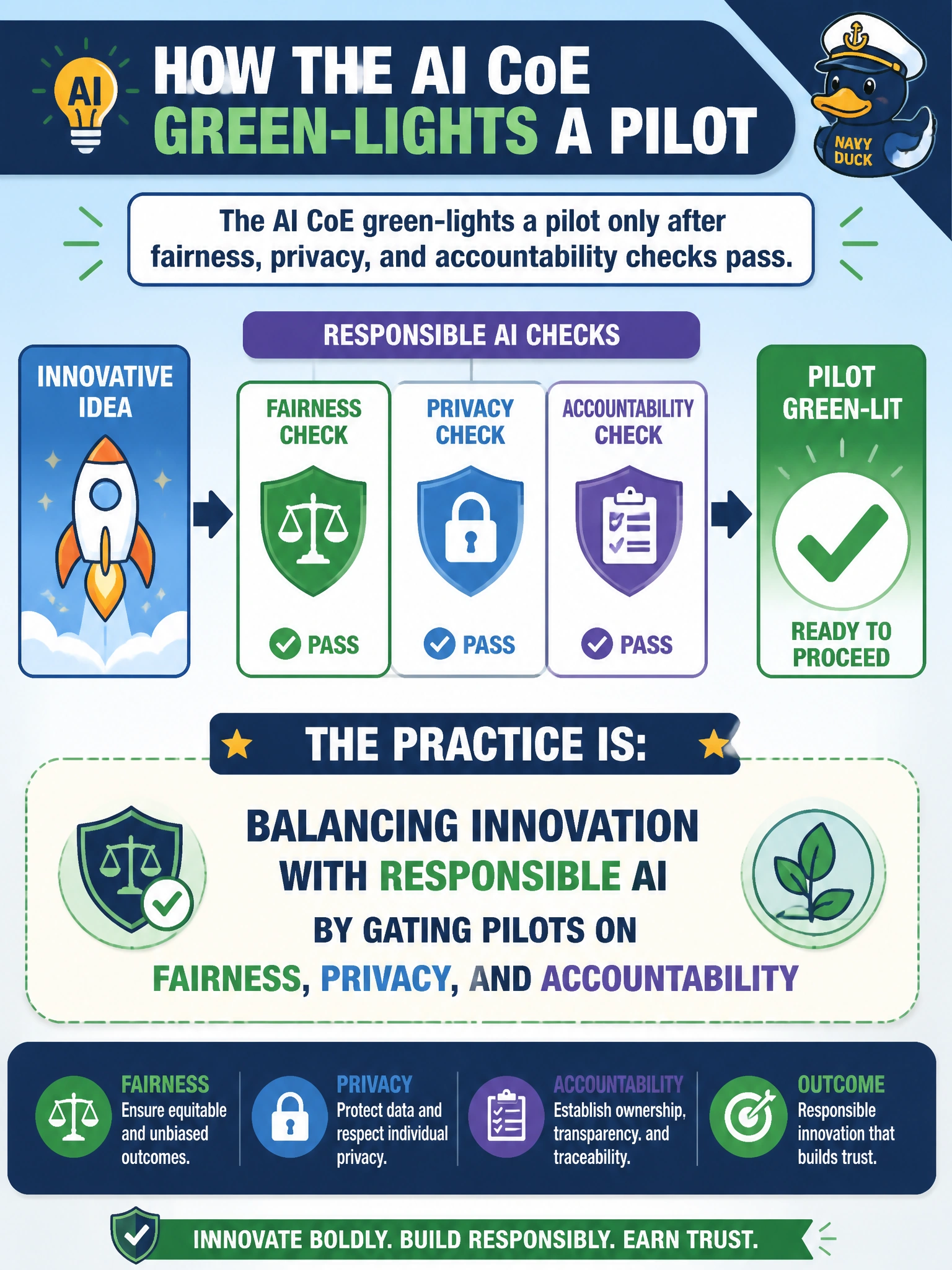
Short Explanation
Cool idea, still wait for fairness, privacy, and accountability — that’s how a CoE balances innovation with responsible AI. You'll still need that gate even if you're strengthening pilot reliability with continuous drift monitoring, documenting pilot transparency with model cards, or preserving audit readiness with prompt logging — they're great hygiene, but they don't show you've passed fairness, privacy, and accountability.
Full Explanation
Balancing innovation with responsible AI means allowing pilots to proceed only when fairness, privacy, and accountability checks pass—gating speed with safeguards rather than choosing one extreme. An AI Center of Excellence that green-lights a municipal pilot only after those checks pass operationalizes that balance: innovation is encouraged, but not at the expense of disparate-impact blindness, data misuse, or ownerless systems. Civic AI CoEs exist to accelerate safe adoption, not to replace that pre-launch gate with preserving audit readiness with centralized prompt logging for fairness, privacy, and accountability.
Strengthening pilot reliability with continuous drift monitoring for fairness, privacy, and accountability fails because it describes post-launch reliability work, not the pre-launch approval gate — drift monitoring watches live performance after the pilot is green-lit, it does not confirm that fairness, privacy, and accountability checks have passed.
Documenting pilot transparency with standardized model cards for fairness, privacy, and accountability fails because it describes transparency documentation, not the gating decision — model cards record key facts for an already-approved use case, they do not constitute passing the fairness, privacy, and accountability checks required to approve it.
Preserving audit readiness with centralized prompt logging for fairness, privacy, and accountability fails differently — centralized prompt logging supports later auditability and traceability, but logging what happens during pilots does not establish that fairness, privacy, and accountability were validated before green-lighting.
Exam caveat: responsible innovation is a balance — do not confuse the pre-launch fairness, privacy, and accountability gate with different safeguards like continuous drift monitoring for pilot reliability, standardized model cards for pilot transparency, or centralized prompt logging for audit readiness, and do not swing to 'never innovate.' Stems that show CoE gates on fairness, privacy, and accountability point to that balanced practice.
Operational check: keep a written pilot checklist covering fairness, privacy, and accountability owners; refuse go-live without CoE sign-off; and record residual risks rather than treating centralized prompt logging for fairness, privacy, and accountability as proof the gate was passed.
Prefer to study offline? Printable PDF study book + test engine ($7.50, unofficial). These questions stay free here.