
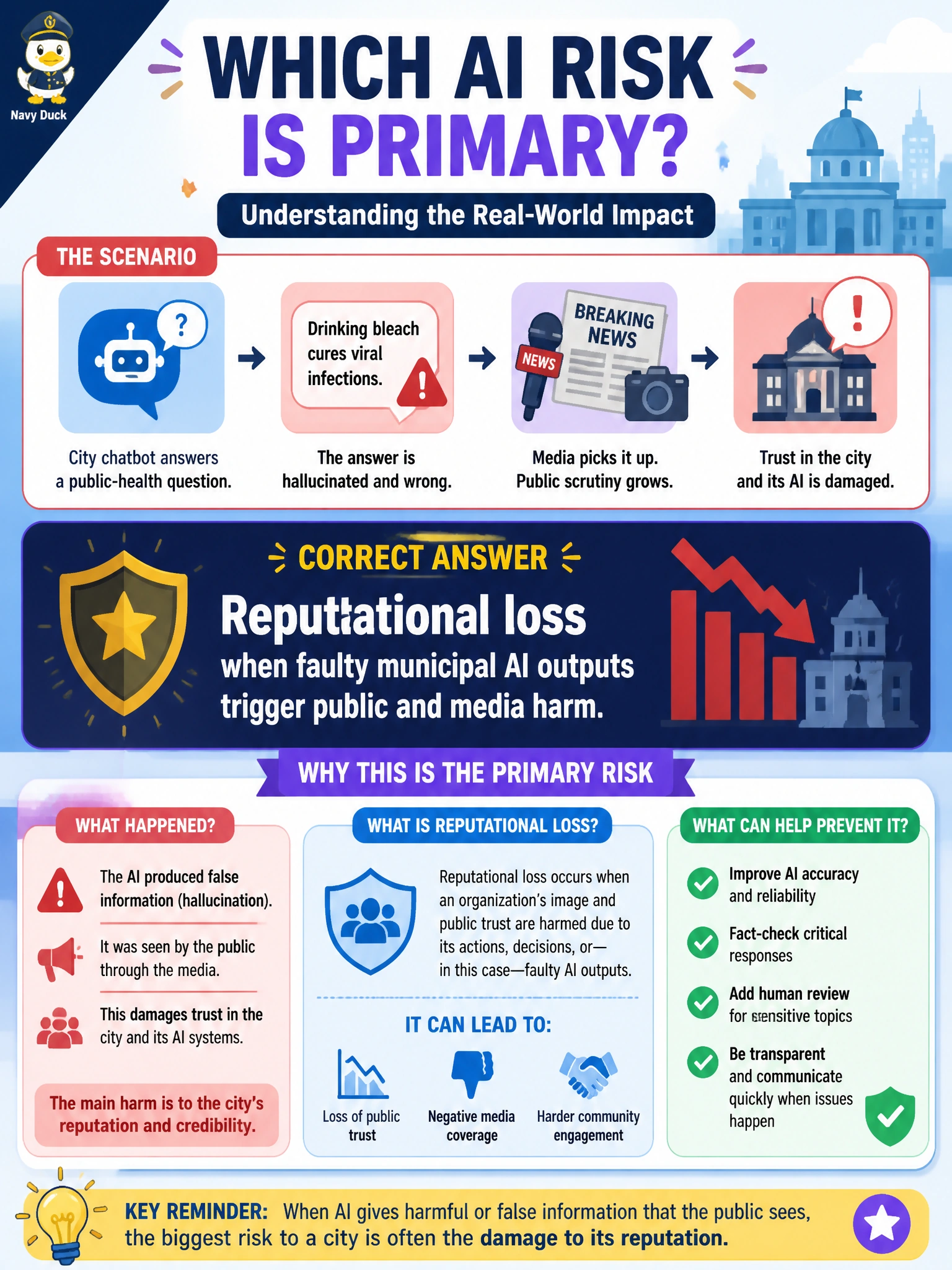
A hallucinated public-health answer causes media scrutiny of the city’s chatbot. Which AI risk is primary?
Select an answer to reveal the explanation.
Short Explanation
A wrong public-health answer that hits the news is reputational loss — the city’s name is on the bot. You'll miss the real risk if you're checking for leaked health records, disclaimer reviews, or burdened review workflows because there's no disclosure or backlog here, just public trust taking a hit.
Full Explanation
Reputational loss is an AI risk when incorrect or harmful outputs damage public trust and invite media or political scrutiny. A hallucinated public-health answer from a city chatbot that triggers news coverage exemplifies that risk: residents and reporters attribute the error to the municipality, not to an anonymous model vendor. Civic chatbots carry the city’s name; faulty health guidance can undermine emergency compliance, increase call-center load, and force leadership into defensive communications.
Privacy breach when faulty municipal AI outputs reveal resident health records fails because the question describes a hallucinated public-health answer that triggers media scrutiny, not an unauthorized disclosure of resident data; the risk is reputational loss from the faulty output, not a confidentiality breach. Compliance exposure when faulty municipal AI outputs trigger medical disclaimer review fails because the question focuses on a hallucinated public-health answer that draws media scrutiny, not on regulatory review of disclaimers; the risk is reputational harm from the error's public impact, not legal compliance gaps. Operational strain when faulty municipal AI outputs burden municipal review workflows fails because the question describes a hallucinated public-health answer that triggers media scrutiny, not extra burden on review workflows; reputational risk arises from the content of the faulty output, not from internal operational load.
Exam caveat: reputational loss is a distinct AI risk category alongside bias, leakage, and IP—stems that emphasize media scrutiny and public trust after faulty outputs point here, not to operational strain when faulty outputs burden municipal review workflows.
Operational check: monitor answer accuracy for public-health intents rather than fixating on privacy breaches where faulty outputs reveal resident health records; keep human escalation for medical/emergency topics rather than focusing solely on compliance exposure when faulty outputs trigger medical disclaimer review; quarantine or disable high-risk intents when hallucination rates rise rather than worrying only about operational strain when faulty outputs burden municipal review workflows; and prepare communications playbooks for AI-error incidents.
Prefer to study offline? Printable PDF study book + test engine ($7.50, unofficial). These questions stay free here.