
Historical policing data risks introducing bias into a municipal deployment-priority model. Which AI risk is primary?
Select an answer to reveal the explanation.
Short Explanation
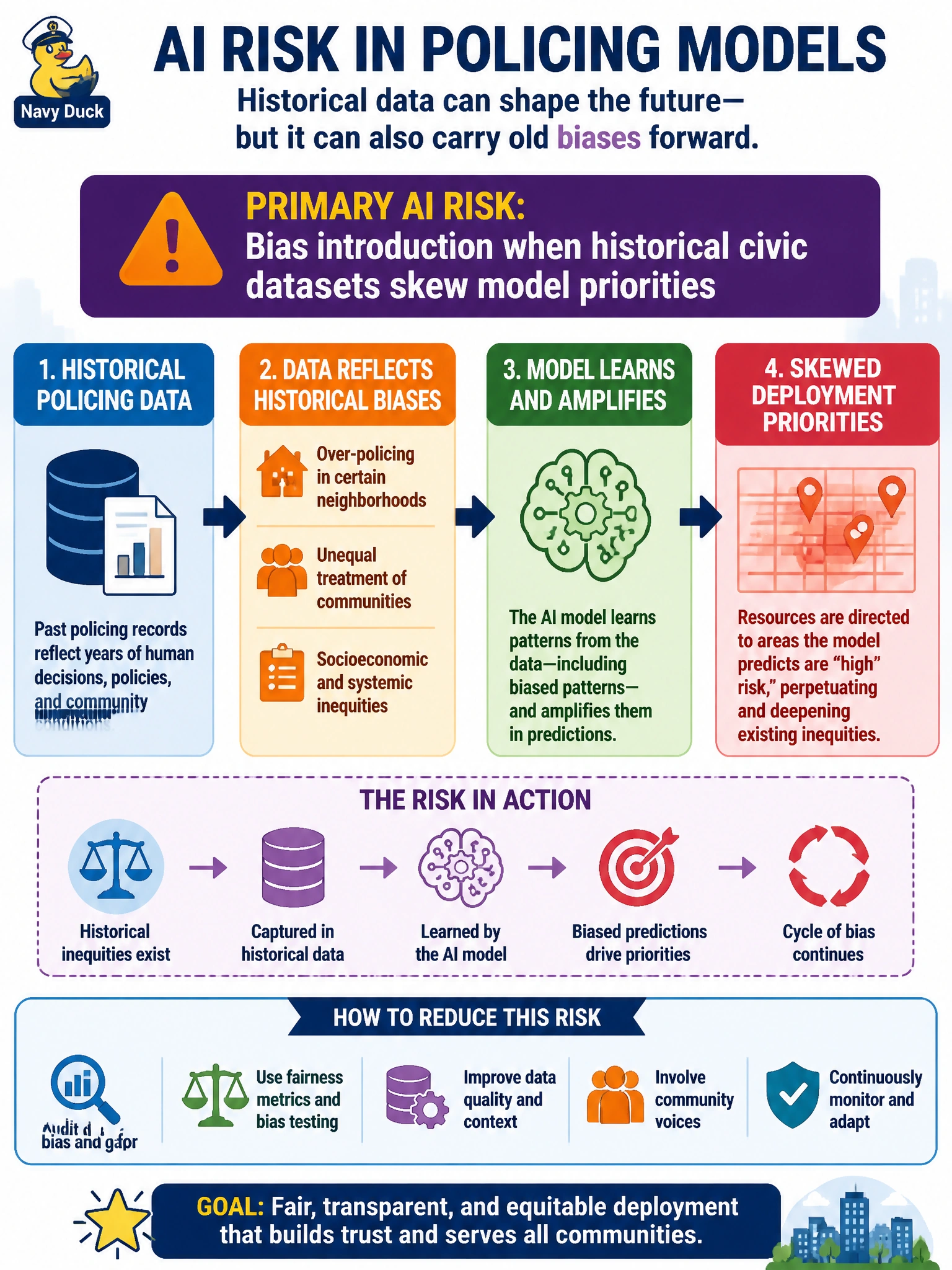
Old policing logs can bake past inequities into your deployment-priority model — that's bias introduction you'll need to catch. You're not looking at historical patrol scores anchoring officer decisions, so it's not automation bias, and you're not tracking how historical bias patterns diverge from current realities, so it's not concept drift. It's also not privacy leakage from historical civic datasets exposing biased traits, it's historical bias skewing your priorities.
Full Explanation
Introduction of bias is an AI risk when training or decision data encode historical inequities that skew outcomes. Using historical policing data in a municipal deployment-priority model surfaces that risk directly: past enforcement intensity, stop patterns, or charging practices can over-weight neighborhoods already heavily policed, turning legacy disparity into automated priority. Civic AI programs must treat historical labels as potentially biased features, evaluate disparate outcomes, and mitigate—not assume neutrality because the data is 'official.'
Automation bias when historical patrol scores unduly anchor officer decisions fails by stage: it describes downstream human deference to system outputs, not the upstream encoding of historical inequities into automated priorities, so it does not address the primary bias risk in this scenario.
Concept drift when historical bias patterns diverge from current realities fails by concept: shifting patterns are a model staleness and accuracy-over-time issue, not skewed priorities inherited from legacy enforcement disparity.
Privacy leakage when historical civic datasets expose biased resident traits fails by risk type: exposure of those traits is a data-protection failure, not the automation of past inequity into deployment priority.
Exam caveat: bias introduction is about skewed outcomes from data and design—not about downstream deference or confidential exposure. Automation bias, concept drift, and privacy leakage are distinct exam risks; only historical inequity skewing priorities signals bias introduction here.
Operational check: run disparate-impact reviews on deployment-priority outputs by geography and relevant groups, document mitigation (reweighting, constraints, human review), and refuse production go-live until fairness owners accept residual risk.
Prefer to study offline? Printable PDF study book + test engine ($7.50, unofficial). These questions stay free here.