
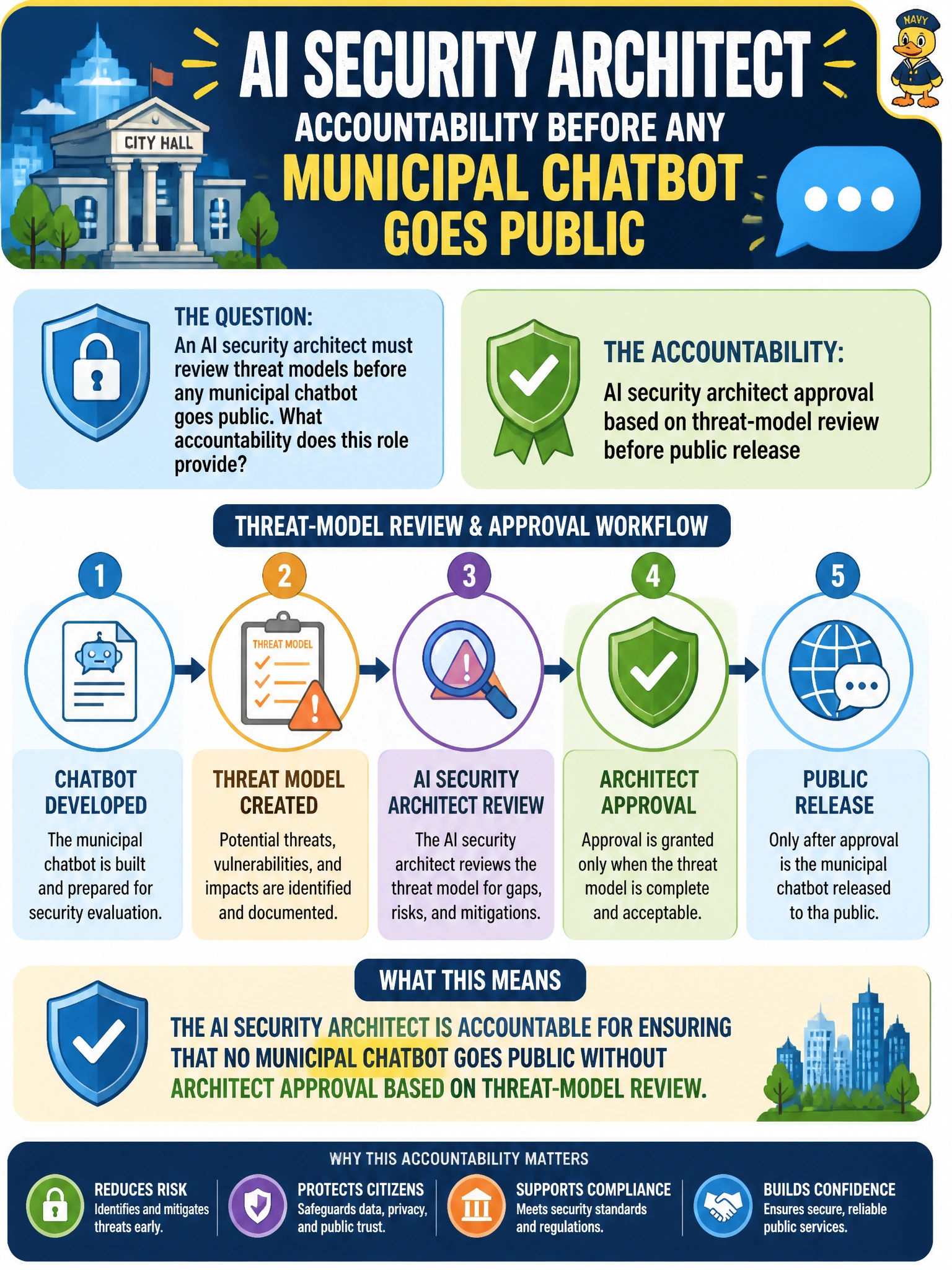
An AI security architect must review threat models before any municipal chatbot goes public. What accountability does this role provide?
Select an answer to reveal the explanation.
Short Explanation
No public city chatbot until the AI security architect signs the threat model — that gate is the job. You'll miss design flaws if you gate on pen-test results, and you'll miss late changes if you settle for a design-freeze approval. You don't get the architect's accountability when it's the CIO signing the threat model.
Full Explanation
AI security architect approval based on threat-model review before public release is the accountability this role provides for municipal chatbots. The architect ensures abuse cases, data flows, trust boundaries, integration risks, and mitigations are examined before a city chatbot faces residents. That gate works because public civic bots expand the attack and misuse surface (prompt injection, data exfiltration via retrieval, social engineering at city scale), and architecture-level review catches design flaws that late testing alone may miss.
AI security architect approval based on penetration-test results before public release fails because penetration testing finds late implementation flaws, not architecture-level abuse cases, data flows, trust boundaries, and mitigations—the stem requires a threat-model review, not a pen-test gate. Municipal CIO approval based on formal threat-model review before public release fails accountability because CIO sign-off is the wrong role—the stem requires the AI security architect's accountable pre-release gate, not executive approval. AI security architect approval based on threat-model review before design freeze fails timing because a design-freeze approval does not gate public release—the stem requires review before public release, after tools, data sources, and trust boundaries have settled.
Exam caveat: a signed threat model that is never updated after major retrieval corpus or tool-plugin changes becomes stale; approval should be tied to meaningful design deltas. Operational check: require AI security architect sign-off as a release gate for public municipal chatbots, store threat-model artifacts with the model card, and re-open review when tools, data sources, or trust boundaries change.
Prefer to study offline? Printable PDF study book + test engine ($7.50, unofficial). These questions stay free here.