
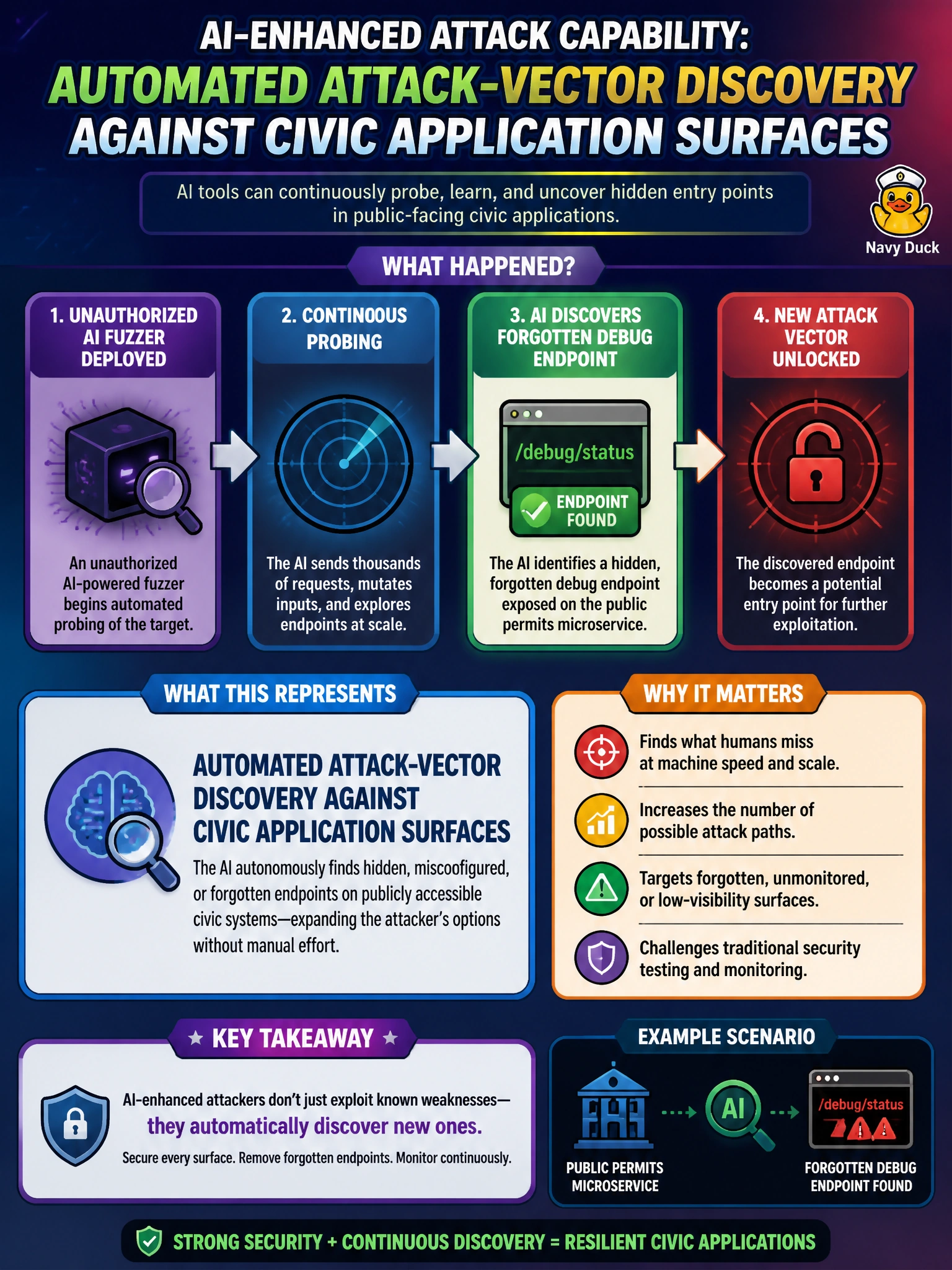
An unauthorized AI fuzzer discovers a forgotten debug endpoint on a public permits microservice during continuous probing. Which AI-enhanced attack capability does this represent?
Select an answer to reveal the explanation.
Short Explanation
AI fuzzing that trips over a forgotten debug door on the permits API is attack-vector discovery on autopilot. That's the bad guys' finder you'll spot in logs, not automated vulnerability exploitation that breaks in once a flaw's known, automated attack-payload delivery that fires the weapon, or automated privilege escalation that levels you up after you're in. Close the endpoint and review exposure.
Full Explanation
Automated attack-vector discovery uses AI-driven fuzzing and continuous probing to find forgotten or weakly protected application surfaces, such as a debug endpoint on a public permits microservice, without waiting for manual bug hunting. Unauthorized continuous probing of civic APIs is adversarial capability: it expands the attacker's map of reachable flaws faster than periodic human scanning alone. Automated vulnerability exploitation against civic application surfaces is active exploitation of an already-known flaw to gain effect, not automated discovery of forgotten debug endpoints on the permits microservice. Automated attack-payload delivery against civic application surfaces is delivery of weaponized input to cause effect, not automated discovery of forgotten debug endpoints via adversarial fuzzing. Automated privilege escalation against civic application surfaces is gaining higher privileges after initial access, not the automated discovery of forgotten debug endpoints through continuous probing. Exam caveat: unauthorized AI fuzzing that finds forgotten debug doors equals automated attack-vector discovery; Automated vulnerability exploitation against civic application surfaces is distinct active exploitation of a known flaw, not attack-surface discovery. Operational check: inventory and authenticate all public microservices, disable debug interfaces in production, rate-limit and alert on fuzz-like traffic against permits APIs, and ensure only scoped, authorized testing runs against municipal application surfaces.
Prefer to study offline? Printable PDF study book + test engine ($7.50, unofficial). These questions stay free here.