
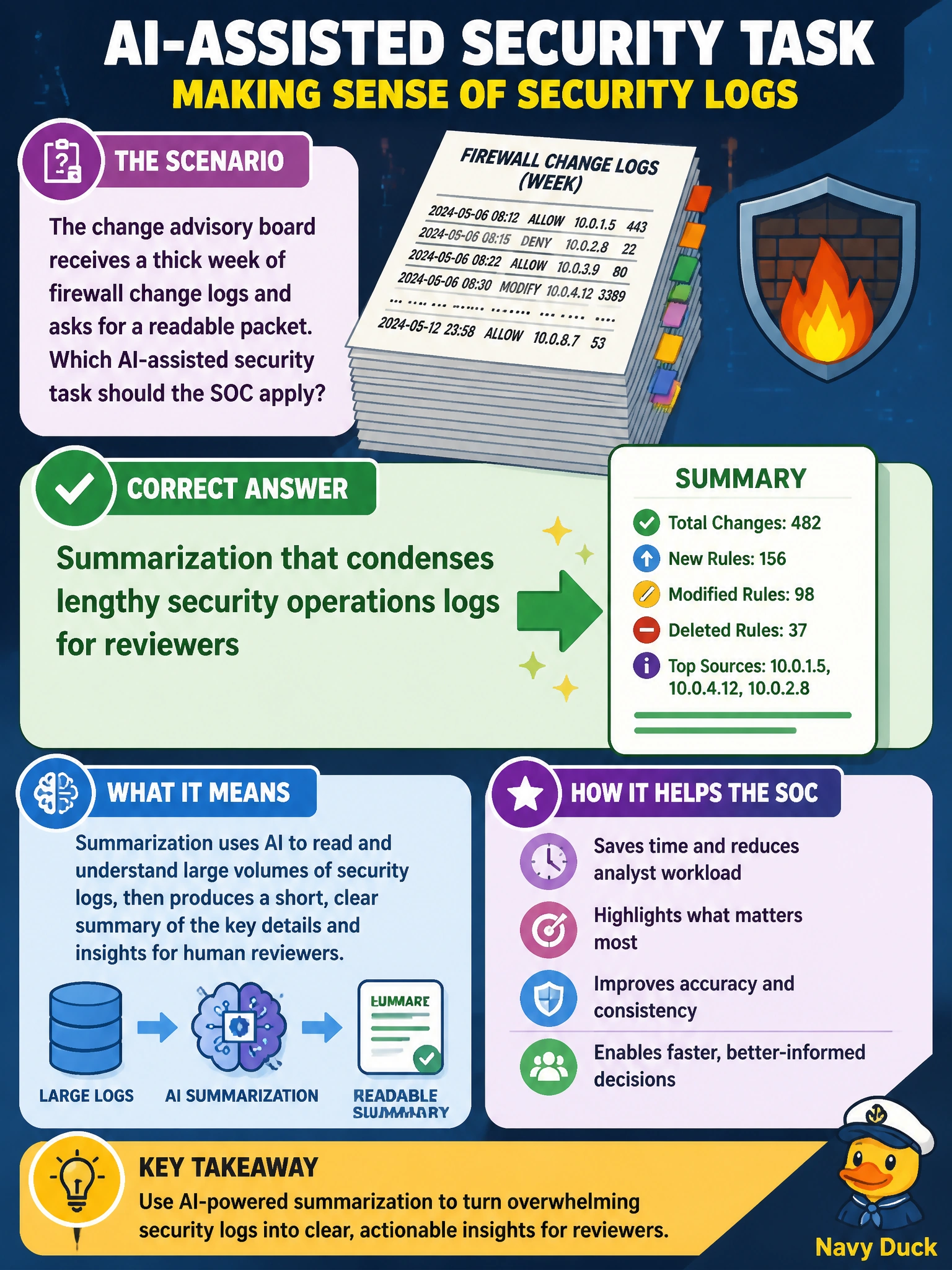
The change advisory board receives a thick week of firewall change logs and asks for a readable packet. Which AI-assisted security task should the SOC apply?
Select an answer to reveal the explanation.
Short Explanation
Nobody wants to read a novel of hit counters before coffee. AI summarization turns long firewall change logs into a CAB-ready brief while the raw logs stay put. You'll get one readable packet only from summarization — classification, clustering, or anomaly detection don't condense logs even when they claim to, so they won't give you that CAB brief.
Full Explanation
AI summarization condenses lengthy firewall change logs into a readable packet so the municipal change advisory board can focus on risk themes, outliers, and exceptions without reading every hit-counter line before a vote. Source logs must remain available; the summary is an aid for reviewers, not a replacement for evidence or for human approval of security-relevant changes.
Classification that condenses lengthy security operations logs for reviewers fails because classification assigns labels or categories to entries; it does not condense a week's logs into a readable packet, which is summarization. Clustering that condenses lengthy security operations logs for reviewers fails because clustering groups similar events to reveal patterns; it does not distill them into one readable summary for a board vote. Anomaly detection that condenses lengthy security operations logs for reviewers fails because anomaly detection flags unusual changes for investigation; it does not condense the full week of logs into the requested packet.
Exam caveat: when the stem asks how AI helps reviewers digest thick ops logs into one readable packet, summarization is the task—classification, clustering, and anomaly detection do not condense logs into a brief even when the option text claims they condense lengthy security operations logs for reviewers.
Operational check: retain immutable originals, label AI summaries as non-authoritative, require CAB or change-owner sign-off on high-risk firewall diffs, and verify that classification, clustering, or anomaly detection tools stay supplementary to the summarized packet because they do not produce the condensed reviewer packet.
Prefer to study offline? Printable PDF study book + test engine ($7.50, unofficial). These questions stay free here.