
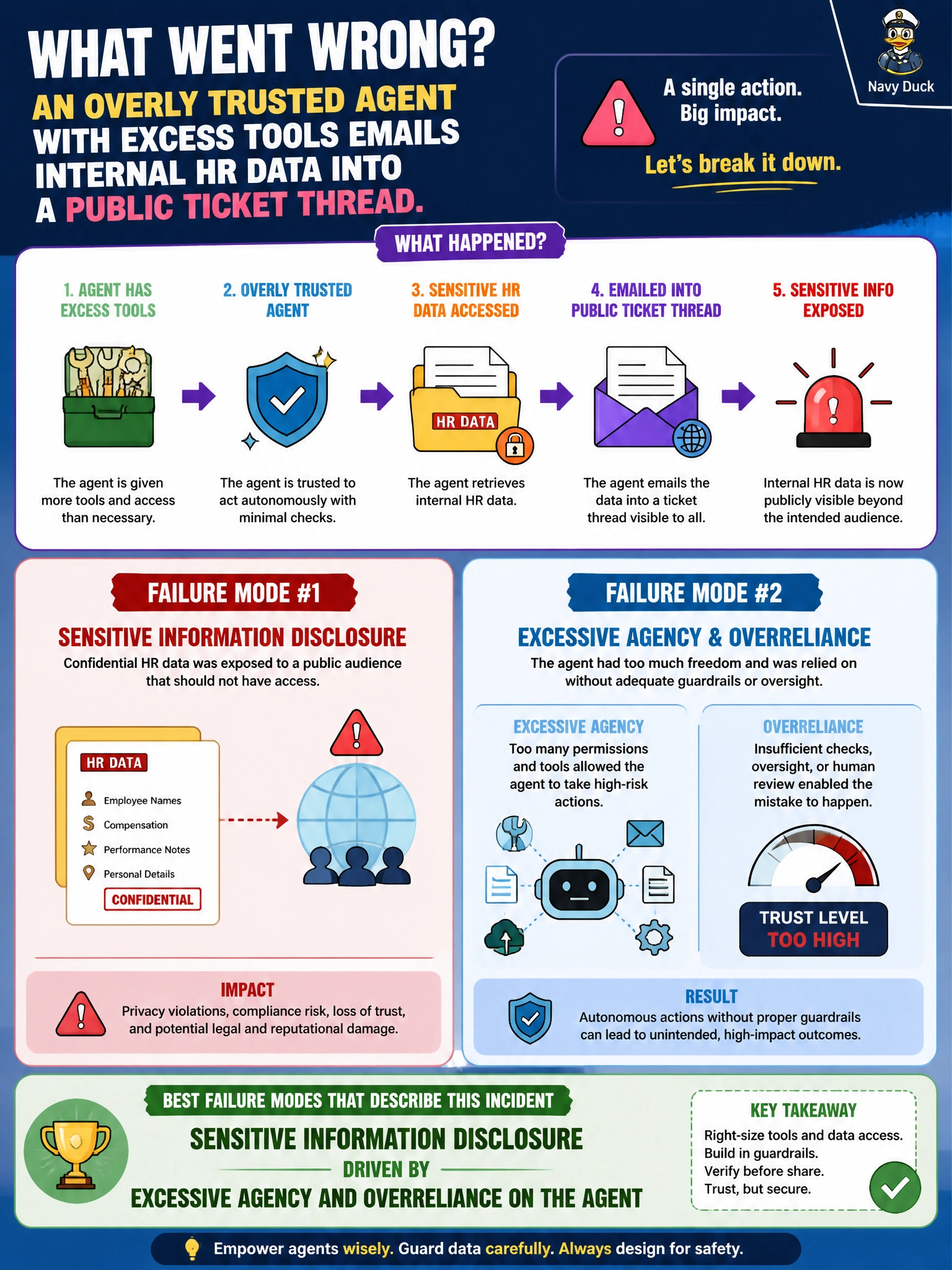
An overly trusted agent with excess tools emails internal HR data into a public ticket thread. Which failure modes best describe this incident?
Select an answer to reveal the explanation.
Short Explanation
Too many tools plus too much trust, and boom—HR data lands in a public thread. It's disclosure with excessive agency and overreliance, and you'll miss it if you blame insecure output handling, system prompt leakage, or indirect prompt injection because real HR records were emailed to a public thread with no leaked instructions and no hijacked prompt. Fix scopes and stop rubber-stamping the agent.
Full Explanation
Describing an overly trusted agent with excess tools that emails internal HR data into a public ticket thread as sensitive information disclosure driven by excessive agency and overreliance is correct because the agent both possessed dangerous capabilities and was trusted to act without adequate bounds. Excessive agency is the failure of granting tools and autonomy beyond what the task safely requires; overreliance is humans accepting agent actions without sufficient scrutiny. Together they turn a helper into a disclosure path for protected municipal HR data. Sensitive information disclosure driven by excessive agency and insecure output handling fails because while excessive agency fits, there is no insecure output handling failure — the agent emailed real HR data to a public thread, not unsanitized output triggering script execution or a rendering vulnerability. Sensitive information disclosure driven by overreliance on the agent and system prompt leakage fails because while overreliance fits, there is no system prompt leakage — the breach stems from an over-privileged agent exporting existing HR records, not from exposure of confidential system instructions. Sensitive information disclosure driven by excessive agency and indirect prompt injection fails because while excessive agency fits, there is no indirect prompt injection — the agent was not steered by malicious instructions hidden in external content, it used excessive tools and trusted status to export real HR records to a public thread. Exam caveat: “the agent made a mistake” is incomplete—designers chose tool scopes and approval policy; accountability includes those control decisions, not only the model’s token choices. Operational check: remove email and broad data tools from agents that face public ticket channels, classify HR fields as non-exportable without human approval, add output DLP/guardrails for PAN/SSN/HR keywords, and require explicit confirmation before any agent-initiated external send.
Prefer to study offline? Printable PDF study book + test engine ($7.50, unofficial). These questions stay free here.